You took a fixed-rate mortgage so the payment would stay put. Then a letter shows up, or the autopay just comes out higher, and the new number is $200 or $300 more than last month.
The rate didn't change. A fixed rate locks two things, principal and interest, and that's all it locks. Most mortgage payments carry two more pieces along for the ride: property taxes and homeowners insurance. Nothing fixes those.
Your servicer collects them in a side account called escrow, pays the bills for you, and once a year checks whether it collected enough. When taxes or insurance go up, the account comes up short, and your payment rises twice. Once to cover the bigger bills going forward. Once more to pay back the gap.
That yearly check has a name, the escrow analysis. It arrives as a statement most people never read past the first line, and it's worth ten minutes of your time for two reasons: federal rules limit what the servicer can collect, and the two bills underneath are the only part of your payment you can actually push down.
$209 a month. That's what the average single-family mortgage holder paid for property insurance in the second quarter of 2026, according to the September 2026 ICE Mortgage Monitor as reported by HousingWire. It's 9.6 percent of the average monthly payment, up 8.7 percent in a year and nearly 80 percent higher than at the start of 2020.
Taxes are moving too, just more slowly. ATTOM put the average single-family property tax bill at $4,427 for 2025, up 3 percent.
Stack the two and a payment that sat still for years can jump in a single month.
The timing makes it worse. The analysis runs on the servicer's calendar, not yours. Your insurance renewal might have gone up in March and your tax bill in October, but you feel both at once, months later, when the new payment kicks in. By then the renewal notice is in a drawer somewhere, and the tax bill may have gone straight to the servicer, so you might never have seen it.
What escrow is, and what your servicer may collect
Escrow is a holding account. Most mortgages have one, and loans with a small down payment nearly always do. Every month, one-twelfth of your expected yearly tax and insurance bills goes in, and when the county or the insurer sends a bill, the servicer pays it from that pot.
The federal rule behind all this is Regulation X, section 1024.17, enforced by the Consumer Financial Protection Bureau. Four limits matter to you:
- The servicer has to analyze the account once a year and send you a statement within 30 days of the end of the escrow year.
- It can keep a cushion, but no more than one-sixth of the year's total payouts. That's two months of escrow deposits.
- If the analysis shows a surplus of $50 or more and you're current on the loan, the servicer must refund it within 30 days.
- If there's a shortage of one month's escrow payment or more, the servicer can't demand it all at once. It can leave the shortage alone or spread it over at least 12 months.
Some states set a smaller cushion or require interest on escrow balances. Your state banking regulator can tell you what applies.
Where a $325 jump comes from
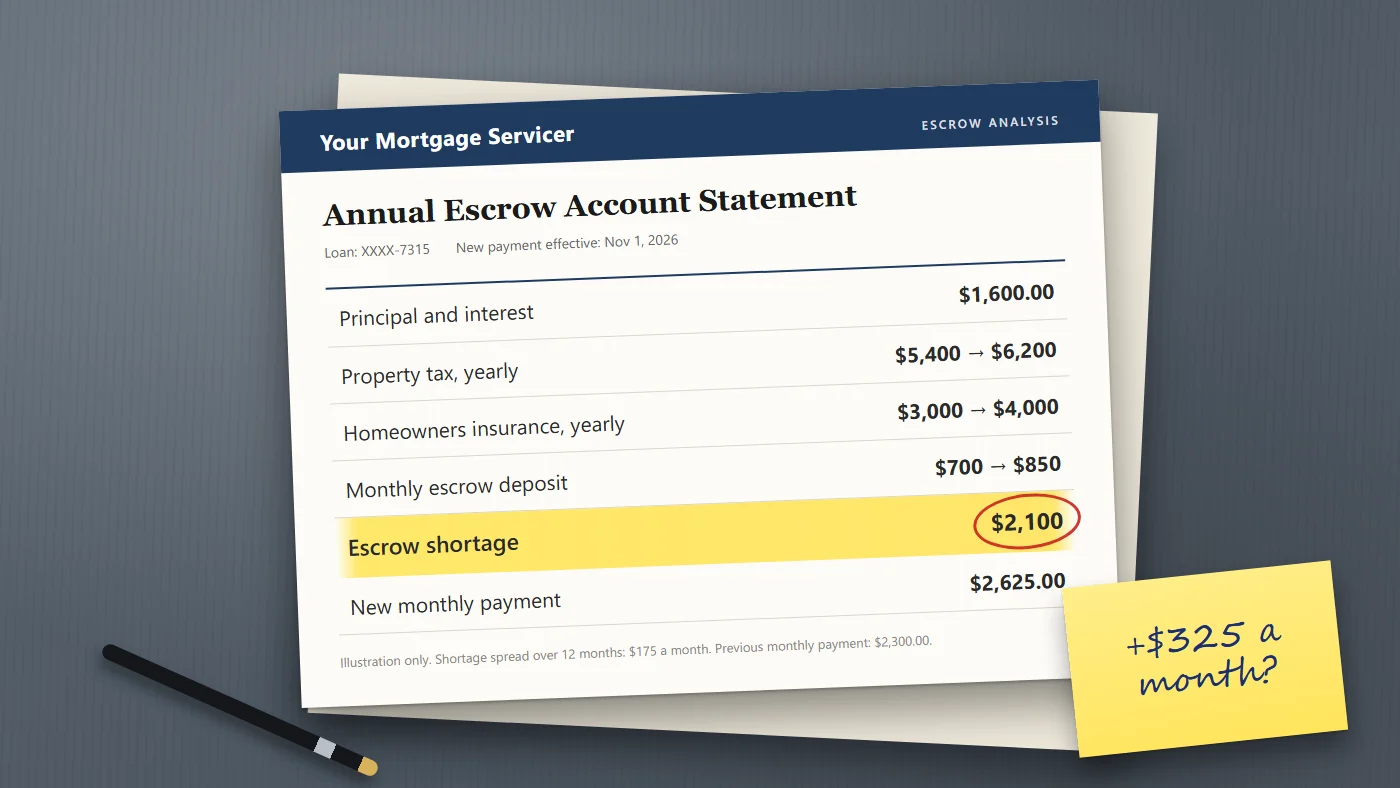
Say you pay $1,600 a month in principal and interest. Last year the tax bill was $5,400 and the insurance premium was $3,000, so escrow collected $700 a month. Total payment: $2,300.
This year the county reassessed and the tax bill came in at $6,200. The insurance renewal came in at $4,000. The servicer paid both in full, $1,800 more than it had collected, so the account ran dry before the year was out.
| Line on the analysis | Last year | This year |
|---|
| Principal and interest | $1,600 | $1,600 |
| Property tax, yearly | $5,400 | $6,200 |
| Homeowners insurance, yearly | $3,000 | $4,000 |
| Monthly escrow deposit | $700 | $850 |
| Allowed cushion (two months) | $1,400 | $1,700 |
| Shortage, spread over 12 months | none | $175 a month |
| Total monthly payment | $2,300 | $2,625 |
The shortage is $2,100. That's the $1,800 the account fell behind, plus $300 to bring the cushion up to the new two-month level. Divide by 12 and you get $175 a month.
So the $325 increase has two layers. About $150 sticks around until the bills change again. The other $175 is a one-year catch-up, and in month 13 the payment should drop to $2,450 if next year's bills hold steady. The example is simplified; real statements spread payouts across the months they're actually due.
The letter rarely spells any of that out. It also rarely mentions that you get a say in how the shortage is paid, or that the projected bills on the statement are sometimes wrong. Those are the parts to check.
How to read the analysis in ten minutes
Get the statement out. It might be titled Annual Escrow Account Disclosure Statement or just Escrow Analysis. Can't find it? Download it from your servicer's website or ask for a copy by phone.
- Find the new payment and the effective date. The first page shows the old payment, the new one, and the month the change starts. That date tells you how long you've got.
- Find the history section. It lists what the servicer expected to pay last year next to what it actually paid. The lines where the two differ are where your shortage came from.
- Check every payout against a real bill. Match the tax amounts to your county bill or the treasurer's website, and the insurance amount to your policy's declarations page. They should agree to the dollar.
- Find next year's projection. The servicer lists the bills it expects to pay over the next 12 months. Add them up and divide by 12, and you should land on the new monthly escrow deposit.
- Check the cushion. Find the lowest projected balance in the coming year. It shouldn't be higher than one-sixth of the year's payouts, which is $1,700 in the example above. If the low point sits well above that, the servicer is collecting more than the rule allows.
- Find the shortage or surplus line. See how the shortage is being collected and over how many months. A surplus of $50 or more means a refund should arrive within 30 days.
Errors that show up on these statements
Most escrow analyses are right. The mistakes that do turn up tend to fall into a handful of groups.
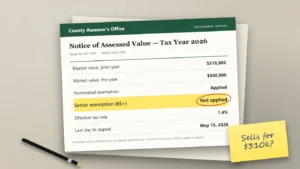
- A tax bill missing your exemptions. If a homestead, senior or veteran exemption dropped off, the county's bill is too high and the servicer simply paid it. The fix is at the assessor's office.
- Taxes on a brand-new home. The first analysis on a new build is often based on the value of the empty lot. When the full assessment lands, the shortage can be large. It's not an error, but you can see it coming.
- The wrong insurance premium. If you switched insurers midyear, the servicer may be projecting the old premium, or both. Send the new declarations page.
- Force-placed insurance. If the servicer thinks your coverage lapsed, it can buy a policy and bill you, and the CFPB notes that coverage usually costs more than one you'd buy yourself. The servicer has to send a written notice at least 45 days before charging you and a reminder at least 15 days before. Once you show you had coverage, it must cancel its policy and refund any overlap within 15 days.
- A bill that never got paid. Late or missed tax and insurance payments from escrow are rare, and they're the servicer's responsibility under Regulation X.
- A cushion bigger than two months.
Your choices for paying the shortage
You usually have three. The statement may only show one.
Spread it over 12 months. That's the default, and no interest is charged. Your payment runs higher for a year, then drops.
Pay it in a lump sum. In the example, sending $2,100 brings the new payment to $2,450 right away instead of $2,625. You pay the same total either way; only the monthly number changes.
Ask for a longer spread. The rule says at least 12 months, so a servicer is free to offer more. Some will, especially if you explain that the higher payment is a strain. Asking costs nothing.
Whatever you pick, the permanent part of the increase stays until the tax or insurance bill underneath it comes down.
Can you shrink the bills underneath?
Often, yes. And the servicer can't do it for you.
Insurance. It's the faster-moving of the two. The same ICE data found that borrowers who switched carriers cut their insurance payments by about 6.6 percent on average and came out roughly $440 a year ahead of people who stayed put, whose premiums rose about 10.4 percent. Those are averages. Your own result depends on your state, your roof and your claims history.
If you shop, I'd get quotes from at least three insurers or an independent agent, and compare the same dwelling limit, deductible and roof terms on each. A lower premium bought with a much higher wind or hail deductible is a different policy, not a saving. If you switch, send the new declarations page to your servicer and ask for a fresh escrow analysis. You don't have to wait for the annual one.
Property tax. Check that every exemption you qualify for is on the bill, then look at the assessed value. If it's higher than the house would sell for, you can appeal, usually within 30 to 45 days of the assessment notice. A win lowers the escrow deposit at the next analysis.
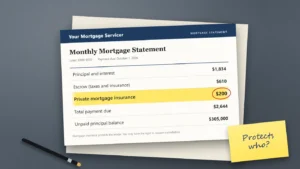
Mortgage insurance. PMI isn't part of escrow, but it sits on the same statement. Once your balance reaches 80 percent of the home's original value, you can ask the servicer in writing to drop it, and it generally has to come off by itself at 78 percent if you're current.
Refinancing. Be realistic here. A refinance changes principal and interest and does nothing to taxes or insurance. Freddie Mac's weekly survey put the average 30-year fixed rate at 6.95 percent on September 17, 2026. If your rate is below that, a refinance would probably raise your payment. If it's well above, run the numbers with a refinance calculator, include closing costs, and see how many months it takes to break even.
If the servicer got it wrong
Start with a phone call. Plenty of problems, like an outdated insurance premium, get fixed that way.
If the call doesn't work, send a written notice of error. Under Regulation X, section 1024.35, the letter needs your name, your loan number and a description of the error, and it goes to the address your servicer designates for disputes. That's often different from the payment address, and it's listed on the statement or the website.
The servicer has to acknowledge the letter within five business days. It generally must investigate and respond within 30 business days, with one 15-day extension allowed if it tells you in writing. Failing to pay taxes or insurance on time from escrow and failing to refund a surplus are both on the list of covered errors.
Still stuck? File a complaint with the CFPB at consumerfinance.gov/complaint. It's free, and servicers are expected to respond.
Should you drop escrow?
Some borrowers can. On a conventional loan, servicers often allow it once you have around 20 percent equity and a clean payment record, sometimes for a fee. FHA loans keep escrow for the life of the loan.
Dropping escrow doesn't lower what you owe. It just moves two large bills onto your own calendar. Miss a tax payment and the county can add penalties or file a lien, and the servicer can step in and set escrow back up. For most households the monthly deposit is the easier way to pay.
When next year's analysis arrives, put it in one folder with your tax bill and your insurance declarations page. Those three sheets explain nearly every change in a fixed-rate payment.
This article is general information, not financial, legal, tax or medical advice.