Insurance
Your Home Insurance Wasn't Renewed: A 30-Day Action Plan
A nonrenewal letter is legal in every state, but it starts a clock. Here is how long you have, what to ask for, and the order to do things in.
 Ray Castellano
Updated Sep 22, 2026 · 11 min read
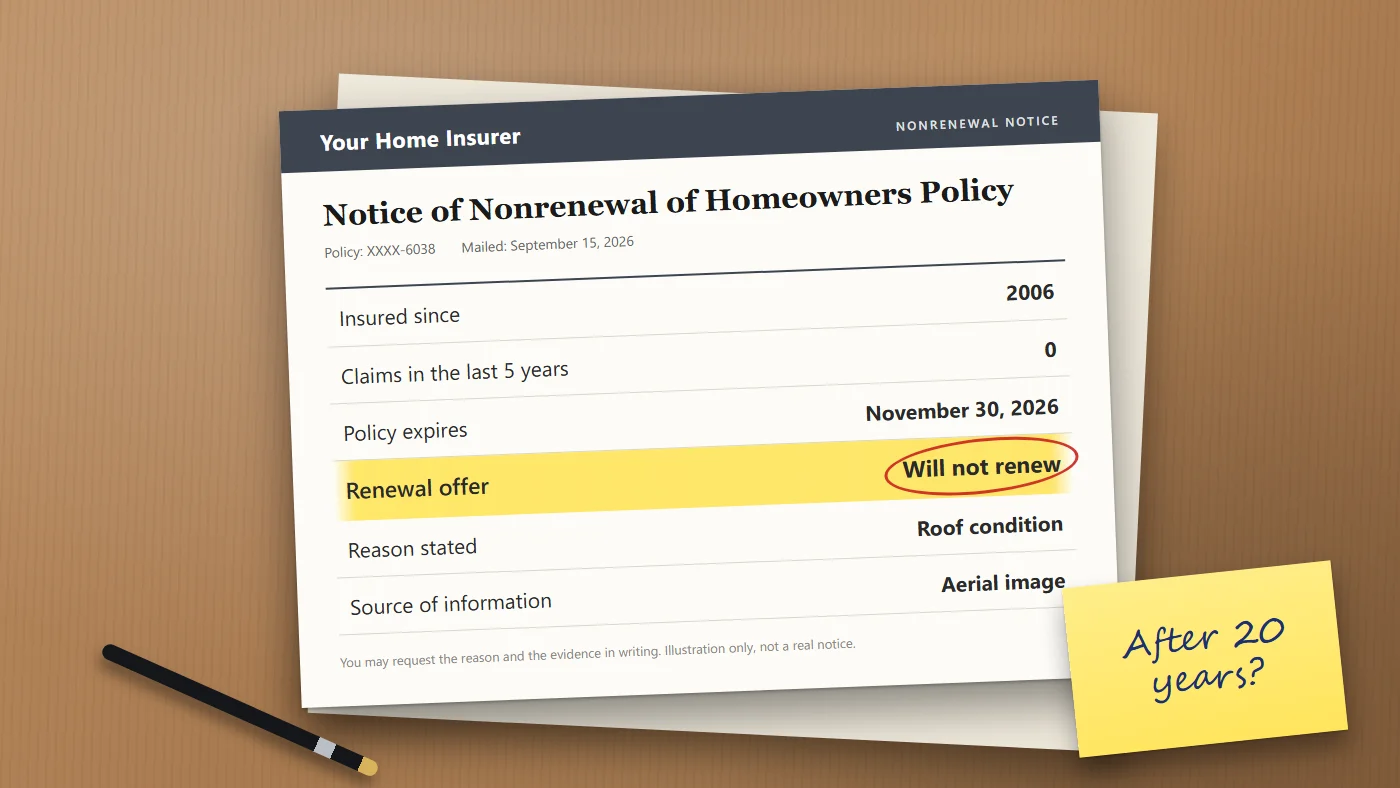
Say you've stayed with one insurer for 20 years. Every bill went out on time, and you never once filed a claim. Then an ordinary envelope turns up in the mail, and the letter inside says your policy won't be renewed when it runs out in about 11 weeks. You read it twice, looking for what you did. No claim, no missed payment.
That homeowner is made up. The letter isn't, and plenty of real people have opened one. How many? Between 2018 and 2023, more than 1.9 million policies went unrenewed at just 23 insurers. Together those companies write about two-thirds of the homeowners market. The tally comes from a U.S. Senate Budget Committee staff report released in December 2024. Industry groups pushed back on its explanation of why. Nobody seriously argued with the count.
Look closely at the wording, though, because your insurer didn't cancel you. That sounds like lawyer talk. It isn't: it decides what the company was allowed to do. To end your coverage partway through a term, it would need a narrow reason, nonpayment, say, or fraud. Declining to renew is far easier. The insurer simply lets the policy run to its end date and doesn't offer you another term. In most states it can do that for broad business reasons, even just to write fewer policies in your ZIP code.
So the law probably won't undo the letter. What it gives you instead is time. Every state wants written notice before the policy ends, and the minimum runs from 30 days in some places to 120 in Florida. Guard that window. The deadline that really matters wasn't set by your insurer anyway. Your mortgage set it.
Your loan requires continuous coverage. Let the policy lapse, and the mortgage servicer can buy a policy on your behalf and send you the bill. This is called force-placed insurance, and it's usually more expensive than anything you'd find yourself (that's the Consumer Financial Protection Bureau's warning, not mine). Often it protects only the lender. After a fire, your belongings, your liability and the cost of living somewhere else generally aren't covered. You'd be paying more for less.
How much time do you have?
Find two dates on the letter: the day it was mailed and the day coverage ends. Count the days between them and compare that with your state's minimum. If the insurer gave you less notice than the law requires, the nonrenewal may not be valid for this term, and your state insurance department can step in.
| State | Minimum notice of nonrenewal |
|---|
| Florida | 120 days for personal residential policies |
| California | 75 days |
| Texas | 60 days for policies bought or renewed in 2024 or later |
| New York | 45 to 60 days |
| Illinois | 30 days, or 60 days for most reasons if the policy has been in force five years or more |
Those are five examples, not a national rule. Legislatures change these numbers, and your state insurance department's website lists the current one.
The deadline that costs money: if coverage lapses, federal rules say your servicer must warn you at least 45 days before charging you for force-placed insurance, and again at least 15 days before.
Notice is only the floor, and a few states build on it. In New York, after a policy has been in force 60 days, an insurer's reasons for dropping you are limited for a three-year period. Illinois won't let a company refuse to renew because of the property's age or location. It'll also hear your side: file with the Department of Insurance at least 20 days before the policy expires and you can ask for a hearing. California took a different route in fire country, freezing nonrenewals for a year in ZIP codes in or next to a declared wildfire emergency. Not sure which rules cover you? A short call to your state insurance department will settle it.
Why it happened: read the reason line
The letter should say why. Many states require the reason right there, or in writing once you ask for it. Texas tightened this up in 2026. Since January 1, insurers there have had to send a written statement explaining why they declined, canceled or didn't renew a policy. Get the reason on paper, because everything you do next depends on it.
The roof, or the condition of the property. More and more, the problem gets spotted from the air. Insurers buy aerial and drone photos, then run them through software that flags worn shingles, tarps, overhanging branches and junk in the yard. Regulators have noticed. West Virginia and Alabama issued bulletins on the practice in 2025, and Tennessee followed with its own in 2026. An unclear or outdated aerial image, Tennessee warns, shouldn't be the only basis for denying a claim. Insurers there should keep the images on file, too, and share them with any policyholder who asks.
Your claims history. Two or three claims in a few years can do it, even small ones.
Your location. Wildfire, hurricane, hail and flood exposure lead insurers to pull back by ZIP code. Nothing about your house caused it.
The company's leaving. Some insurers have stopped writing homeowners policies in whole states.
The first two can sometimes be reversed, especially when the evidence is an old photo of a roof you've since replaced or a claim in the database that was really just a phone call asking about coverage. The last two can't. Shop. So what do the next 30 days look like, and what do you say to the mortgage servicer if no regular insurer wants the house?