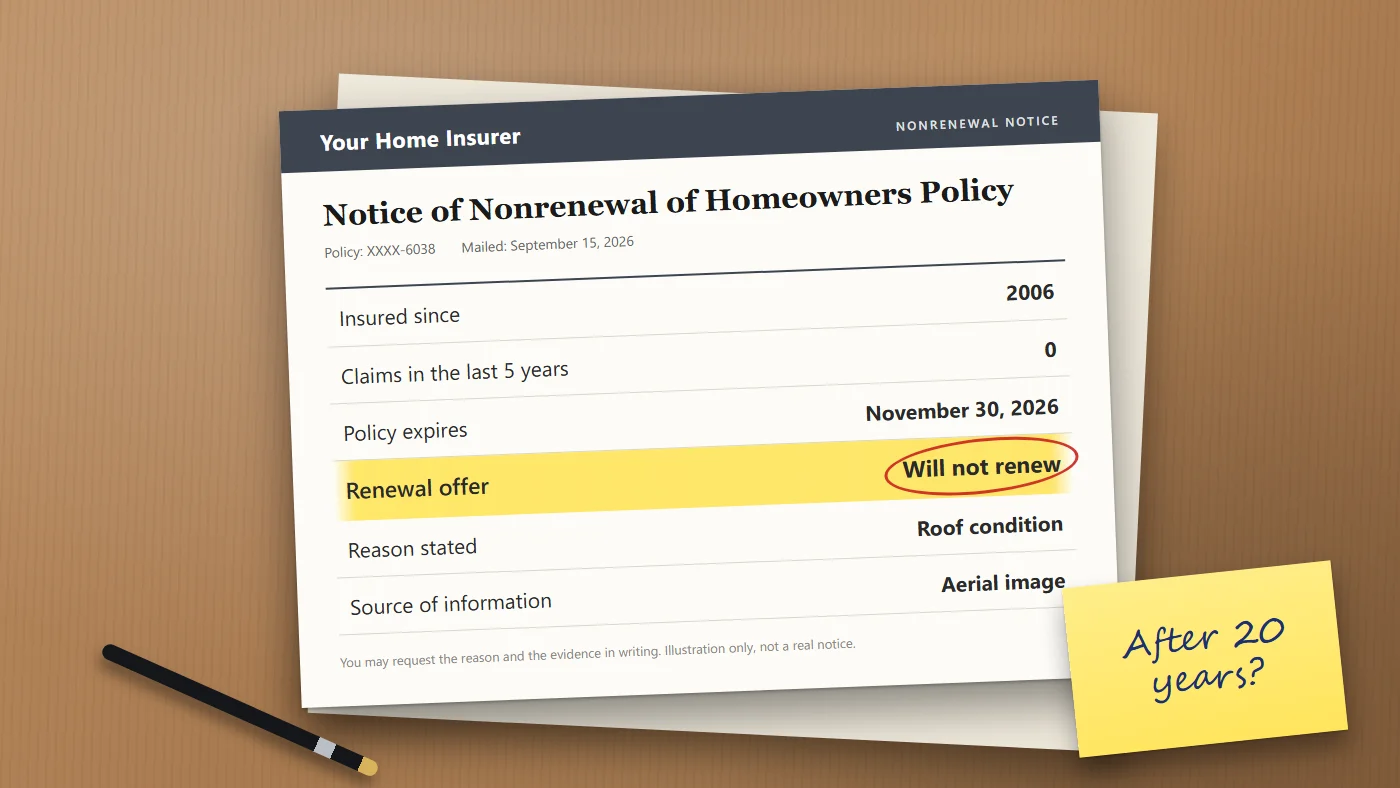
Say you've stayed with one insurer for 20 years. Every bill went out on time, and you never once filed a claim. Then an ordinary envelope turns up in the mail, and the letter inside says your policy won't be renewed when it runs out in about 11 weeks. You read it twice, looking for what you did. No claim, no missed payment.
That homeowner is made up. The letter isn't, and plenty of real people have opened one. How many? Between 2018 and 2023, more than 1.9 million policies went unrenewed at just 23 insurers. Together those companies write about two-thirds of the homeowners market. The tally comes from a U.S. Senate Budget Committee staff report released in December 2024. Industry groups pushed back on its explanation of why. Nobody seriously argued with the count.
Look closely at the wording, though, because your insurer didn't cancel you. That sounds like lawyer talk. It isn't: it decides what the company was allowed to do. To end your coverage partway through a term, it would need a narrow reason, nonpayment, say, or fraud. Declining to renew is far easier. The insurer simply lets the policy run to its end date and doesn't offer you another term. In most states it can do that for broad business reasons, even just to write fewer policies in your ZIP code.
So the law probably won't undo the letter. What it gives you instead is time. Every state wants written notice before the policy ends, and the minimum runs from 30 days in some places to 120 in Florida. Guard that window. The deadline that really matters wasn't set by your insurer anyway. Your mortgage set it.
Your loan requires continuous coverage. Let the policy lapse, and the mortgage servicer can buy a policy on your behalf and send you the bill. This is called force-placed insurance, and it's usually more expensive than anything you'd find yourself (that's the Consumer Financial Protection Bureau's warning, not mine). Often it protects only the lender. After a fire, your belongings, your liability and the cost of living somewhere else generally aren't covered. You'd be paying more for less.
How much time do you have?
Find two dates on the letter: the day it was mailed and the day coverage ends. Count the days between them and compare that with your state's minimum. If the insurer gave you less notice than the law requires, the nonrenewal may not be valid for this term, and your state insurance department can step in.
| State | Minimum notice of nonrenewal |
|---|
| Florida | 120 days for personal residential policies |
| California | 75 days |
| Texas | 60 days for policies bought or renewed in 2024 or later |
| New York | 45 to 60 days |
| Illinois | 30 days, or 60 days for most reasons if the policy has been in force five years or more |
Those are five examples, not a national rule. Legislatures change these numbers, and your state insurance department's website lists the current one.
The deadline that costs money: if coverage lapses, federal rules say your servicer must warn you at least 45 days before charging you for force-placed insurance, and again at least 15 days before.
Notice is only the floor, and a few states build on it. In New York, after a policy has been in force 60 days, an insurer's reasons for dropping you are limited for a three-year period. Illinois won't let a company refuse to renew because of the property's age or location. It'll also hear your side: file with the Department of Insurance at least 20 days before the policy expires and you can ask for a hearing. California took a different route in fire country, freezing nonrenewals for a year in ZIP codes in or next to a declared wildfire emergency. Not sure which rules cover you? A short call to your state insurance department will settle it.
Why it happened: read the reason line
The letter should say why. Many states require the reason right there, or in writing once you ask for it. Texas tightened this up in 2026. Since January 1, insurers there have had to send a written statement explaining why they declined, canceled or didn't renew a policy. Get the reason on paper, because everything you do next depends on it.
The roof, or the condition of the property. More and more, the problem gets spotted from the air. Insurers buy aerial and drone photos, then run them through software that flags worn shingles, tarps, overhanging branches and junk in the yard. Regulators have noticed. West Virginia and Alabama issued bulletins on the practice in 2025, and Tennessee followed with its own in 2026. An unclear or outdated aerial image, Tennessee warns, shouldn't be the only basis for denying a claim. Insurers there should keep the images on file, too, and share them with any policyholder who asks.
Your claims history. Two or three claims in a few years can do it, even small ones.
Your location. Wildfire, hurricane, hail and flood exposure lead insurers to pull back by ZIP code. Nothing about your house caused it.
The company's leaving. Some insurers have stopped writing homeowners policies in whole states.
The first two can sometimes be reversed, especially when the evidence is an old photo of a roof you've since replaced or a claim in the database that was really just a phone call asking about coverage. The last two can't. Shop. So what do the next 30 days look like, and what do you say to the mortgage servicer if no regular insurer wants the house?
The 30-day plan
- Day 1: write down the dates and call your agent. Note the expiration date and count backward. Ask the agent or the company for the specific reason in writing, and ask straight out whether fixing the problem would change the decision.
- Days 1 to 3: request the evidence. If the reason is property condition, ask for the inspection report or the aerial image and the date it was taken. Images can be months or years old. If the roof's been replaced since, send the roofer's invoice, the permit and dated photos.
- Days 2 to 5: pull your claims report. Your claims history lives in a database called CLUE that insurers share, and it can reach back up to seven years on you and on the house. You're entitled by federal law to one free copy every 12 months from the company that keeps it. Look for claims that aren't yours, or phone inquiries logged as claims, and dispute any errors.
- Days 3 to 10: start shopping, whatever else is pending. Don't wait for an appeal to play out. Get quotes moving now, using the approach in the next section.
- Days 5 to 15: fix what you can and document it. Trim branches back from the roof, haul off the debris, fence the pool, get the roof estimate. If you were planning a new roof in a few years anyway, moving it up can reopen the standard market. Get a licensed roofer to put the roof's age and remaining life in writing.
- Days 10 to 20: bring in the state if something looks wrong. File a complaint with your state insurance department if the notice was late, the reason is vague, the insurer won't share the image or the facts are wrong. Filing's free, and a complaint gives the regulator a reason to look at the evidence the insurer relied on.
- Days 20 to 30: bind the new policy and tell your servicer. Set the new policy to start the exact day the old one ends, so there's no gap and no overlap. Send the declarations page to your servicer's insurance department and confirm they got it.
How to shop when you've been dropped
Most applications ask if you've been nonrenewed or canceled in the past three to five years. Answer truthfully. A false answer can void the policy when you file a claim, and the new insurer can see your CLUE report anyway.
A nonrenewal for location or a company pulling out barely counts against you. One for roof condition matters until the roof is fixed. That's why having the reason in writing pays off when you shop.
Right now, prices and appetite differ enormously from one insurer to the next. One company is leaving your county while another is trying to grow there, and the only way to find the second one is to get several quotes at the same time. There are three routes, and you can use more than one.
- An independent agent. Independent agents represent many insurers and can send one application to all of them. They often know which companies are writing in your area this month. A captive agent sells for one company only.
- Direct and online quotes. Useful for insurers that don't work through agents. Enter the same coverage amounts every time so the quotes line up.
- Surplus lines insurers. Specialty companies that take risks standard insurers turn down. They're legal and widely used in Florida, California, Texas and Louisiana. They're less regulated on price, and state guaranty funds generally don't back them if they fail. An agent with a surplus lines license places the coverage.
Compare quotes line by line on four items: the dwelling limit, the wind or hurricane deductible (often a percentage of the dwelling limit, not a flat amount), whether the roof is covered at replacement cost or depreciated value, and water backup coverage. Cheaper quotes often pay less for the roof. I'd put the roof line side by side before looking at the premium at all.
Ask each insurer what would bring the price down. A newer roof, a monitored alarm, storm shutters, a water shutoff device and a higher deductible are common discounts. In Florida and some other coastal states, a wind mitigation inspection can lower the premium.
If no regular insurer will take the house
Suppose every quote comes back as a no. Most states keep an insurer of last resort for exactly that moment. In 33 states and D.C. it's a FAIR plan (the letters stand for Fair Access to Insurance Requirements). Several coastal states also have a wind pool or a state-backed company. Expect thinner protection than the regular market offers, as the NAIC points out. A basic FAIR policy may pay for fire, smoke, wind and vandalism, then leave you on your own for theft, liability and water damage.
Many owners pair a FAIR policy with a "difference in conditions" policy from a private insurer to fill those gaps. Rules for getting in vary; in Texas, at least two companies have to have turned you down first.
Think of a last-resort plan as a bridge. It satisfies the mortgage and protects the house from the biggest risks. Keep shopping at every renewal, because insurer appetite shifts year to year and a repaired roof changes what you qualify for.
If your servicer force-places coverage anyway
Maybe the servicer never got word of your new policy, or the paperwork crossed in the mail. You still have rights under federal mortgage servicing rules. Before charging you, the servicer owes you a first notice at least 45 days ahead. A reminder has to follow at least 15 days before the charge. Once you send proof that you had coverage, the servicer gets 15 days to cancel the force-placed policy, and it must refund the premium for any stretch when both policies overlapped.
Pay through escrow? Call and confirm the servicer has the new insurer's name, the policy number and the premium. Payments sent to the old company by mistake are a common way a policy lapses right after a switch. Your monthly payment gets recalculated at the next escrow analysis if the premium changed.
Mistakes that make it worse
Waiting on the appeal before shopping is the classic one. Appeals sometimes work. Thirty days go fast.
Letting coverage lapse, even for a day. A gap shows up on future applications and can raise your price, on top of the force-placed risk.
Filing a small claim on the way out. A $1,200 claim on a policy that's ending puts a fresh claim on your record just as you apply elsewhere.
Hiding the nonrenewal. Insurers check, and a misstatement can cost you the claim later.
Buying on price alone. A policy that pays actual cash value on a 15-year-old roof may pay only a fraction of replacement cost after a storm.
Skipping the state insurance department. It's free, it has authority over the company, and a complaint puts a regulator in the loop.
Today, write the expiration date on a calendar, count back 30 days from it, and make the call asking for the reason in writing.
This article is general information, not financial, legal, tax or medical advice.