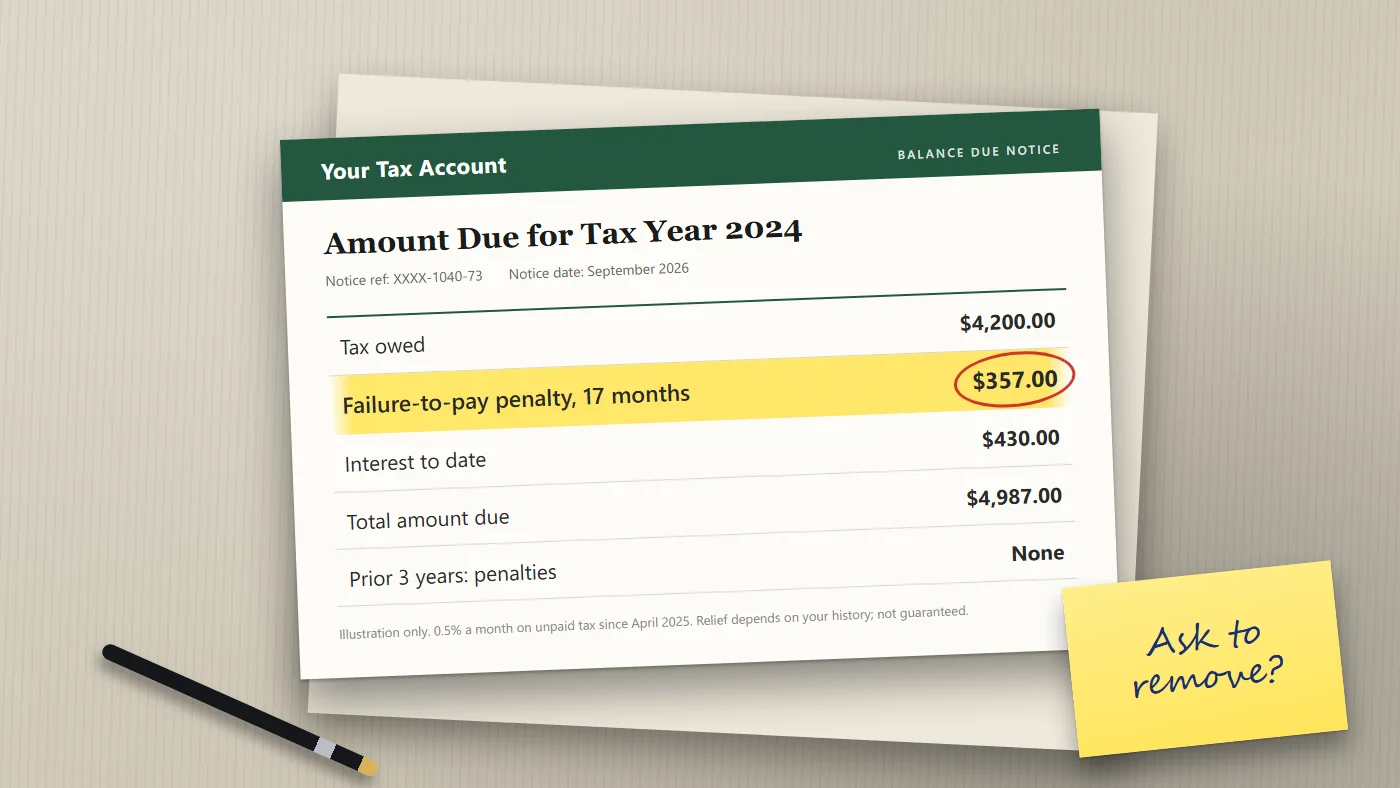
The envelope says Department of the Treasury. Inside is a notice with a balance, and under the tax you expected sits a line you didn't: a penalty, often with interest already stacked on top of it.
The IRS hands out a lot of these. In fiscal year 2025 it assessed 46.7 million civil penalties on individual, estate and trust income tax accounts, worth $33.1 billion. The most common one by far was the failure-to-pay penalty, assessed 24.3 million times.
Now the number the notice leaves out. That same year the IRS removed 3.9 million of those penalties, worth $7.5 billion, including more than 3.1 million failure-to-pay penalties. One of the main ways that happens is a policy called first-time abatement. You use it by asking.
Asking costs nothing. You don't need a lawyer. There are exact conditions, though, and if you don't meet them the answer is no. Below: the conditions as the IRS words them, what to say on the phone, what a payment plan costs, and where the "settle for less" offers you see advertised actually fit.
Which penalties can come off?
First-time abatement covers three penalties. Two of them show up on ordinary individual notices.
| Penalty | How it's figured | Cap | Notes |
|---|
| Failure to file | 5% of the unpaid tax for each month or part of a month the return is late | 25% | For returns due after December 31, 2025, a return more than 60 days late carries a minimum of $525 or 100% of the tax due, whichever is less. |
| Failure to pay | 0.5% of the unpaid tax for each month or part of a month | 25% | Drops to 0.25% a month during an approved payment plan if you filed on time. Rises to 1% a month if you don't pay within 10 days of a notice of intent to levy. |
| Failure to deposit | Applies to employers who miss payroll tax deposits | Varies | Not relevant to most individual filers. |
When both the filing and payment penalties run in the same month, the filing penalty is reduced by the payment penalty. So the combined charge is 5% a month, not 5.5%, and after five months the filing penalty maxes out while the payment penalty keeps going.
Interest is its own animal. The IRS charges it on unpaid tax and on penalties, compounded daily, at the federal short-term rate plus 3 percentage points. For the quarter starting October 1, 2026, the rate on individual underpayments is 7%. You can't get interest removed by itself, but the IRS says it'll automatically reduce or remove the interest tied to a penalty when that penalty comes off.
The first-time abatement rules, word for word
The IRS calls this administrative relief, and it rests on one idea: a clean record. Its first-time abate page, last reviewed July 14, 2026, says you may qualify if you have a timely compliance history, meaning:
- The same type of return was filed on time for the prior three years. For a Form 1040, that's your three prior individual returns.
- In those three years, no penalty was assessed (other than an estimated tax penalty), or one was assessed and later removed for reasonable cause or because of an IRS error.
The IRS also wants you current now, with required returns filed or on extension, and the tax paid or a payment arrangement in place. Owe a balance you haven't dealt with? Ask about a payment plan on the same call.
There are limits. The relief doesn't apply to returns filed once or only rarely, and the page lists only the three penalties above, so an accuracy-related penalty from an audit isn't covered. Nothing is guaranteed, either. The agent reviews your account history, and a penalty from two years ago means no. At that point the fallback is reasonable cause, covered further down.
3.15 million. That's how many failure-to-pay penalties the IRS removed from individual, estate and trust accounts in fiscal year 2025, out of 24.3 million assessed, according to the IRS Data Book. Their value: $5.0 billion.
One timing detail costs people money. The failure-to-pay penalty keeps growing until the tax is paid in full. If the IRS grants first-time abatement while you still owe, the penalty already assessed comes off, but new penalty keeps piling up on the unpaid balance every month until it's paid, so the cleaner order is to pay the tax first, or at least set up a plan, and only then ask.
What changed in 2026. The same IRS page says that starting in summer 2026, the agency is applying what it calls an automatic exemption from penalty. If you file or pay late but have the clean three-year history, the IRS says it won't assess the penalty at all. You don't have to ask. It covers Form 1040 and several business returns, beginning with 2025 tax year returns.
If that holds, a penalty on a 2025 return with a clean history behind it may never show up. Penalties for 2024 and earlier, and any case the automatic check misses, still go the old route: you call and ask. So the rest of this piece is about that call.
First, the notice. The phone number is printed in the top right corner, and the agent will ask for the notice number and the tax year. Second, your account transcripts for the three prior years, which you can pull at IRS.gov under "Get transcript" and which show whether any penalty was assessed. Third, a decision on the balance: can you pay it today, or do you need a plan?
If you can pay the tax, pay it before you call. Then the penalty you're asking to remove is a fixed number, not a moving one.
Keep it short on the phone, and use the IRS's own words:
"I received notice [number] for tax year [year] with a failure-to-pay penalty. I filed and paid on time for the three prior years and have no penalties in that period. I'm requesting first-time abatement."
If you also owe tax: "I'd also like to set up a payment plan for the balance."
The agent can usually check your account while you wait. The IRS page says you can ask by phone, or in writing with a statement or Form 843, Claim for Refund and Request for Abatement. Phone is faster. If the agent can't remove the penalty on the call, ask them to note the request and send it for review, then follow up with Form 843.
Write down the date, the agent's ID number and the outcome. If it's approved, a letter follows, and the interest on the penalty comes off with it.
Didn't qualify? Try reasonable cause
If a penalty in the prior three years blocks first-time abatement, the other route is reasonable cause. The IRS lists what generally qualifies: death, serious illness or unavoidable absence of you or an immediate family member; fire, natural disaster or civil disturbance; being unable to get necessary records; and system problems that delayed an electronic filing or payment.
What doesn't count? Relying on a preparer, not knowing the rules, and plain mistakes. For the payment penalty in particular, the IRS says lack of funds isn't reasonable cause.
Send a written explanation with dates and documents, such as a doctor's letter, a disaster declaration, or correspondence that shows what happened and how it kept you from filing or paying on time. Form 843 works here too.
Payment plans and what they cost
If the balance itself is the problem, a plan is separate from the penalty request and usually easier to get.
Short-term plan. Up to 180 days, with no setup fee. You can apply online if you owe less than $100,000 in tax, penalties and interest combined. Penalties and interest keep running until you're done.
Long-term plan (installment agreement). Monthly payments, available online if you owe $50,000 or less combined. Setup fees as of September 2026:
- Online with direct debit: $29
- Online with another payment method: $69
- By phone, mail or in person: $107 with direct debit, $178 without
- Low-income taxpayers: waived with direct debit, $43 without, and the $43 may be reimbursed when the plan is finished
- Changing an existing plan online: $6
Here's a benefit plenty of people miss. If you filed on time and you're in an approved installment agreement, the failure-to-pay rate drops from 0.5% a month to 0.25% for the life of the plan. On a $10,000 balance that's $25 a month instead of $50, before interest.
You wouldn't be alone. The IRS set up 3.16 million new installment agreements in fiscal 2025 and had 4.87 million active at year end.
The settlement offer, in real numbers
An offer in compromise is the "settle for less" program you see in ads. It's real. It's also narrow. The IRS says it generally approves an offer when the amount offered is the most it can expect to collect within a reasonable period. Inconvenience doesn't enter into it.
The fiscal 2025 Data Book: 38,797 offers received, 5,464 accepted, for $98.1 million. That's roughly one acceptance for every seven offers. Long odds. A year earlier, 33,591 were received and 7,199 accepted.
The application takes Form 656 and Form 433-A (OIC), a detailed statement of your income, expenses and assets. The fee is $205, nonrefundable, plus an initial payment of 20% of the offer if you propose a lump sum. People who meet the IRS low-income guidelines don't pay either. You also have to have filed all required returns and made required estimated payments, and you can't be in an open bankruptcy. Individuals can now check eligibility and file through their IRS online account.
Before you pay anyone to prepare an offer, run the free Offer in Compromise Pre-Qualifier on IRS.gov. If it says you don't qualify, a paid preparer can't change the arithmetic.
Seven steps, in order
- Read the notice and find the penalty line. Note the notice number, the tax year, the type of penalty and the amount.
- Pull your account transcripts for the three prior years at IRS.gov and look for penalties.
- Pay the tax if you can. If not, pick between a short-term plan and a monthly plan.
- Call the number on the notice and ask for first-time abatement using the script above. Set up the payment plan on the same call if you need one.
- If you're turned down, ask why. If the reason is a prior penalty, gather documents for a reasonable cause request and send Form 843.
- Get it in writing. Keep the IRS letter showing the penalty removed, then check the next notice or your online account for the adjusted interest.
- Set a reminder for next year. One late payment resets the three-year clock.
When is paid help worth it?
Most first-time abatement requests take one phone call, and a paid firm can't make that call better than you can. The IRS doesn't take a request more seriously because a company sent it.
Help earns its fee when several years are tangled together, when the balance is over the online limits or a lien or levy notice has arrived, or when you're preparing an offer in compromise, where one mistake in the financial statement can sink the whole thing. If I had a levy notice on the table, I wouldn't wait to make that call.
If you go that way, pick someone who can represent you before the IRS: an enrolled agent, a CPA or a tax attorney. Get the fee in writing before any work starts, and ask what outcome they expect and why. A promise is your cue to leave. Low-income taxpayers can get free representation from Low Income Taxpayer Clinics, which the IRS lists on its site, and the Taxpayer Advocate Service steps in when the normal process has broken down.
Before any of that, find the three-year history on your transcripts. If the line for penalties reads zero, the phone number in the corner of the notice is where to start.
This article is general information, not financial, legal, tax or medical advice.