In the second quarter of 2026, 29.6% of the vehicles traded in toward a new car were worth less than the loan still attached to them. That's from Edmunds, which tracks dealer transactions nationwide. A year earlier the share was 26.6%.
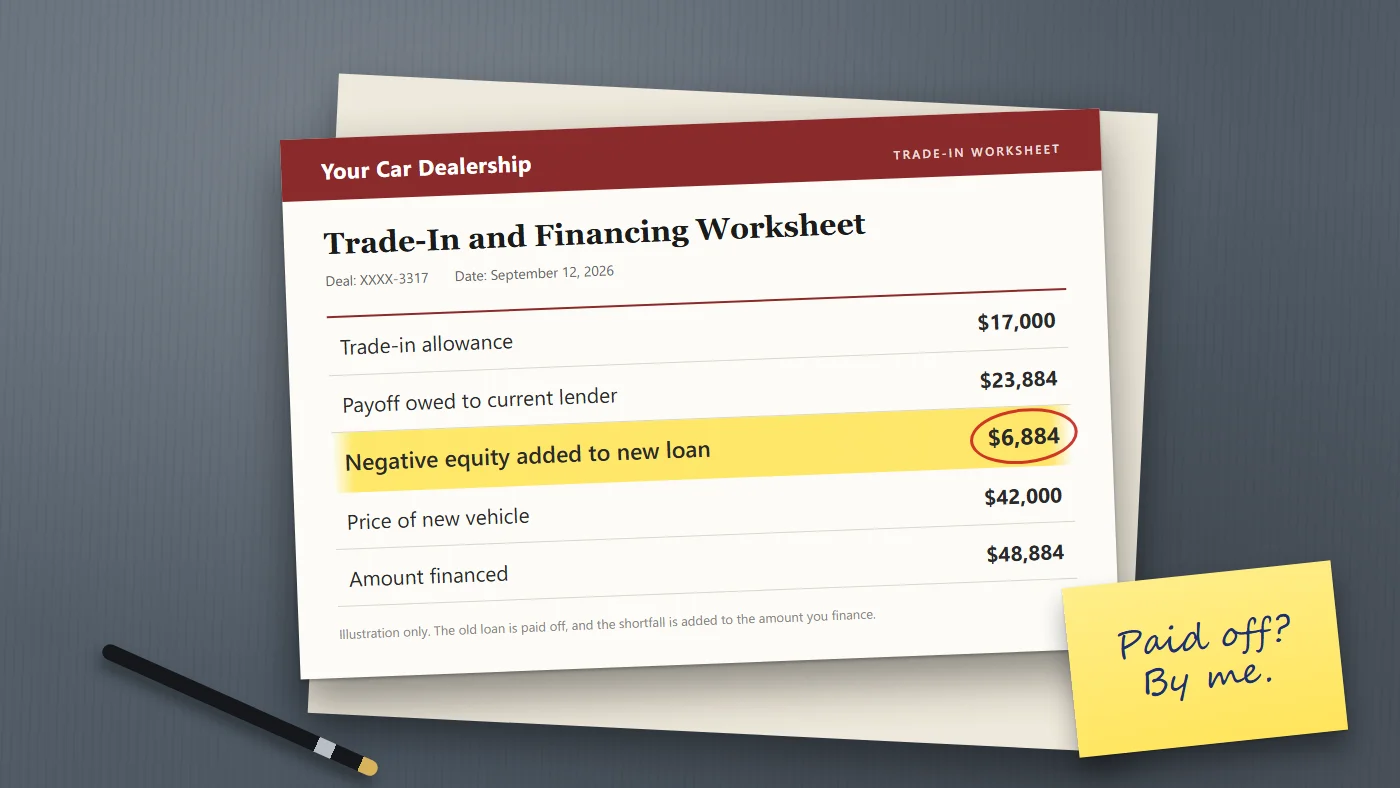
The average shortfall was $6,884, a record for a second quarter. Think of it as what a typical underwater owner still owed after the dealer credited the trade-in at full value. It didn't vanish at the signing table. It went into the next loan.
You can see it in the payment. Buyers who rolled old debt into a new-car loan paid $944 a month on average last quarter, according to Edmunds, while the average across all new-vehicle loans was $777. That $167 gap is the old car, still being paid for after it's gone from the driveway.
Lenders call this negative equity; most people say upside down, or underwater. It means you owe more than the car would sell for today. It isn't proof you did something foolish. Mostly it's arithmetic, and for several years now the arithmetic hasn't been on the owner's side.
How does a car end up worth less than the loan?
New cars lose value fastest in their first few years. Loan balances fall slowest in those same years, since early payments go mostly to interest. Stretch the term, put little down, and the value line dips under the balance line and can stay there for a long while.
Terms keep stretching. Edmunds reported that a record 23.9% of new-vehicle loans signed in the second quarter of 2026 ran 84 months or longer, and the average term reached 70.4 months. Seven years is a long time to stay ahead of a depreciating car.
Then there's timing. Edmunds analysts point out that many of the cars coming back underwater now were bought in 2022, when inventory was thin, incentives were scarce and prices were at their peak. People paid top dollar and financed it. Car values have since come back to earth, but the loans haven't caught up, and the average trade-in with negative equity was 4.0 years old last quarter.
Add-ons push the same way. A service contract, GAP coverage and a paint-and-fabric package can add a few thousand dollars to the amount financed on day one. None of it makes the car worth a dime more.
"We'll pay off your trade," translated
The Federal Trade Commission has a consumer page aimed at exactly this sales line. Some dealers promise to pay off your loan no matter what you owe. If you owe more than the car is worth, the FTC says, that promise may be misleading, because the dealer might add the difference to your new loan, take it out of your down payment, or both.
Its example is simple. Your car is worth $15,000 and you owe $18,000. The lender has to get $18,000 before it'll release the title, so the dealer sends the payoff and credits you $15,000 for the car. The missing $3,000 has to come from somewhere. In most deals, it's written into the amount financed on the new contract.
So yes, the old loan gets paid off, in the narrow sense that the old lender gets its money. You're the one paying it, with interest, for years. And if a dealer told you it would pay off the car itself and then rolled the balance into your financing anyway, the FTC calls that illegal.
Edmunds projects that buyers who rolled negative equity into a new-car loan in the second quarter of 2026 will pay an average of $16,270 in interest over the life of the loan. The average new-vehicle buyer: $9,811.
That's a gap of nearly $6,500. Interest alone. The $6,884 of old debt sits on top of it.
Why the second loan is riskier than the first
Rolling debt forward does more than raise the payment. The new loan starts out underwater on the first day, often deeper than the old one was, because the new car depreciates just like the last one did while it carries its own price plus a slice of the previous car's.
The Consumer Financial Protection Bureau looked at this in a June 2024 report built on loans originated from 2018 through 2022. Borrowers who financed negative equity paid $626 a month on average, against $496 for buyers whose trade-in had positive value. Their loans ran longer, 73 months against 68. Their average loan-to-value ratio was 119.3%, compared with 88.9%, and they were more than twice as likely to have the account assigned to repossession within two years.
There's a newer, smaller cost too. The car loan interest deduction that started with 2025 now has final Treasury regulations, published September 8, 2026, and they say the part of a loan that covers negative equity wasn't borrowed to buy the vehicle. Interest on that slice isn't deductible, even when the rest of the loan qualifies.
None of this makes a trade automatically wrong. It means the decision needs real numbers. You can get them in under an hour. No salesperson required.