In the second quarter of 2026, 29.6% of the vehicles traded in toward a new car were worth less than the loan still attached to them. That's from Edmunds, which tracks dealer transactions nationwide. A year earlier the share was 26.6%.
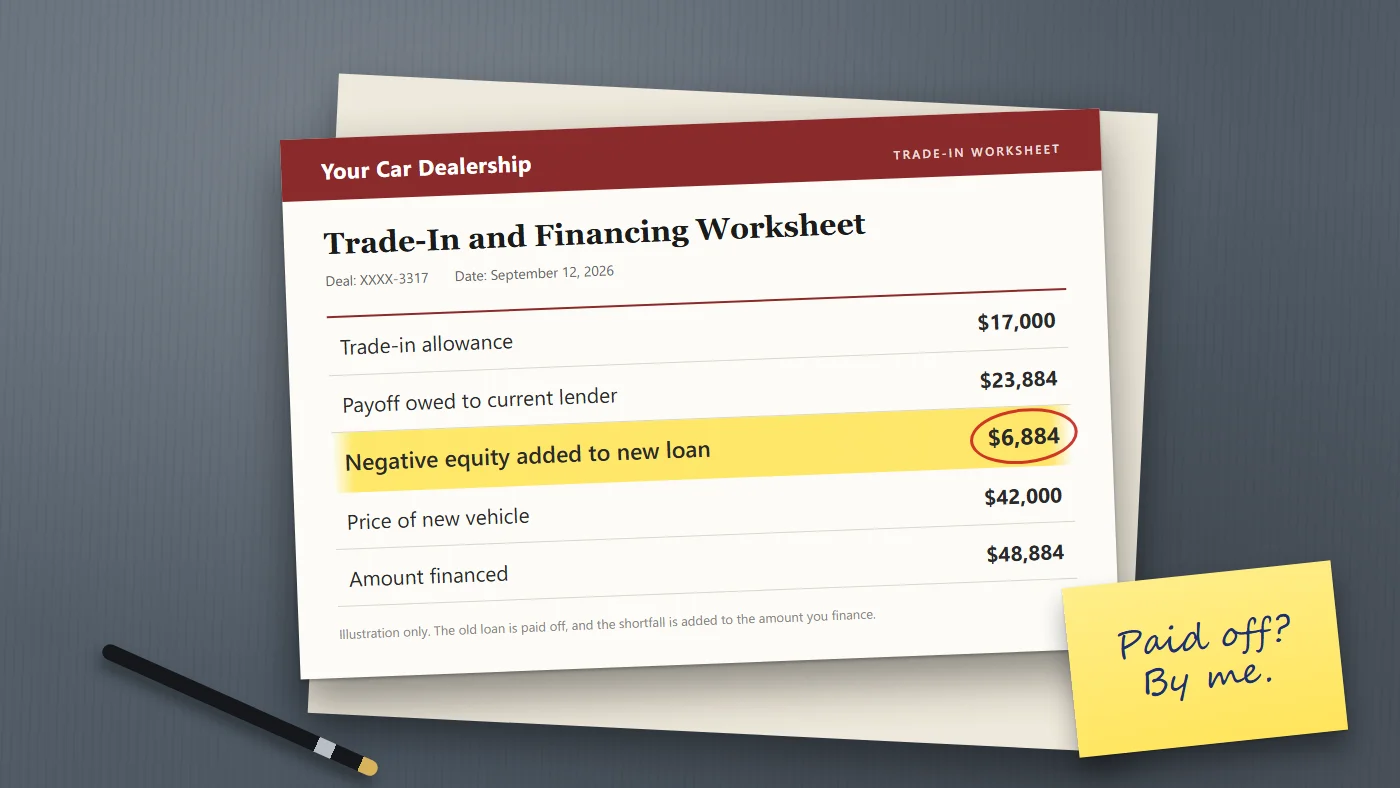
The average shortfall was $6,884, a record for a second quarter. Think of it as what a typical underwater owner still owed after the dealer credited the trade-in at full value. It didn't vanish at the signing table. It went into the next loan.
You can see it in the payment. Buyers who rolled old debt into a new-car loan paid $944 a month on average last quarter, according to Edmunds, while the average across all new-vehicle loans was $777. That $167 gap is the old car, still being paid for after it's gone from the driveway.
Lenders call this negative equity; most people say upside down, or underwater. It means you owe more than the car would sell for today. It isn't proof you did something foolish. Mostly it's arithmetic, and for several years now the arithmetic hasn't been on the owner's side.
How does a car end up worth less than the loan?
New cars lose value fastest in their first few years. Loan balances fall slowest in those same years, since early payments go mostly to interest. Stretch the term, put little down, and the value line dips under the balance line and can stay there for a long while.
Terms keep stretching. Edmunds reported that a record 23.9% of new-vehicle loans signed in the second quarter of 2026 ran 84 months or longer, and the average term reached 70.4 months. Seven years is a long time to stay ahead of a depreciating car.
Then there's timing. Edmunds analysts point out that many of the cars coming back underwater now were bought in 2022, when inventory was thin, incentives were scarce and prices were at their peak. People paid top dollar and financed it. Car values have since come back to earth, but the loans haven't caught up, and the average trade-in with negative equity was 4.0 years old last quarter.
Add-ons push the same way. A service contract, GAP coverage and a paint-and-fabric package can add a few thousand dollars to the amount financed on day one. None of it makes the car worth a dime more.
"We'll pay off your trade," translated
The Federal Trade Commission has a consumer page aimed at exactly this sales line. Some dealers promise to pay off your loan no matter what you owe. If you owe more than the car is worth, the FTC says, that promise may be misleading, because the dealer might add the difference to your new loan, take it out of your down payment, or both.
Its example is simple. Your car is worth $15,000 and you owe $18,000. The lender has to get $18,000 before it'll release the title, so the dealer sends the payoff and credits you $15,000 for the car. The missing $3,000 has to come from somewhere. In most deals, it's written into the amount financed on the new contract.
So yes, the old loan gets paid off, in the narrow sense that the old lender gets its money. You're the one paying it, with interest, for years. And if a dealer told you it would pay off the car itself and then rolled the balance into your financing anyway, the FTC calls that illegal.
Edmunds projects that buyers who rolled negative equity into a new-car loan in the second quarter of 2026 will pay an average of $16,270 in interest over the life of the loan. The average new-vehicle buyer: $9,811.
That's a gap of nearly $6,500. Interest alone. The $6,884 of old debt sits on top of it.
Why the second loan is riskier than the first
Rolling debt forward does more than raise the payment. The new loan starts out underwater on the first day, often deeper than the old one was, because the new car depreciates just like the last one did while it carries its own price plus a slice of the previous car's.
The Consumer Financial Protection Bureau looked at this in a June 2024 report built on loans originated from 2018 through 2022. Borrowers who financed negative equity paid $626 a month on average, against $496 for buyers whose trade-in had positive value. Their loans ran longer, 73 months against 68. Their average loan-to-value ratio was 119.3%, compared with 88.9%, and they were more than twice as likely to have the account assigned to repossession within two years.
There's a newer, smaller cost too. The car loan interest deduction that started with 2025 now has final Treasury regulations, published September 8, 2026, and they say the part of a loan that covers negative equity wasn't borrowed to buy the vehicle. Interest on that slice isn't deductible, even when the rest of the loan qualifies.
None of this makes a trade automatically wrong. It means the decision needs real numbers. You can get them in under an hour. No salesperson required.
The two numbers that tell you where you stand
One is what it costs to close the loan. The other is what the car would really bring. Most people guess at both, and they tend to guess wrong in the same direction.
Start with the loan. The balance on your statement isn't what it costs to close it, so call the lender or log in and ask for a 10-day payoff quote. That figure includes interest through the payoff date and any fees. It usually runs a bit higher than the balance.
Then the car. Price it in more than one place; the FTC suggests the NADA Guides (now run by J.D. Power), Edmunds and Kelley Blue Book. Enter the real mileage and an honest condition, and use the trade-in figure, not retail. Retail is what a dealer would charge for your car after buying it from you.
Published values are estimates, though. A written offer from a dealer or a car-buying service, good for a few days, is a fact. How far apart can those offers be? On the same car, a thousand dollars or more, so collect two or three.
With both numbers in hand:
- Subtract the payoff from the value. A negative number is your negative equity today.
- Look at what else got financed into the current loan. If a service contract or GAP policy is in there, you can usually cancel it and have the prorated refund applied to the balance. That alone can close part of the gap.
- Write the result down.
It sounds fussy. It isn't. Someone who walks into a showroom knowing "I'm $4,200 under" negotiates very differently from someone who finds out in the finance office at 8 p.m.
What rolling it over costs
Say your payoff is $24,000 and the best offer on the car is $17,000. You're $7,000 under.
What if you just fold it into the next loan? Plenty of people do. At 7% over 72 months, that $7,000 slice by itself tacks about $119 onto every payment.
Over six years it runs up roughly $1,600 in interest. So you'd end up paying around $8,600 to get rid of a $7,000 hole, for a car that's long gone from your driveway.
Across the whole market, the Edmunds averages tell the same story.
| Second quarter of 2026 (Edmunds) | All new-car buyers | Buyers who rolled in negative equity |
|---|
| Average monthly payment | $777 | $944 |
| Projected interest over the life of the loan | $9,811 | $16,270 |
| Average old debt carried into the new loan | none | $6,884 |
And some people are in a lot deeper than $7,000. Edmunds looked at underwater trade-ins in the third quarter of 2025: about one in four (24.7%) were more than $10,000 upside down, and 8.3% were past $15,000.
Ways out, cheapest first
The dull answer is usually the cheap one. Keep driving the car and let the gap close on its own. Every payment knocks the balance down, and after the first few years the car's value falls more slowly. If it runs well, another 12 to 18 months can shrink a $4,000 gap to something manageable.
You can speed that up by paying extra toward principal. Even $50 or $100 a month shortens the time you're underwater, and the FTC lists paying the loan down faster as a first step. Tell the lender in writing that the extra goes to principal, or use the option in the payment portal. Otherwise some servicers treat it as an early payment on next month's bill.
Refinancing helps when it's for a lower rate, not a longer term. Has your credit improved since you bought the car? Did the dealer arrange the original loan? Then a lower rate may be out there, and it sends more of each payment to principal. There are limits. Plenty of lenders won't refinance a loan that's well above the car's value, and stretching the term only digs the hole deeper. Credit unions are sometimes more flexible on loan-to-value, so I'd ask there first.
Sell it yourself. A private sale usually brings more than a trade-in offer, sometimes enough to erase the gap. A loan on the title adds a few steps: the buyer's money goes to your lender, you cover any shortfall, and then the lender releases the title. Many banks and credit unions will handle that at a branch. Online car-buying services sit in the middle. They pay less than a private buyer would, but they save you most of the hassle.
Need a different vehicle and have savings? Pay the shortfall in cash at the time of the trade, and it stays out of the new loan. The cash is gone. So is the interest.
Sometimes rolling it over can't be avoided, because the old car is unsafe or the repair would cost more than the gap. Then limit the damage:
- Pick a cheaper vehicle than the one you had in mind. A two- or three-year-old car has already taken its steepest depreciation.
- Take the shortest term you can afford. The FTC makes the same point, since a longer term means more interest and more time underwater.
- Ask the dealer to show in writing how the trade-in and the old payoff are handled. Then find the amount financed and compare it with the price of the car. Higher by roughly the size of your gap? The debt was rolled in.
- Say no to add-ons you didn't ask for. Each one pushes the new loan further above the new car's value.
- Read the contract before you sign it, not after.
Shopping around before you decide
Negative equity is one of the few car problems where an hour of comparison can move the outcome by thousands of dollars. Most of that hour goes to four sets of numbers.
Trade-in offers come first, because they're free. Estimates take a few minutes each, written offers from dealers and car-buying services cost nothing, and the spread between the lowest and highest offer is often wider than people expect.
Next to your best offer, put the private-party value. Is the difference close to the size of your gap? Then selling on your own could solve the problem outright.
For refinancing, get quotes from a credit union, a bank and an online lender. They'll show if a lower payment is possible without adding months. Many lenders will prequalify you with a soft credit check, which doesn't touch your score.
GAP is the last one, and it's about what happens if things go wrong while you're still underwater. If the car's totaled or stolen, you're on the hook for the difference between what the insurer pays and what you owe. That's the gap GAP covers. Auto insurers and credit unions may sell it for less than a dealership does. Read the terms, though. Some policies cap the payout, and some exclude balances carried over from an earlier loan.
What if the dealer misled you?
Say you were told the dealer would pay off your loan, and later you found the old balance inside your new contract. Keep everything: the ad, the texts, both contracts. Then report it to the FTC at ReportFraud.ftc.gov. The FTC uses those reports to spot patterns and build cases, but it doesn't resolve individual disputes, so file with your state attorney general's consumer protection office too.
Americans owed $1.71 trillion on auto loans in the second quarter of 2026, by the Federal Reserve Bank of New York's count. Before anyone offers to make your old loan disappear, call your lender for the 10-day payoff and put a real value on the car.
This article is general information, not financial, legal, tax or medical advice.