Home & Mortgage
How to Appeal Your Property Tax Assessment — Plus Senior Freezes and Exemptions by State
The county's number for your house is an estimate, and the tax breaks for older homeowners usually sit behind an application nobody mails you.
 Ray Castellano
Updated Sep 22, 2026 · 11 min read
The number on your assessment notice isn't a fact about your house. It's an estimate, usually produced by a computer model that has never seen your kitchen, your 24-year-old roof or the crack running across the basement floor. The county multiplies that estimate by a tax rate, and the result is your bill.
Those bills keep climbing. ATTOM, a property data firm, reported in April 2026 that the average tax bill on a single-family home reached $4,427 in 2025, up 3 percent in a year. New Jersey led the country at $10,499. That happened in a year when ATTOM's estimate of the average home's value actually slipped.
You're allowed to argue with the estimate. Every state has a formal process for it, it's usually free or close to it, and you don't need a lawyer to start. Very few people bother.
Fewer than 5 percent. That's the National Taxpayers Union Foundation's estimate of how many taxpayers ever challenge their assessment. The same group says 30 to 60 percent of taxable property in the U.S. is over-assessed, and that most people who show up properly prepared win at least a partial reduction.
Treat those as ballpark figures from an advocacy group, not a promise. Results swing a lot from one county to the next. Still, the pattern is hard to miss.
Most homeowners pay the bill without ever checking the math underneath it.
Then there's the part that matters more once you're past 65. Most states run at least one property tax break that older homeowners can use: an extra exemption, a freeze, a credit or a deferral. In most places it won't show up on your bill by itself. You apply, often with proof of age and income, and some programs make you reapply every year.
So you're really asking two questions about the same bill. Is the value right? And are you getting every reduction you qualify for? They go to different offices, on different forms, with different deadlines, and people who handle one often forget the other.
Why would the county get it wrong?
Assessors value thousands of homes at once, working from recent sales, square footage, lot size, age and a short list of recorded features. On average, that holds up. On any single house it can miss by a mile.
The usual suspects:
- The record is wrong. It shows four bedrooms when you've got three, a finished basement that's bare concrete, or square footage that quietly includes the garage.
- The model can't see condition. Old wiring, a tired roof or water damage lowers what a buyer would pay, and none of it is visible from the curb.
- The comparable sales aren't comparable. Your lot backs onto a four-lane road, and the sales the county leaned on were three streets over.
- The market cooled. ATTOM put the average estimated single-family value at $494,231 in 2025, down 1.7 percent from 2024. Assessments tend to trail a softening market.
Try a gut check. Would your house sell today for the market value the county has on file? If a realistic price is clearly lower, you may have a case.
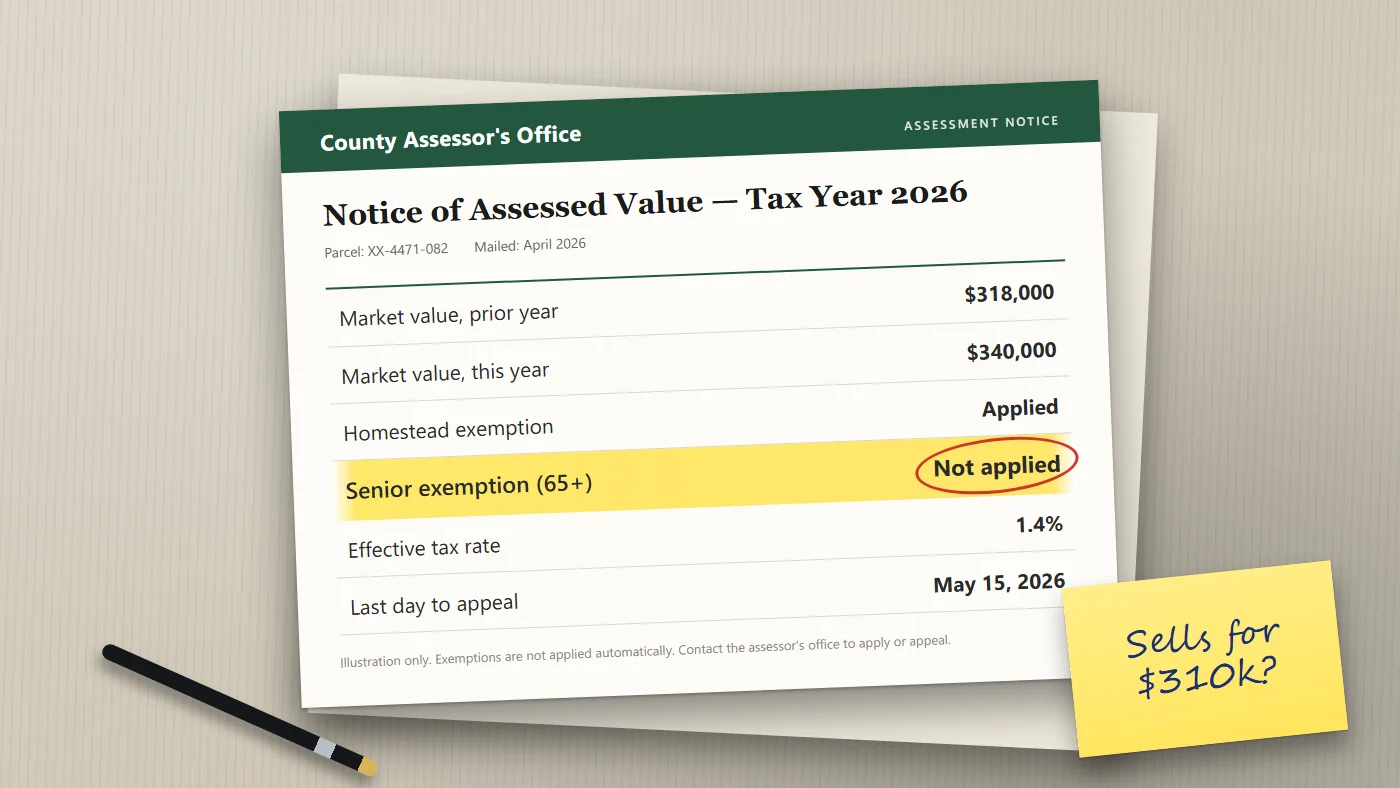
Say your home carries an assessed market value of $340,000, and the effective tax rate where you live is 1.4 percent. Recent sales of similar houses nearby point to $310,000. If the board accepts that number, taxable value drops by $30,000 and the bill falls by about $420 a year, and in many places the lower value carries forward until the next reassessment. Your rate will differ. Run your own numbers.
The senior breaks nobody mails you
Relief for older homeowners tends to come in four shapes. Your state may offer one, several, or something with a different name that works the same way.
| Type | What it does | Typical conditions |
|---|
| Extra homestead exemption | Removes a set dollar amount from your taxable value | Age 65+, primary residence, one-time or annual application |
| Assessment or tax freeze | Locks your assessed value or tax amount at a base year | Age 65+, income limit, often yearly renewal |
| Circuit breaker credit or rebate | Pays back part of the tax when it's high relative to income | Income limit, claimed on a state form or tax return |
| Deferral | Lets you postpone the tax until the home is sold | Age 65+, equity and income limits, interest accrues, a lien is placed |
Rules vary by state and sometimes by county, and so do the dollar amounts. In Texas the over-65 piece alone takes $60,000 off your value for school taxes. In Illinois the freeze has a $75,000 income limit and a form that's due every year. New Jersey's combined application for its senior programs is due November 2, 2026, which is only weeks away.
The state-by-state details come next, then the appeal itself and the deadlines that trip people up.