The number on your assessment notice isn't a fact about your house. It's an estimate, usually produced by a computer model that has never seen your kitchen, your 24-year-old roof or the crack running across the basement floor. The county multiplies that estimate by a tax rate, and the result is your bill.
Those bills keep climbing. ATTOM, a property data firm, reported in April 2026 that the average tax bill on a single-family home reached $4,427 in 2025, up 3 percent in a year. New Jersey led the country at $10,499. That happened in a year when ATTOM's estimate of the average home's value actually slipped.
You're allowed to argue with the estimate. Every state has a formal process for it, it's usually free or close to it, and you don't need a lawyer to start. Very few people bother.
Fewer than 5 percent. That's the National Taxpayers Union Foundation's estimate of how many taxpayers ever challenge their assessment. The same group says 30 to 60 percent of taxable property in the U.S. is over-assessed, and that most people who show up properly prepared win at least a partial reduction.
Treat those as ballpark figures from an advocacy group, not a promise. Results swing a lot from one county to the next. Still, the pattern is hard to miss.
Most homeowners pay the bill without ever checking the math underneath it.
Then there's the part that matters more once you're past 65. Most states run at least one property tax break that older homeowners can use: an extra exemption, a freeze, a credit or a deferral. In most places it won't show up on your bill by itself. You apply, often with proof of age and income, and some programs make you reapply every year.
So you're really asking two questions about the same bill. Is the value right? And are you getting every reduction you qualify for? They go to different offices, on different forms, with different deadlines, and people who handle one often forget the other.
Why would the county get it wrong?
Assessors value thousands of homes at once, working from recent sales, square footage, lot size, age and a short list of recorded features. On average, that holds up. On any single house it can miss by a mile.
The usual suspects:
- The record is wrong. It shows four bedrooms when you've got three, a finished basement that's bare concrete, or square footage that quietly includes the garage.
- The model can't see condition. Old wiring, a tired roof or water damage lowers what a buyer would pay, and none of it is visible from the curb.
- The comparable sales aren't comparable. Your lot backs onto a four-lane road, and the sales the county leaned on were three streets over.
- The market cooled. ATTOM put the average estimated single-family value at $494,231 in 2025, down 1.7 percent from 2024. Assessments tend to trail a softening market.
Try a gut check. Would your house sell today for the market value the county has on file? If a realistic price is clearly lower, you may have a case.
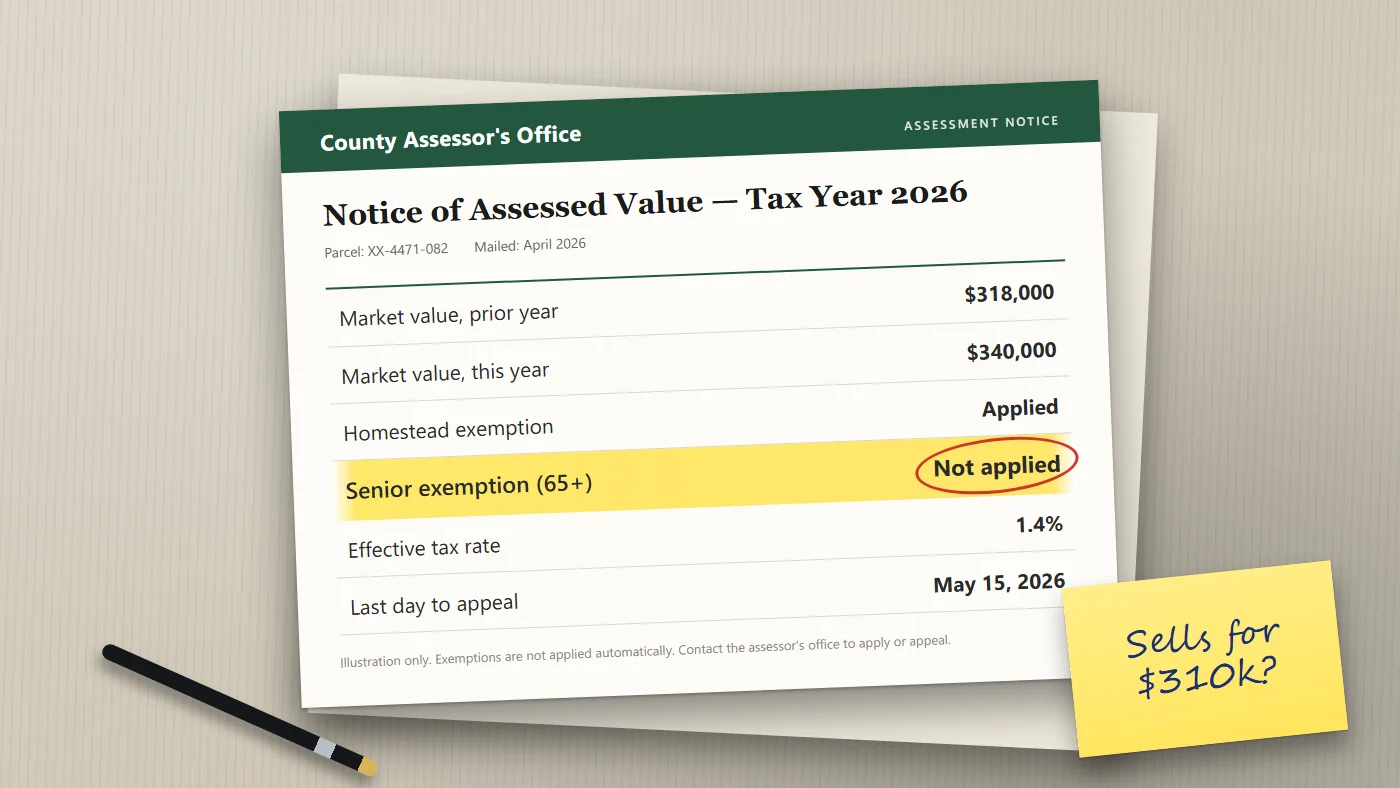
Say your home carries an assessed market value of $340,000, and the effective tax rate where you live is 1.4 percent. Recent sales of similar houses nearby point to $310,000. If the board accepts that number, taxable value drops by $30,000 and the bill falls by about $420 a year, and in many places the lower value carries forward until the next reassessment. Your rate will differ. Run your own numbers.
The senior breaks nobody mails you
Relief for older homeowners tends to come in four shapes. Your state may offer one, several, or something with a different name that works the same way.
| Type | What it does | Typical conditions |
|---|
| Extra homestead exemption | Removes a set dollar amount from your taxable value | Age 65+, primary residence, one-time or annual application |
| Assessment or tax freeze | Locks your assessed value or tax amount at a base year | Age 65+, income limit, often yearly renewal |
| Circuit breaker credit or rebate | Pays back part of the tax when it's high relative to income | Income limit, claimed on a state form or tax return |
| Deferral | Lets you postpone the tax until the home is sold | Age 65+, equity and income limits, interest accrues, a lien is placed |
Rules vary by state and sometimes by county, and so do the dollar amounts. In Texas the over-65 piece alone takes $60,000 off your value for school taxes. In Illinois the freeze has a $75,000 income limit and a form that's due every year. New Jersey's combined application for its senior programs is due November 2, 2026, which is only weeks away.
The state-by-state details come next, then the appeal itself and the deadlines that trip people up.
How six big states handle it
All of this was current as of September 2026, and the spread is wide.
Texas. School districts must exempt $140,000 of a homestead's value, and owners who are 65 or older or disabled get another $60,000 off for school taxes. You apply to your county appraisal district on Form 50-114. A 65-plus homestead also gets a ceiling on school taxes.
Illinois. The Senior Citizens Homestead Exemption takes $8,000 off equalized assessed value in Cook County and the counties that border it, and $5,000 everywhere else. The separate Senior Freeze is open to households with income of $75,000 or less for tax year 2026, rising to $77,000 for 2027 and $79,000 for 2028. You file Form PTAX-340 each year. Skip a year and you don't get the freeze for that year.
New York. Enhanced STAR, the larger school tax break for owners 65 and up, has an income limit of $110,750 for 2026 and $113,550 for 2027. Starting in 2026, the state says it will upgrade eligible STAR recipients to Enhanced STAR on its own in the year a resident owner turns 65. That makes New York the exception on this list. Never registered for STAR at all? You still need to.
Florida. Counties and cities may adopt an extra exemption of up to $50,000 for residents 65 and older whose household income falls under a cap. The Department of Revenue puts that cap at $38,686 for 2026. It only cuts taxes levied by the local governments that adopted it. School taxes aren't touched.
New Jersey. The Senior Freeze reimburses increases above your base-year tax, and the income limit for 2025 is $172,475. The state now uses one form, PAS-1, for the Senior Freeze, ANCHOR and the newer Stay NJ benefit. The deadline for the 2025 application is November 2, 2026.
California. Proposition 13 already limits yearly increases in assessed value. Under Proposition 19, owners 55 or older can carry their lower taxable value to a replacement home anywhere in the state, with a claim filed at the new county's assessor.
Five of those six ask you to file something. A freeze also gets more valuable the sooner you lock it in, because it pins your base year. Wait three years and you're usually freezing a bigger number.
Check for missing exemptions first
Start here. It's the quicker job, and nobody has to agree with you.
- Find what you already get. Exemptions are listed on your tax bill or on your parcel's page at the assessor's or appraisal district's website. Look for words like homestead, senior, over-65, freeze or STAR.
- Pull your state's list. Use the state revenue department's site, not a third-party page. Search "property tax relief" plus your state's name and pick the .gov result.
- Check three details for each program: the age cutoff and the date it's measured on, the income limit and which year's income counts, and whether you reapply every year.
- Gather proof. Most offices want a driver's license or birth certificate, something showing the home is your primary residence, and, for income-tested programs, last year's federal return or your Social Security benefit statement.
- Ask about back years. Some states let you claim a missed exemption for one or more prior years. Others don't. It costs nothing to ask.
How to appeal, step by step
Depending on where you live, it's called an appeal, a protest, a grievance or a petition. The bones are nearly identical.
- The day the notice lands, read it and find the deadline. The appeal window usually runs 30 to 45 days from that notice, which isn't long.
- Get your property record card next. The assessor's office or website hands it out free, and it's where the mistakes listed above tend to hide. A plain factual error is the easiest appeal there is.
- Then come comparable sales, three to five of them. Look for houses near yours, of similar size and age, that sold around the valuation date printed on your notice. The assessor's own sales search is the place to start, since that's data the board already trusts.
- Show the condition, too. Dated photos help; written contractor estimates help more. A $22,000 bid for foundation work is evidence. "The house needs work" isn't.
- Call the assessor's office before you file. Many counties offer an informal review, and staff can sometimes agree to a lower value on the spot.
- File the formal appeal on time. Use the county's form, state the value you think is right, and attach your evidence. Keep a copy and proof of the date you filed.
- Go to the hearing. It's usually short and informal. You present your number and evidence, the assessor presents theirs, and you stick to value.
- Know the next level. If the board says no, most states allow a further appeal to a state board or tax court, again with its own deadline.
One caution. In some places a review can push your value up, too. If there's an unpermitted addition or the record undercounts your square footage, think before you open the file.
Deadlines are short, and they don't match
Miss the window and you're usually waiting a full year. The calendar moves a lot from state to state:
- Texas: May 15, or 30 days after the appraisal district's notice is delivered, whichever is later. The form is 50-132.
- New Jersey: April 1, or 45 days after assessment notices are bulk-mailed, whichever is later. A few counties, Monmouth among them, use January 15.
- California: the regular filing period opens July 2. It closes September 15 in counties where the assessor mails a value notice to every owner by August 1, and November 30 everywhere else. For 2026, the September 15 counties have already closed.
Your deadline should be printed on the notice. If it isn't, call the assessor's office, ask for the last day to file for this tax year, and write it down while you're still on the phone.
Do it yourself, or pay for help?
For an ordinary house with a clear error or decent comparable sales, you can handle this yourself. Filing is usually free or cheap. Boards see homeowners without lawyers all day.
Help makes sense when the dollars get bigger. There are three kinds.
An independent appraisal. A licensed appraiser inspects the house and writes a formal opinion of value, and boards give it real weight, especially when condition is the argument. Expect a fee in the hundreds of dollars for a typical single-family home. Ask whether the report will use the valuation date on your notice.
A property tax consultant. These firms file and argue the appeal for you. Most work on contingency and keep a percentage of the first year's savings. Get that percentage in writing, and ask whether you owe anything if the appeal fails. Licensing rules differ by state.
A property tax attorney. Worth a call for a high-value home, inherited property with title questions, or a case headed to a state tax court.
Before you sign, get two or three quotes and compare them with a plain estimate of your savings. If a realistic win is $400 a year, giving up 40 percent of year one might be fine. A flat $600 up front probably isn't.
If money is tight, look for free help first. Some Area Agencies on Aging and legal aid offices help older homeowners with exemption and freeze applications at no charge.
Mistakes that sink good cases
- Arguing that your taxes went up too much. The board rules on value, not on the size of the bill.
- Bringing asking prices or online estimates instead of closed sales.
- Missing the deadline by a day. Boards almost never make exceptions.
- Forgetting the yearly renewal on an income-based freeze.
- Paying a company to file a senior exemption form the county accepts for free.
If you only get to one of these jobs this year, I'd make it the exemptions check. It takes one bill and about twenty minutes. Pull last year's tax bill out of the drawer tonight, find the exemptions line, and then put the month your assessment notice usually arrives on the calendar, with a reminder a week ahead.
This article is general information, not financial, legal, tax or medical advice.