Home & Mortgage
Reverse Mortgages: Who They Actually Work For — and the Costs in the Fine Print
A reverse mortgage is a loan against your house that grows instead of shrinking, and the ads skip the three parts that decide whether it helps you.
 Ray Castellano
Updated Sep 22, 2026 · 10 min read
You've probably seen the commercial. A familiar face explains that if you're 62 or older, you can turn your home equity into tax-free cash, skip the monthly mortgage payment and stay in your home.
Each of those claims is accurate. A reverse mortgage is a real product, the most common kind is insured by the Federal Housing Administration, and for some homeowners it solves a real problem. It's also a loan. There are fees at the start, interest every month, and conditions that can make the whole balance due while you're still alive and living there.
The Consumer Financial Protection Bureau studied these ads and published an advisory about what they leave out. Its first point is the one to remember: a reverse mortgage is a home loan, not a government benefit. Its second is that you can still lose the home. And without a good plan, it warns, you can outlive the money.
The ads say even less about your family. When the last borrower dies, the CFPB says, heirs get 30 days from the due-and-payable notice to decide whether to pay off the loan, sell the house or hand it to the lender. Extensions of up to six months are possible.
Most of what the ads skip comes down to three costs. None of them is hidden. They're in the loan documents, and a counselor you're required to see will walk you through them. They just don't make it into the 60 seconds on TV.
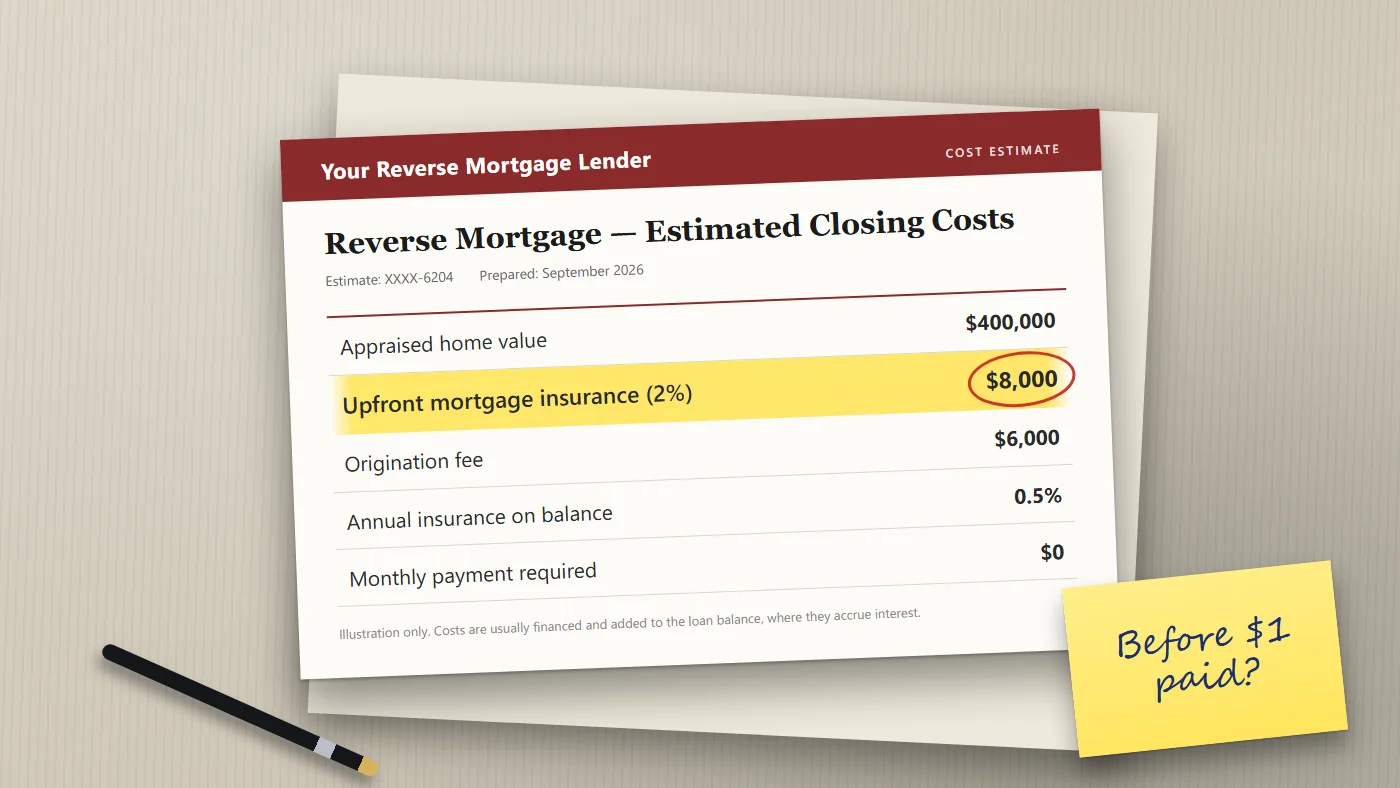
2 percent on day one. The upfront mortgage insurance premium on a federally insured reverse mortgage is 2 percent of your home's value, up to the program limit. On a $400,000 home that's $8,000, usually rolled into the loan before you see a dollar.
How does the loan actually work?
The federally insured version is called a Home Equity Conversion Mortgage, or HECM. It's the bulk of the market and the version this article covers unless noted.
The basic terms, according to the FTC and the CFPB:
- The youngest borrower must be at least 62, and the home must be your primary residence.
- Any existing mortgage gets paid off, usually with the first money from the reverse mortgage.
- You can take the money as a lump sum, monthly payments, a line of credit, or a mix.
- You make no monthly loan payment. Interest and fees are added to the balance each month, so the debt grows and your equity shrinks.
- You still own the home, and you still pay property taxes, homeowners insurance and upkeep.
- The loan comes due when the last borrower dies, sells, or stops living in the home.
How much you can borrow depends on the age of the youngest borrower, current interest rates and the home's value. The share rises with age and falls when rates are high. For 2026, HUD counts home value only up to $1,249,125, a limit set in Mortgagee Letter 2025-22 for case numbers assigned January 1 through December 31, 2026.
You get a fraction of the home's value, not the whole thing. HUD rules also generally cap how much of it you can take in the first year.
The three costs the ads leave out
Cost one: the fees at closing. A HECM is one of the pricier loans to open. Say your home appraises at $400,000.
| Closing cost | Rule | On a $400,000 home |
|---|
| Upfront mortgage insurance premium | 2 percent of home value, up to the program limit | $8,000 |
| Origination fee | Greater of $2,500 or 2% of the first $200,000 plus 1% above that, capped at $6,000 | Up to $6,000 |
| Appraisal, title, recording and other closing costs | Vary by state and lender | Varies |
| Counseling session | Set by the agency; the FTC says it's often around $125 | About $125 |
That's as much as $14,000 before third-party closing costs, and most borrowers finance it. It starts accruing interest on day one.
Cost two: a balance that compounds. Every month the lender adds interest plus an annual insurance premium of 0.5 percent of the balance. Nothing gets paid down, so next month's interest lands on a bigger number.
Take a $100,000 balance growing at a combined 7.5 percent a year, compounded monthly. After 10 years it's about $211,000. After 15, about $307,000. After 20, about $446,000. You borrowed $100,000; the rest is interest on interest.
Cost three: the conditions. "Stay in your home as long as you live" comes with terms attached. The loan can be called due if you fall behind on property taxes or homeowners insurance, if you let the house fall into disrepair, or if it stops being your primary residence. The CFPB spells out one case families rarely see coming: if you spend more than 12 consecutive months in a hospital, nursing home or assisted living facility and no co-borrower lives in the house, the loan becomes due.
That third cost is how people actually lose homes with a reverse mortgage. It's rarely the loan itself. It's an unpaid tax bill or a lapsed insurance policy.
Whether any of this is worth paying depends on your situation and on what happens to the house after you. Your family should hear that part before anyone signs.