You've probably seen the commercial. A familiar face explains that if you're 62 or older, you can turn your home equity into tax-free cash, skip the monthly mortgage payment and stay in your home.
Each of those claims is accurate. A reverse mortgage is a real product, the most common kind is insured by the Federal Housing Administration, and for some homeowners it solves a real problem. It's also a loan. There are fees at the start, interest every month, and conditions that can make the whole balance due while you're still alive and living there.
The Consumer Financial Protection Bureau studied these ads and published an advisory about what they leave out. Its first point is the one to remember: a reverse mortgage is a home loan, not a government benefit. Its second is that you can still lose the home. And without a good plan, it warns, you can outlive the money.
The ads say even less about your family. When the last borrower dies, the CFPB says, heirs get 30 days from the due-and-payable notice to decide whether to pay off the loan, sell the house or hand it to the lender. Extensions of up to six months are possible.
Most of what the ads skip comes down to three costs. None of them is hidden. They're in the loan documents, and a counselor you're required to see will walk you through them. They just don't make it into the 60 seconds on TV.
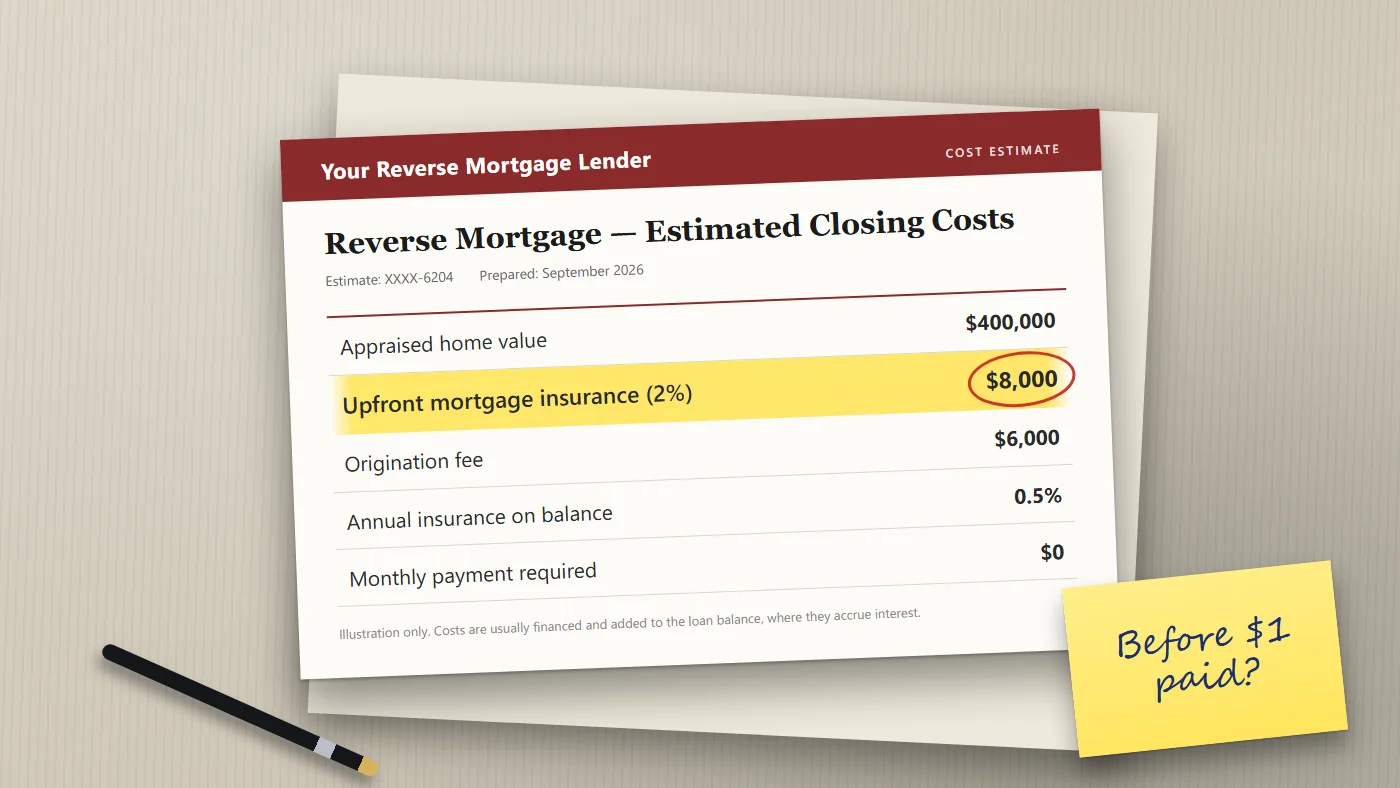
2 percent on day one. The upfront mortgage insurance premium on a federally insured reverse mortgage is 2 percent of your home's value, up to the program limit. On a $400,000 home that's $8,000, usually rolled into the loan before you see a dollar.
How does the loan actually work?
The federally insured version is called a Home Equity Conversion Mortgage, or HECM. It's the bulk of the market and the version this article covers unless noted.
The basic terms, according to the FTC and the CFPB:
- The youngest borrower must be at least 62, and the home must be your primary residence.
- Any existing mortgage gets paid off, usually with the first money from the reverse mortgage.
- You can take the money as a lump sum, monthly payments, a line of credit, or a mix.
- You make no monthly loan payment. Interest and fees are added to the balance each month, so the debt grows and your equity shrinks.
- You still own the home, and you still pay property taxes, homeowners insurance and upkeep.
- The loan comes due when the last borrower dies, sells, or stops living in the home.
How much you can borrow depends on the age of the youngest borrower, current interest rates and the home's value. The share rises with age and falls when rates are high. For 2026, HUD counts home value only up to $1,249,125, a limit set in Mortgagee Letter 2025-22 for case numbers assigned January 1 through December 31, 2026.
You get a fraction of the home's value, not the whole thing. HUD rules also generally cap how much of it you can take in the first year.
The three costs the ads leave out
Cost one: the fees at closing. A HECM is one of the pricier loans to open. Say your home appraises at $400,000.
| Closing cost | Rule | On a $400,000 home |
|---|
| Upfront mortgage insurance premium | 2 percent of home value, up to the program limit | $8,000 |
| Origination fee | Greater of $2,500 or 2% of the first $200,000 plus 1% above that, capped at $6,000 | Up to $6,000 |
| Appraisal, title, recording and other closing costs | Vary by state and lender | Varies |
| Counseling session | Set by the agency; the FTC says it's often around $125 | About $125 |
That's as much as $14,000 before third-party closing costs, and most borrowers finance it. It starts accruing interest on day one.
Cost two: a balance that compounds. Every month the lender adds interest plus an annual insurance premium of 0.5 percent of the balance. Nothing gets paid down, so next month's interest lands on a bigger number.
Take a $100,000 balance growing at a combined 7.5 percent a year, compounded monthly. After 10 years it's about $211,000. After 15, about $307,000. After 20, about $446,000. You borrowed $100,000; the rest is interest on interest.
Cost three: the conditions. "Stay in your home as long as you live" comes with terms attached. The loan can be called due if you fall behind on property taxes or homeowners insurance, if you let the house fall into disrepair, or if it stops being your primary residence. The CFPB spells out one case families rarely see coming: if you spend more than 12 consecutive months in a hospital, nursing home or assisted living facility and no co-borrower lives in the house, the loan becomes due.
That third cost is how people actually lose homes with a reverse mortgage. It's rarely the loan itself. It's an unpaid tax bill or a lapsed insurance policy.
Whether any of this is worth paying depends on your situation and on what happens to the house after you. Your family should hear that part before anyone signs.
What your spouse and your heirs face
A younger spouse. If one spouse is under 62, some couples put only the older one on the loan, either to qualify or to borrow more. HUD rules now let an eligible non-borrowing spouse stay in the home after the borrower dies, if specific conditions are met. The loan payments stop, though. Ask the counselor to explain exactly what your spouse would have to do and sign, and get it in writing.
Your children. When the last borrower dies, the servicer sends a notice that the loan is due. According to the CFPB, heirs then have 30 days to decide whether to buy the home, sell it or turn it over to the lender, and that can be stretched up to six months so they can sell or line up their own financing.
Their options:
- Pay off the balance and keep the house, with their own money or a new mortgage.
- Sell the house. If it sells for more than the balance, the heirs keep the difference.
- Pay 95 percent of the appraised value if the balance is bigger than the house is worth. FHA insurance covers the rest.
- Hand the property to the lender and walk away.
A HECM is a non-recourse loan. Your heirs never owe more than the house is worth, and the lender can't go after their other assets. They won't inherit a debt.
They may inherit a lot less than they expected, though. And a short clock.
Tell them now. Give them the servicer's name and the loan number, and show them where the papers are. Thirty days isn't long when someone has just died.
Who a reverse mortgage tends to fit
No group is always a good fit. These conditions make it more likely to work:
- You plan to stay in this house for many years, ideally for good. The closing costs only make sense spread over a long stay.
- The house works for aging, with a bedroom and bath on one floor, or you can afford to add them.
- You can comfortably cover taxes, insurance and repairs from other income. The lender runs a financial assessment on this and may set aside part of the loan to pay those bills.
- An existing mortgage payment is squeezing a fixed income, and paying it off with a HECM would remove that payment.
- Leaving the house free and clear to your heirs isn't your top priority, and they know it.
Who should probably look elsewhere
- You might move within five years, to be near family, to a smaller place or into assisted living.
- You're already behind on taxes or insurance. The loan doesn't fix that, and falling behind again can mean foreclosure.
- You need a modest sum once. Paying $14,000 in fees to borrow $25,000 is a poor trade.
- Someone else lives in the house and isn't on the loan, like an adult child or a partner. They'd have to leave or pay off the loan when you die or move out.
- A salesperson suggests using the money to buy an annuity or another investment. The FTC warns about exactly this pitch.
So what else is there? The CFPB suggests pricing a few alternatives first. Waiting a few years is one, since borrowing at 62 leaves less for later. A home equity loan or line of credit costs less but needs monthly payments. There's also refinancing into a smaller payment, downsizing, and state or local programs that help with property taxes, utilities and home repairs. Some state and local agencies offer single-purpose reverse mortgages, which the FTC calls the least expensive kind. They can only be used for the one purpose the lender approves, such as repairs or property taxes.
If you go ahead: how to shop
The government sets the insurance premiums, so those are the same everywhere. What differs from lender to lender is the interest rate, the margin on adjustable loans, the origination fee and any servicing fee. Over 15 years, those differences add up to real money.
- Do the counseling first. It's required for a HECM, and it's the one conversation you'll have with someone who isn't selling you anything. You can find a HUD-approved counselor at 800-569-4287. The CFPB says an agency can't charge you the fee if you can't afford it.
- Run a reverse mortgage calculator for a rough figure at your age and home value. Treat it as a ballpark. Plenty of calculators exist mainly to collect your phone number.
- Get written quotes from at least three HECM lenders on the same day. Ask each for the rate or margin, the origination fee, all closing costs, and the Total Annual Loan Cost disclosure, which shows the projected yearly cost over different time spans.
- Push on the origination fee. The cap is $6,000, and some lenders charge less.
- Pick the payout carefully. With a line of credit, interest accrues only on what you draw. A lump sum at a fixed rate starts compounding on the full amount right away.
- Bring someone with you. A son or daughter or a trusted friend at the counseling session and the lender meetings protects you, and it heads off surprises later.
- Use the three days. After closing you have at least three business days to cancel for any reason, without penalty. The FTC advises doing it in writing, by certified mail with a return receipt.
After closing: keeping the loan in good standing
These rules are simple, and they matter more than anything else you'll do with the loan.
- Pay property taxes and homeowners insurance on time, every time. If you qualify for a senior property tax exemption or freeze, apply for it.
- Return the annual occupancy certificate your servicer mails you. Ignoring it can start a default process.
- Keep the house in reasonable repair.
- If you'll be away for a long stretch for medical reasons, tell the servicer and ask how the 12-month rule applies to you.
- If you ever can't pay the taxes or insurance, call the servicer and a HUD-approved counselor right away. Repayment plans exist, and they're far easier to set up early.
Report high-pressure sales tactics or suspected fraud at ReportFraud.ftc.gov, to the CFPB, or to your state attorney general.
If I were weighing one of these, I'd book the counseling session before talking to a single lender, and I'd bring whoever will be handling the house after me. Put the counselor's number, 800-569-4287, next to the phone.
This article is general information, not financial, legal, tax or medical advice.