If you were born in 1953, you turn 73 this year. From here on, the IRS requires you to pull money out of your traditional IRA and most workplace retirement accounts every year. Need the cash or not.
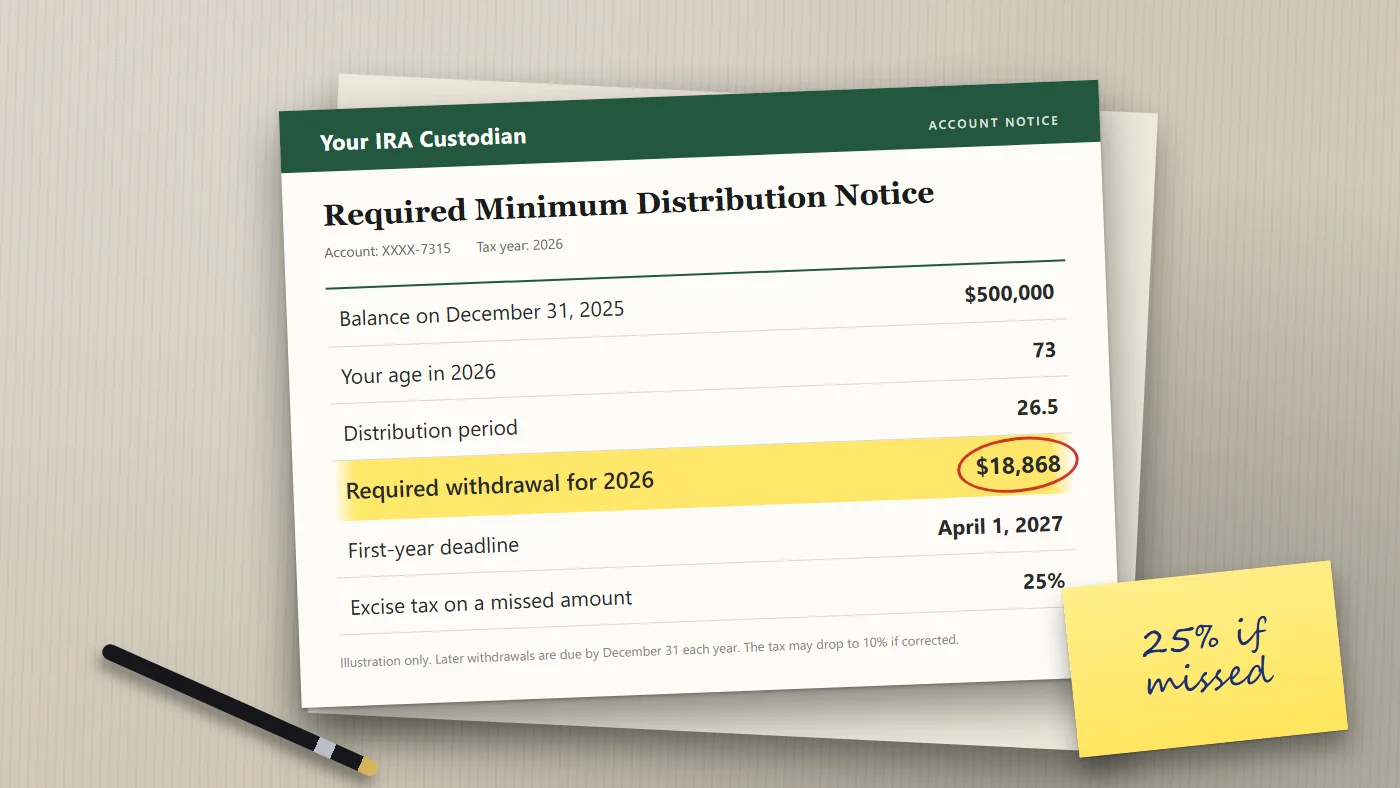
Officially, it's the required minimum distribution, or RMD. Skip it, or take too little, and you owe an excise tax of 25% of the amount you didn't withdraw. Say your IRA held $500,000 at the end of last year. Your first RMD is about $18,868. Miss it entirely and the tax is about $4,717, and that's on top of the regular income tax you'll still pay when the money finally comes out.
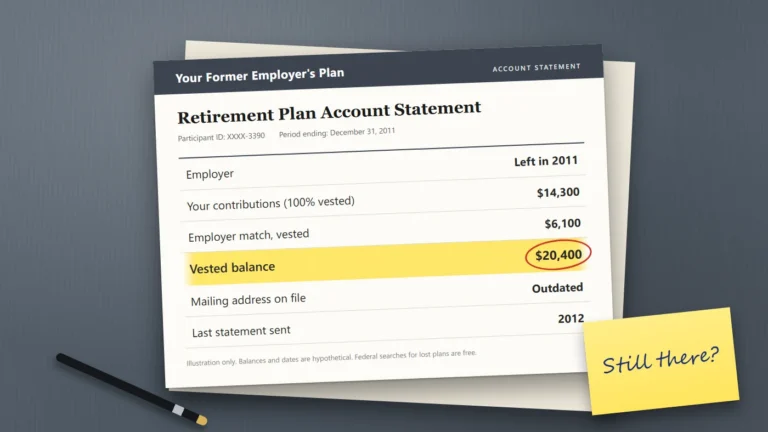
Most people who get caught aren't careless. They're the savers who left an account alone for forty years, the surviving spouse who inherits the paperwork along with the accounts, the retiree with a 401(k) still sitting at an employer he left a decade ago and a mailing address the plan hasn't had in years. It's a rule that punishes you for not touching your money, which is exactly what you were told to do for decades.
Why the rule at all? You skipped income tax on this money when you earned it, and the deal was always that you'd pay the tax later. At 73, later arrives. Each year you take last year's December 31 balance, divide it by a number from an IRS table, withdraw at least that much and report it as income.
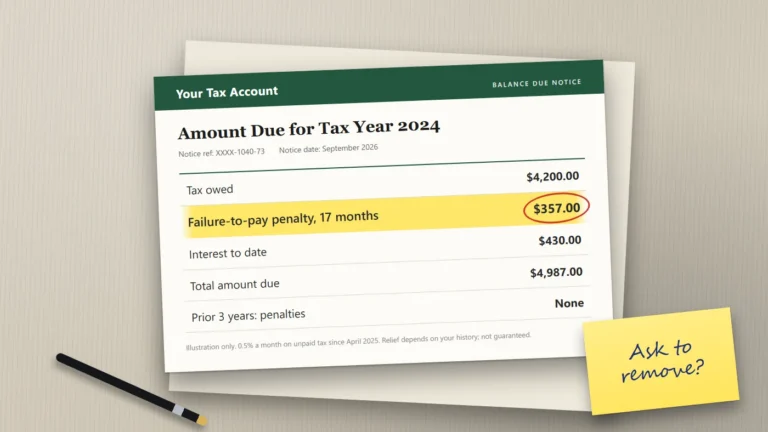
The number to remember: 25%. That's the excise tax on any RMD amount you miss. It drops to 10% if you take out the missed money and file the correction within the IRS "correction window," which generally runs through the end of the second year after the miss. Before 2023 the penalty was 50%.
Who has to take one?
Almost everyone with pre-tax retirement savings. IRS rules cover traditional, SEP and SIMPLE IRAs, plus 401(k), 403(b), 457(b), profit-sharing and other defined contribution plans.
Roth accounts are the big exception. RMD rules don't apply to Roth IRAs or to designated Roth accounts in a workplace plan while the owner is alive. Your heirs will face withdrawal rules. You won't.
Your birth year sets the starting age. Under the SECURE 2.0 Act, people born from 1951 through 1959 start at 73, and people born in 1960 or later start at 75. If you were born in 1959, the statute was drafted in a way that seems to give you both ages. In proposed regulations, the IRS says 73.
There's also a still-working exception. If you're still employed at 73, your current employer's plan may let you put off RMDs from that plan until the year you retire. You can't use it if you own more than 5% of the business. It never applies to IRAs. And it doesn't reach old 401(k) accounts left behind at former employers.
The April 1 trap in year one
Your very first RMD gets a special deadline: April 1 of the year after you turn 73. Every RMD after that is due by December 31.
That extra three months looks generous.
It isn't free. Turn 73 in 2026, wait until March 2027 to take the first withdrawal, and you still owe the second one by December 31, 2027. Two taxable withdrawals land in one tax year. On a $500,000 account that holds its value, that's roughly $38,000 of income in 2027.
For plenty of households, that stack is enough to push income into a higher bracket, make more of your Social Security taxable, or trigger the Medicare income surcharge known as IRMAA, which is set using your tax return from two years earlier. So a doubled RMD in 2027 can raise your Part B and Part D premiums in 2029. Taking the first RMD by December 31 of the year you turn 73 avoids all of that. Waiting only makes sense if this year's income is unusually high and next year's will be much lower.
How the math works
You need two numbers: your account balance on December 31 of last year, and the "distribution period" for the age you reach this year, which comes from the Uniform Lifetime Table in IRS Publication 590-B. Divide the first by the second.
| Age this year | Distribution period | RMD per $100,000 of balance |
|---|
| 73 | 26.5 | about $3,774 |
| 75 | 24.6 | about $4,065 |
| 80 | 20.2 | about $4,950 |
| 85 | 16.0 | $6,250 |
| 90 | 12.2 | about $8,197 |
Watch the direction. Each year the divisor shrinks, so the required share keeps climbing: about 3.8% of the account at 73, more than 6% at 85, more than 8% at 90. If your investments do well, the dollar amount can rise for a long time.
There's one exception to the table. If your spouse is your sole beneficiary and is more than 10 years younger than you, you use the Joint Life and Last Survivor table in Publication 590-B instead, and it produces a smaller RMD.
Division is the easy part. Where people actually get into trouble is the account-by-account rules, the calendar, and the first few weeks after they realize they missed one, which is what the rest of this guide covers, along with the legal ways to make future RMDs smaller.
If you own more than one traditional IRA, you figure the RMD for each one separately. Then you can add them up and take the total from any one IRA, or any mix of them. SEP and SIMPLE IRAs count as IRAs here. Owners of several 403(b) contracts get the same pooling.
Workplace plans such as 401(k)s and 457(b)s work differently. RMDs from those plans have to come out of each plan account separately, so a big IRA withdrawal does nothing for the RMD on an old 401(k), and a 401(k) withdrawal doesn't cover your IRA.
Spouses can't cover for each other either. Your IRA and your spouse's IRA each carry their own RMD.
Inherited IRAs sit in their own bucket too. For deaths after 2019, most beneficiaries who aren't spouses have to empty the account within ten years, and if the original owner had already started RMDs, yearly withdrawals are generally required along the way. Miss one and it's the same 25% tax. You also can't pool an inherited IRA with your own.
Picture a retiree with two IRAs and a 401(k) from a job she left in 2009. In November she takes a large withdrawal from the first IRA and figures she's done for the year. Her IRAs are fine. But the 401(k) RMD never came out, and the 25% tax applies to that missed amount.
Your RMD checklist for this year
- List every tax-deferred account you own. Traditional, SEP and SIMPLE IRAs, plus every 401(k), 403(b) and 457(b), including plans at former employers. Old plans are the ones people forget.
- Find each December 31 balance. It's on your year-end statement. For IRAs, the custodian also reports it to the IRS on Form 5498.
- Look for the custodian's RMD notice. IRA custodians must tell you by January 31 if an RMD is due for the year, and they either give you the amount or offer to calculate it. Check it anyway. The custodian only knows about the accounts it holds.
- Divide each balance by your distribution period. Use the age you'll be on your birthday this year. At 73 the divisor is 26.5.
- Decide on tax withholding. RMDs are ordinary income. Having the custodian withhold federal tax from the distribution can keep you clear of an underpayment penalty next April.
- Schedule it. Most custodians will set up an automatic RMD, monthly or once a year.
- Take it by December 31. Don't wait for the last week of the year. Sales and transfers can take several business days to settle, and custodians often set their own processing cutoffs in December.
You can always take more than the minimum. You can't bank the extra, though. A large withdrawal this year doesn't reduce next year's RMD, except by shrinking the balance it's calculated from.
If I could get every reader to do just one item on that list, it'd be number six. Automation is the best defense against this penalty, and it matters more each year, especially if a spouse or an adult child may someday have to take over the paperwork.
Already missed one? Fix it in this order
Don't sit on it. First, get the missed amount out as its own distribution, separate from this year's RMD, so the records stay clean.
Then the paperwork: Form 5329 for the year of the miss. You want Part IX, "excess accumulations," which is the IRS's name for an RMD shortfall. No return due for that year otherwise? The form can go in by itself, on paper.
That same form is where you ask for a waiver. The IRS can waive the tax if the shortfall came from reasonable error and you're taking reasonable steps to fix it. Per the Form 5329 instructions, you attach a statement of explanation, then write "RC" and the amount you want waived, in parentheses, on the dotted line next to line 54a or 54b. The tax is figured on whatever's left. Ask for a full waiver and that's zero.
And if the waiver isn't granted? You can still land on 10% instead of 25%, as long as you take the missed distribution and file a return reflecting the tax inside the correction window. It closes at the earliest of three points: the IRS mails a deficiency notice, it assesses the tax, or the last day of the second tax year after the year of the miss arrives.
What counts as reasonable error? There's no official list. People typically cite a serious illness, a death in the family, a custodian's mistake or bad advice from a professional. Keep the letter short and dated, stick to what happened, and show the money has already come out.
Ways to shrink future RMDs, and who can help run the numbers
Once RMDs start, most people want them smaller. Four tools come up most, each with a trade-off.
Roth conversions. You pay income tax now on whatever you move from a traditional IRA to a Roth. The payoff is later: that money grows tax-free, with no lifetime RMDs. Lower-income years suit this best, often the stretch between retirement and 73. After RMDs begin there's an ordering rule, though. The year's RMD comes out first, and it can't itself be converted.
Qualified charitable distributions. If you give to charity anyway, look here first. From age 70½, you can have money sent from your IRA directly to a qualified charity, and the gift counts toward your RMD without ever landing in your taxable income. How much? Up to $111,000 per person for 2026. (That limit comes from IRS Notice 2025-67.) The route matters, too. The check goes from the custodian straight to the charity, not through your bank account.
A qualifying longevity annuity contract (QLAC). This is a deferred annuity bought inside your IRA or plan, and it trades access for guaranteed income later. What you put in stays out of the balance used for the RMD math until payments begin. There's a ceiling on that: $210,000 in premiums for 2026. Payments can start as late as age 85. Payout rates vary by insurer and move with interest rates, so get quotes from more than one company.
The still-working exception. If you plan to work past 73 and your employer's plan accepts roll-ins, moving old 401(k) money into the current plan may delay those RMDs until you retire. Ask the plan administrator before you move a dollar.
An online RMD calculator will confirm your yearly number. What it can't tell you is whether converting $40,000 this year pushes you into a higher Medicare premium bracket two years out, or whether an annuity fits your situation at all. That's where a fee-only financial advisor or a CPA who does retirement tax planning earns the fee. In a first meeting, ask if they act as a fiduciary and how they're paid, then whether they'll run the conversion math year by year before recommending any product.
What to do this week
Turning 73 this year? Decide now between the first RMD by December 31 and the April 1, 2027 extension, which brings two taxable withdrawals next year. Turn up a missed RMD from an earlier year and it's the money out plus Form 5329 with a waiver request. Going early also keeps the 10% rate within reach if the waiver is denied.
Either way, this week's job fits on one sheet of paper: every tax-deferred account, old workplace plans included, with its December 31, 2025 balance next to it. Then call each custodian and ask for an automatic distribution dated well before the end of December.
This article is general information, not financial, legal, tax or medical advice.