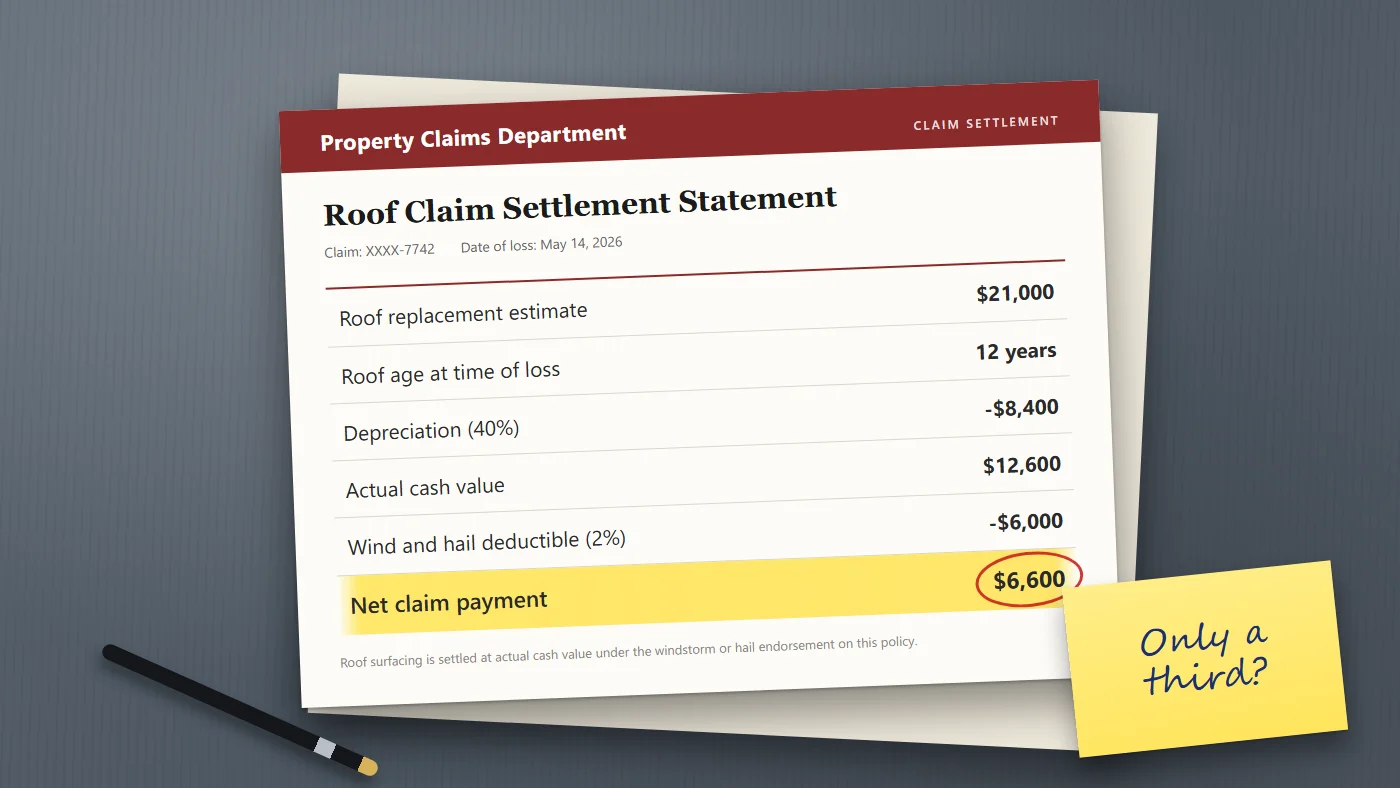
Say a hailstorm wrecks a 12-year-old shingle roof. The roofer's bid for a full replacement comes to $21,000. The insurance check that shows up is $6,600, a little under a third of the bill.
Nothing was denied. The claim was paid exactly as the policy says. The trouble is that the policy doesn't say what the owner thinks it says anymore. At some renewal in the last few years, the roof section quietly moved from "replacement cost" to "actual cash value," or ACV. Under ACV the insurer first knocks years of wear off the roof's price, then takes your deductible out of what's left.
You don't have to take anyone's word for how that math works. The Texas Department of Insurance publishes its own example: a house insured for $200,000 with a 2% deductible, which is $4,000, and a roof that costs $10,000 to replace. A replacement cost policy pays $6,000. An actual cash value policy pays $4,500 if the roof is 5 years old, $3,000 at 10 years, and nothing at all at 20.
$0 is what the actual cash value policy pays in the Texas Department of Insurance example on a 20-year-old roof that costs $10,000 to replace. The replacement cost policy pays $6,000 for the same damage.
Why roofs? Because that's where the claims are. Wind and hail are the most common cause of homeowners claims, according to the Insurance Information Institute: about one insured home in 35 has a wind or hail claim in a given year, based on 2019 to 2023 data. An insurer that can't raise rates fast enough has one other lever, and it's paying less per roof.
Washington gave the shift a push this year. On March 18, 2026, the Federal Housing Finance Agency announced that Fannie Mae and Freddie Mac will accept actual cash value coverage on roofs for single-family homes and condos, while the rest of the house still has to be insured at replacement cost. Fannie Mae's Selling Guide now reads that roofs "must be insured, but do not have to be insured on a replacement cost basis." The stated goal is lower premiums. In practice it means your mortgage no longer stands in the way of an ACV roof, so expect to see more of them.
Three ways a policy can pay for a roof
Every home policy uses one of three methods. The name is on the declarations page or in an attached endorsement.
Replacement cost (RCV). The insurer pays what it costs to put on a comparable new roof, minus your deductible. It usually pays in two checks: the depreciated value up front, then the rest once the work is done and you've sent the final invoice.
Actual cash value (ACV). The insurer pays the depreciated value, minus your deductible, and that's the end of it. The NAIC's own consumer example uses $15,000 in roof damage and a $1,000 deductible. The family with replacement cost coverage gets $14,000, and the family with ACV gets $4,000 after $10,000 of depreciation comes off the top.
Roof payment schedule. Think of it as ACV with the math printed in advance. A table in the policy lists the percentage the insurer will pay at each roof age, often with separate columns for shingles, metal and tile. Say your 15-year-old roof sits on a row that pays 60%. You get 60% of the damage. Then the deductible comes off that.
| Roof age | Replacement cost policy pays | Actual cash value policy pays |
|---|
| 5 years | $6,000 | $4,500 |
| 10 years | $6,000 | $3,000 |
| 20 years | $6,000 | $0 |
Texas Department of Insurance example: $10,000 roof, $4,000 deductible (2% of a $200,000 dwelling limit). Depreciation rates differ by insurer.
How did this get into my policy?
The change usually arrives as an endorsement at renewal, with a title along the lines of "Roof Surfacing Payment Schedule," "Actual Cash Value Loss Settlement for Windstorm or Hail" or "Limited Roof Surfacing Coverage." Some companies apply it to every policy in a storm-prone state, while others switch it on once the roof hits a set age, commonly somewhere between 10 and 15 years for asphalt shingles and sometimes 20, depending on the company, the material and the state.
Two details are easy to miss. Many of these endorsements apply only to wind and hail, so a fire on the same roof may still be settled at replacement cost. And some add a "cosmetic damage" exclusion, which drops coverage for dents and marks that change how a metal roof looks but not whether it keeps water out.
How clearly an insurer has to tell you about a cut in coverage depends on your state. Some require a separate, conspicuous notice. Others don't.
Why the deductible makes it worse
Storm deductibles have grown at the same time. Many policies now carry a separate wind and hail deductible set as a percentage of the dwelling limit, typically 1% to 5%, the Insurance Information Institute says. The percentage applies to the insured value of the house. Not to the size of the damage.
Back to the $21,000 bid. Say the insurer depreciates a 12-year-old roof by 40%, which leaves an actual cash value of $12,600. The policy has a 2% wind and hail deductible on a $300,000 dwelling limit, so $6,000 comes off. The check is $6,600, and the owner is on the hook for $14,400.
With replacement cost coverage and the same deductible, the insurer would have paid $15,000. Those three letters cost this owner $8,400 on one storm. You can find out which version you've got tonight, without calling anybody.