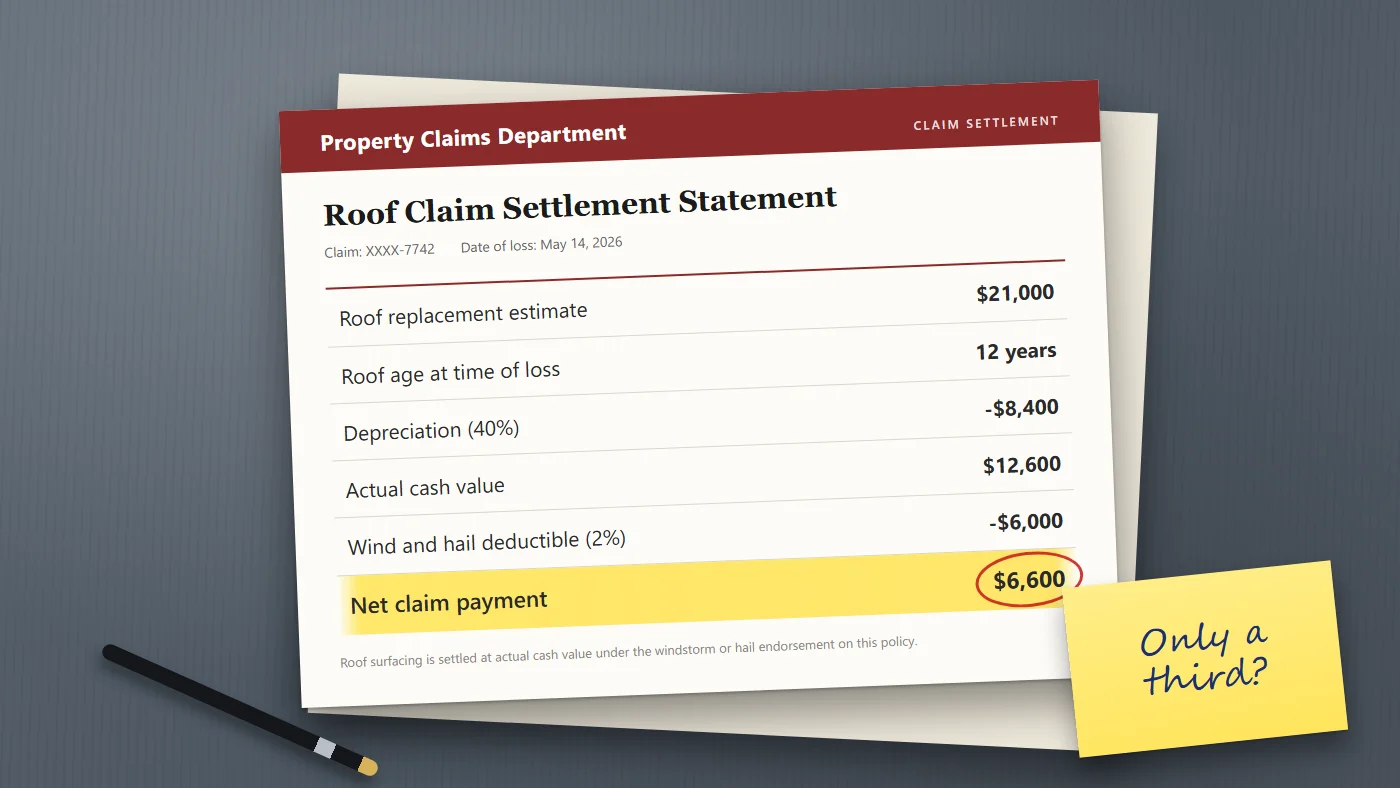
Say a hailstorm wrecks a 12-year-old shingle roof. The roofer's bid for a full replacement comes to $21,000. The insurance check that shows up is $6,600, a little under a third of the bill.
Nothing was denied. The claim was paid exactly as the policy says. The trouble is that the policy doesn't say what the owner thinks it says anymore. At some renewal in the last few years, the roof section quietly moved from "replacement cost" to "actual cash value," or ACV. Under ACV the insurer first knocks years of wear off the roof's price, then takes your deductible out of what's left.
You don't have to take anyone's word for how that math works. The Texas Department of Insurance publishes its own example: a house insured for $200,000 with a 2% deductible, which is $4,000, and a roof that costs $10,000 to replace. A replacement cost policy pays $6,000. An actual cash value policy pays $4,500 if the roof is 5 years old, $3,000 at 10 years, and nothing at all at 20.
$0 is what the actual cash value policy pays in the Texas Department of Insurance example on a 20-year-old roof that costs $10,000 to replace. The replacement cost policy pays $6,000 for the same damage.
Why roofs? Because that's where the claims are. Wind and hail are the most common cause of homeowners claims, according to the Insurance Information Institute: about one insured home in 35 has a wind or hail claim in a given year, based on 2019 to 2023 data. An insurer that can't raise rates fast enough has one other lever, and it's paying less per roof.
Washington gave the shift a push this year. On March 18, 2026, the Federal Housing Finance Agency announced that Fannie Mae and Freddie Mac will accept actual cash value coverage on roofs for single-family homes and condos, while the rest of the house still has to be insured at replacement cost. Fannie Mae's Selling Guide now reads that roofs "must be insured, but do not have to be insured on a replacement cost basis." The stated goal is lower premiums. In practice it means your mortgage no longer stands in the way of an ACV roof, so expect to see more of them.
Three ways a policy can pay for a roof
Every home policy uses one of three methods. The name is on the declarations page or in an attached endorsement.
Replacement cost (RCV). The insurer pays what it costs to put on a comparable new roof, minus your deductible. It usually pays in two checks: the depreciated value up front, then the rest once the work is done and you've sent the final invoice.
Actual cash value (ACV). The insurer pays the depreciated value, minus your deductible, and that's the end of it. The NAIC's own consumer example uses $15,000 in roof damage and a $1,000 deductible. The family with replacement cost coverage gets $14,000, and the family with ACV gets $4,000 after $10,000 of depreciation comes off the top.
Roof payment schedule. Think of it as ACV with the math printed in advance. A table in the policy lists the percentage the insurer will pay at each roof age, often with separate columns for shingles, metal and tile. Say your 15-year-old roof sits on a row that pays 60%. You get 60% of the damage. Then the deductible comes off that.
| Roof age | Replacement cost policy pays | Actual cash value policy pays |
|---|
| 5 years | $6,000 | $4,500 |
| 10 years | $6,000 | $3,000 |
| 20 years | $6,000 | $0 |
Texas Department of Insurance example: $10,000 roof, $4,000 deductible (2% of a $200,000 dwelling limit). Depreciation rates differ by insurer.
How did this get into my policy?
The change usually arrives as an endorsement at renewal, with a title along the lines of "Roof Surfacing Payment Schedule," "Actual Cash Value Loss Settlement for Windstorm or Hail" or "Limited Roof Surfacing Coverage." Some companies apply it to every policy in a storm-prone state, while others switch it on once the roof hits a set age, commonly somewhere between 10 and 15 years for asphalt shingles and sometimes 20, depending on the company, the material and the state.
Two details are easy to miss. Many of these endorsements apply only to wind and hail, so a fire on the same roof may still be settled at replacement cost. And some add a "cosmetic damage" exclusion, which drops coverage for dents and marks that change how a metal roof looks but not whether it keeps water out.
How clearly an insurer has to tell you about a cut in coverage depends on your state. Some require a separate, conspicuous notice. Others don't.
Why the deductible makes it worse
Storm deductibles have grown at the same time. Many policies now carry a separate wind and hail deductible set as a percentage of the dwelling limit, typically 1% to 5%, the Insurance Information Institute says. The percentage applies to the insured value of the house. Not to the size of the damage.
Back to the $21,000 bid. Say the insurer depreciates a 12-year-old roof by 40%, which leaves an actual cash value of $12,600. The policy has a 2% wind and hail deductible on a $300,000 dwelling limit, so $6,000 comes off. The check is $6,600, and the owner is on the hook for $14,400.
With replacement cost coverage and the same deductible, the insurer would have paid $15,000. Those three letters cost this owner $8,400 on one storm. You can find out which version you've got tonight, without calling anybody.
Check your own policy in 15 minutes
You need the full policy packet from your last renewal, not just the bill. If you can't find it, your agent or the insurer's website can send a complete copy.
- Find the declarations page and the list of forms. Near the bottom there's a list of endorsement names and form numbers. Every one of them changes the base policy.
- Look for roof language. Scan the list for "roof," "surfacing," "windstorm or hail," "actual cash value" or "payment schedule." If one turns up, read that endorsement all the way through. It's usually a page or two.
- Find the wind and hail deductible. It may be shown as a percentage. Multiply it by your Coverage A limit and write the dollar figure down.
- Write down the roof's age and gather proof. A permit, a paid invoice or a home inspection report all work. Insurers sometimes go by the age of the house when they have no record of a newer roof, which can put you on the wrong row of the schedule.
- Ask your agent three questions in writing. How is my roof settled for wind and hail, replacement cost or actual cash value? At what roof age does that change? What would it cost to buy replacement cost coverage for the roof back?
- Run your own number. Take a realistic replacement price for your roof, apply your policy's schedule, and subtract the deductible. No schedule? As a rough stand-in, the Texas example works out to 3% of the roof's value per year, and our $21,000 example assumes a bit more than that. That's your exposure in a bad storm.
- Decide before storm season, not after. You can't change coverage for a loss that's already happened.
If your insurer won't sell replacement cost on the roof, another company may, often after a roof inspection. When you compare quotes, put the roof settlement method on the same line as the premium. A policy that's $300 cheaper and pays 40% of a roof isn't the cheaper policy. If I had one question to ask every company, it'd be that one.
If the storm has already happened
You can still move the outcome, mostly through paperwork.
Photograph the damage from the ground and keep receipts for any tarp or emergency repair. Policies require you to prevent further damage, and those costs are usually part of the claim. Report it promptly, since policies and some state laws set time limits for storm losses and they differ.
Ask the adjuster for the itemized estimate, not only the total. Find the depreciation line and check two things: the roof age the insurer used, and whether the depreciation is marked recoverable. On a replacement cost policy it normally is, and you collect it after the roof is replaced by sending the final invoice and proof of payment. Policies put a deadline on that step, and the window varies from one policy to the next, so find that paragraph before you book the roofer.
What if the scope is wrong? Say the adjuster priced a repair and two licensed roofers say the slope can't be repaired. Send the roofers' written findings and ask for a reinspection. If the reinspection doesn't settle it, your policy's appraisal clause is the next step. A complaint to your state insurance department costs nothing. Past that, a licensed public adjuster or an attorney can take it on.
Be wary of anyone who offers to "cover" or "waive" your deductible. In Texas it's illegal for a contractor to offer to waive, rebate or absorb it, according to the Texas Department of Insurance, and rules elsewhere vary. Read anything a door-to-door roofer asks you to sign after a storm, too. Some of those papers hand your insurance rights to the contractor.
What a new roof costs, and what moves the price
Whether you're budgeting for a gap after a claim or thinking about replacing an aging roof, you need a real local number. National averages only get you partway, but they're somewhere to start.
HomeAdvisor's 2026 data, updated in June, puts the average roof replacement at about $9,609 nationally. Your roof may not look much like the average, though. Most projects land somewhere between $5,902 and $13,376.
The material you pick shows up right away in the price. Asphalt shingles run roughly $3 to $7 a square foot installed, by HomeAdvisor's figures. Metal costs more, roughly $7 to $13 a square foot.
Then there's the permit. Depending on where you live, it can be as little as $100 or as much as $1,400. Big, steep or complicated roofs run well above all of these numbers, and so do prices right after a regional storm, when every crew in the county is booked for weeks.
Your insurer cares about the material, too, and not always the way you'd expect. Metal lasts longer, yet it's a frequent target of the cosmetic damage exclusions mentioned earlier. Impact-resistant shingles rated Class 4 cost more than standard ones, and some insurers take something off the premium for them. The NAIC also points homeowners to FORTIFIED, a roof standard from the Insurance Institute for Business and Home Safety.
Collect at least three written bids from licensed, insured local contractors. A bid that's only a total doesn't tell you much. Each one should spell out the material and its rating, tear-off and disposal, underlayment, flashing, ventilation, the permit and the warranty. It's also fair to ask whether a roofer has handled insurance claims before and will meet the adjuster on site. When it's time to pay, use a traceable method, and don't hand over the full amount up front.
Replace early, or wait?
It's a money question with an insurance twist. If your roof is two or three years from your insurer's age cutoff, a phone call now is worth the time.
On that call, ask what a new roof would do to your premium and to the settlement method. Companies don't all answer the same way. With many, a new roof moves you back to the top row of the schedule, or back to replacement cost, and it can earn a new-roof discount on top. With others it changes nothing. Whatever you hear, get it in writing before you sign a roofing contract.
Plenty of life left in the roof? Then buying back replacement cost coverage may be the cheaper move. The other option is setting aside cash equal to the exposure you figured in step 6, and writing that number on the inside cover of your policy folder, next to the roofer's phone number.
This article is general information, not financial, legal, tax or medical advice.