Home & Mortgage
Selling an Inherited or Outdated House: As-Is Offers, Cash Buyers and the Tax Rules
What a cash offer really pays next to a regular sale, and the one tax number heirs need to document before anything else.
 Ray Castellano
Updated Sep 22, 2026 · 11 min read
The postcards start a few weeks after the funeral. "We buy houses for cash. Any condition. Close in 7 days." If the house is dated, still full of furniture and three states away from where you live, that can sound like relief.
Sometimes it is. It also has a price, and the price is almost never printed on the postcard. Investors who buy for cash commonly work from a formula that lands somewhere around 50% to 70% of what the house would bring on the open market. HomeLight's March 2026 look at house-buying companies found that some flippers pay as little as 50% of a home's after-repair value, while the big online "iBuyers" pay up to 95% but charge service fees on top.
On a house worth $300,000 fixed up, the gap between a quick cash offer and a regular sale can easily top $50,000. For some families that's a fair trade for speed and zero repairs. For plenty of others, it's money they didn't know they were leaving on the table.
A second number matters just as much, and this one works in your favor. Under federal tax law, your cost basis in an inherited house is generally its fair market value on the date of death, not what your parents paid for it in 1985. If you can document that value, most of the gain that built up over their lifetime never gets taxed. If you can't, you may end up arguing about it with the IRS years later.
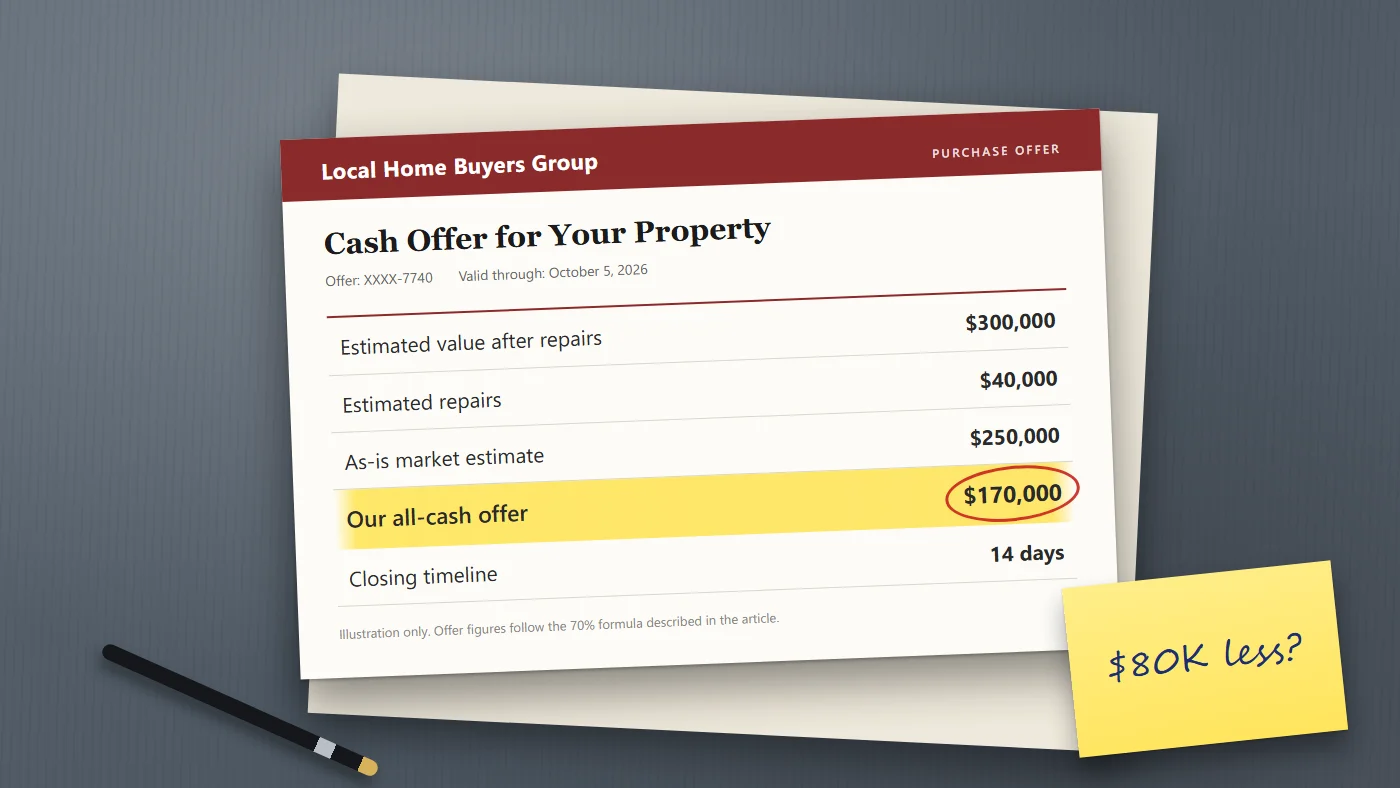
70%: the starting point many cash investors use. They take 70% of the fixed-up value, then subtract repairs. On a house worth $300,000 after $40,000 of work, that formula produces an offer near $170,000.
How a cash offer gets built
Most local "we buy houses" outfits are either investors who plan to renovate and resell, or wholesalers who plan to hand your contract to an investor for a fee. Either way, the math starts at the end. They estimate what the house will sell for after repairs, a figure called the after-repair value, or ARV.
The rule of thumb in that business is the 70% rule. Take 70% of ARV, subtract the expected repair bill, and that's the offer. The 30% that comes off the top covers the investor's buying and selling costs, loan interest, risk and profit.
It isn't universal. HomeLight puts the range at roughly 50% of ARV from some flippers up to 95% from iBuyers, which buy newer homes in better shape, in fewer markets, and then take a service charge. Bankrate reports that the two biggest iBuyers charge about 5% of the sale price, plus closing and repair costs.
What does that look like on one house? The table below uses round numbers and is only an illustration, not a forecast for your sale. Assume the house would sell for $300,000 fixed up, needs $40,000 of work, and would bring $250,000 on the open market as it stands.
| Cash investor | List as-is with an agent | Repair, then list |
|---|
| Sale price | $170,000 | $250,000 | $300,000 |
| Repairs you pay | $0 | $0 | $40,000 |
| Agent commissions (5.46%) | $0 | $13,650 | $16,380 |
| Seller closing costs (assumed 2%) | Often paid by buyer | $5,000 | $6,000 |
| Carrying costs at $1,500 a month | $1,500 (1 month) | $6,000 (4 months) | $10,500 (7 months) |
| Rough net to heirs | $168,500 | $225,350 | $227,120 |
The 5.46% commission is the national average for both agents combined in Clever Real Estate's August 2026 survey of 434 agents. It's negotiable, and it varies by market.
Two things jump out. In this example the cash sale nets about $57,000 less than the as-is listing. And doing the repairs yourself barely beats selling as-is, once you count seven months of property taxes, insurance and utilities on an empty house. Heirs who live far away often find the middle column is the one nobody pitched them.
None of this makes a cash sale wrong. It can be the better call when the house has defects serious enough that a mortgage lender won't finance it, when the estate needs money fast, or when nobody in the family can manage a four-month sale from another state, deal with the showings and keep the lawn mowed in the meantime. You just want to know what the speed costs before you agree to pay for it.
The same math holds if the dated house is your own and you're downsizing. The investor's formula doesn't care who owns the place. The tax side is different, though. An owner who lived in the home for two of the last five years can usually exclude up to $250,000 of gain, or $500,000 for a married couple filing jointly. Heirs lean on another rule entirely.
For heirs, the sale price is half the picture. Before you sign with anyone, you'll need to settle who can legally sell, what the house was worth on one specific day, and what the IRS will expect from you next April.