The postcards start a few weeks after the funeral. "We buy houses for cash. Any condition. Close in 7 days." If the house is dated, still full of furniture and three states away from where you live, that can sound like relief.
Sometimes it is. It also has a price, and the price is almost never printed on the postcard. Investors who buy for cash commonly work from a formula that lands somewhere around 50% to 70% of what the house would bring on the open market. HomeLight's March 2026 look at house-buying companies found that some flippers pay as little as 50% of a home's after-repair value, while the big online "iBuyers" pay up to 95% but charge service fees on top.
On a house worth $300,000 fixed up, the gap between a quick cash offer and a regular sale can easily top $50,000. For some families that's a fair trade for speed and zero repairs. For plenty of others, it's money they didn't know they were leaving on the table.
A second number matters just as much, and this one works in your favor. Under federal tax law, your cost basis in an inherited house is generally its fair market value on the date of death, not what your parents paid for it in 1985. If you can document that value, most of the gain that built up over their lifetime never gets taxed. If you can't, you may end up arguing about it with the IRS years later.
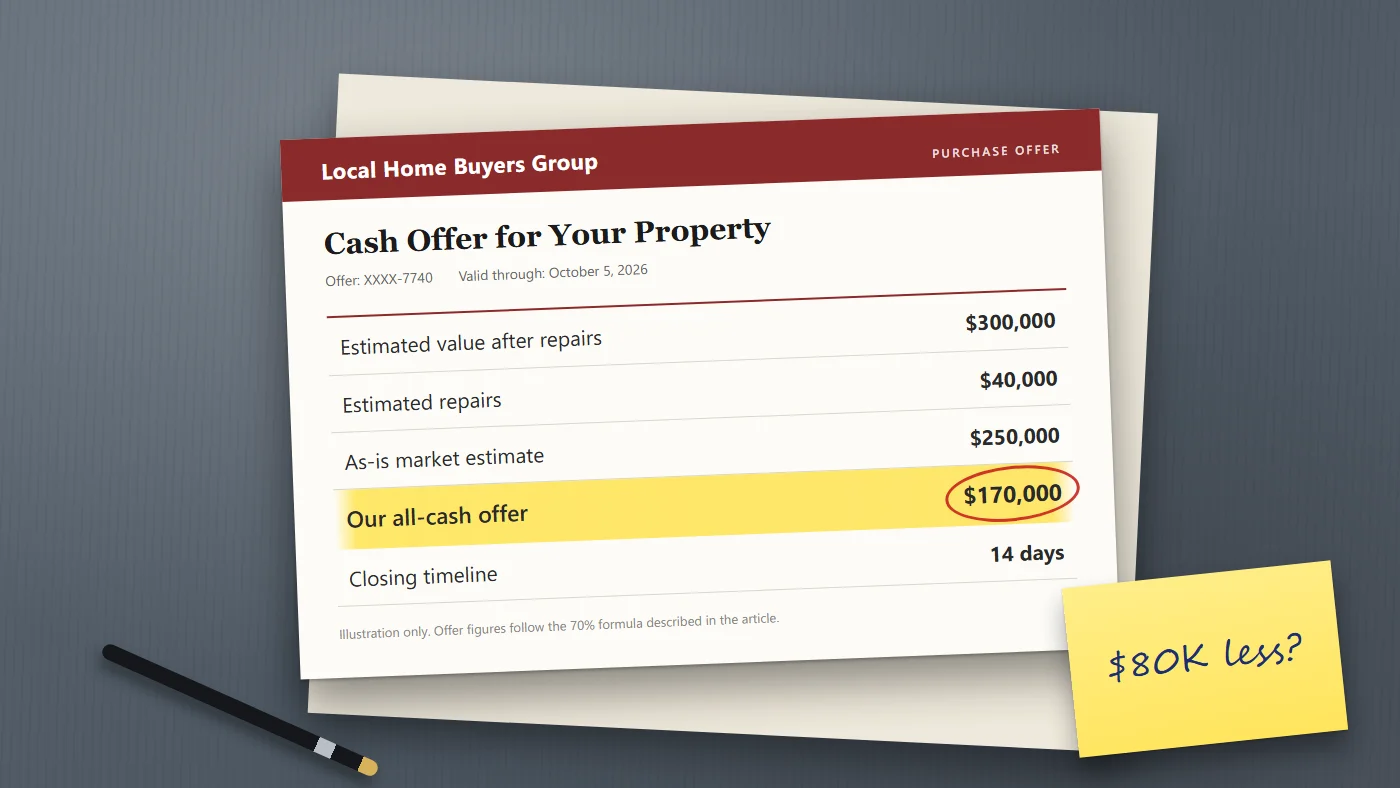
70%: the starting point many cash investors use. They take 70% of the fixed-up value, then subtract repairs. On a house worth $300,000 after $40,000 of work, that formula produces an offer near $170,000.
How a cash offer gets built
Most local "we buy houses" outfits are either investors who plan to renovate and resell, or wholesalers who plan to hand your contract to an investor for a fee. Either way, the math starts at the end. They estimate what the house will sell for after repairs, a figure called the after-repair value, or ARV.
The rule of thumb in that business is the 70% rule. Take 70% of ARV, subtract the expected repair bill, and that's the offer. The 30% that comes off the top covers the investor's buying and selling costs, loan interest, risk and profit.
It isn't universal. HomeLight puts the range at roughly 50% of ARV from some flippers up to 95% from iBuyers, which buy newer homes in better shape, in fewer markets, and then take a service charge. Bankrate reports that the two biggest iBuyers charge about 5% of the sale price, plus closing and repair costs.
What does that look like on one house? The table below uses round numbers and is only an illustration, not a forecast for your sale. Assume the house would sell for $300,000 fixed up, needs $40,000 of work, and would bring $250,000 on the open market as it stands.
| Cash investor | List as-is with an agent | Repair, then list |
|---|
| Sale price | $170,000 | $250,000 | $300,000 |
| Repairs you pay | $0 | $0 | $40,000 |
| Agent commissions (5.46%) | $0 | $13,650 | $16,380 |
| Seller closing costs (assumed 2%) | Often paid by buyer | $5,000 | $6,000 |
| Carrying costs at $1,500 a month | $1,500 (1 month) | $6,000 (4 months) | $10,500 (7 months) |
| Rough net to heirs | $168,500 | $225,350 | $227,120 |
The 5.46% commission is the national average for both agents combined in Clever Real Estate's August 2026 survey of 434 agents. It's negotiable, and it varies by market.
Two things jump out. In this example the cash sale nets about $57,000 less than the as-is listing. And doing the repairs yourself barely beats selling as-is, once you count seven months of property taxes, insurance and utilities on an empty house. Heirs who live far away often find the middle column is the one nobody pitched them.
None of this makes a cash sale wrong. It can be the better call when the house has defects serious enough that a mortgage lender won't finance it, when the estate needs money fast, or when nobody in the family can manage a four-month sale from another state, deal with the showings and keep the lawn mowed in the meantime. You just want to know what the speed costs before you agree to pay for it.
The same math holds if the dated house is your own and you're downsizing. The investor's formula doesn't care who owns the place. The tax side is different, though. An owner who lived in the home for two of the last five years can usually exclude up to $250,000 of gain, or $500,000 for a married couple filing jointly. Heirs lean on another rule entirely.
For heirs, the sale price is half the picture. Before you sign with anyone, you'll need to settle who can legally sell, what the house was worth on one specific day, and what the IRS will expect from you next April.
The tax rule that does most of the work
Say your parents bought the house for $90,000, and it was worth $340,000 when the last of them died. Eight months later you and your sister sell it for $350,000 and pay $25,000 in commissions and closing costs.
How much gain do you report? None. Your gain is figured from $340,000, not $90,000, and after selling costs there's nothing left over. The IRS says the basis of property you inherit is generally its fair market value on the date of death. Tax pros call that a stepped-up basis.
Without the step-up, you'd face a gain of about $235,000. At a 15% federal long-term rate, that's roughly $35,000 in tax the rule takes off the table.
A few details trip people up.
It doesn't matter how long you held it. The Form 8949 instructions say to report a sale of inherited property as long-term no matter the holding period, and to write "INHERITED" in the date-acquired column. Long-term gains are taxed at 0%, 15% or 20%, depending on income.
Gifts are a different animal. If a parent signs the house over to you while they're alive, you generally take over their old basis, which is how families who "put the kids on the deed" to skip probate can create a big tax bill by accident. Talk to an estate attorney first.
And the home-sale exclusion people mention? It usually doesn't apply. The $250,000 exclusion ($500,000 for married couples) is for a home you owned and lived in for two of the last five years, and an heir who never moved in doesn't qualify.
Losses are murkier. The IRS doesn't allow a loss on personal-use property. If no heir used the house personally and it went to an unrelated buyer, tax preparers generally treat a loss as a capital loss, but ask a tax professional before you count on it.
Federal estate tax is rare. For deaths in 2026 the federal basic exclusion is $15,000,000 per person. Some states have their own estate or inheritance taxes with far lower thresholds, so check yours.
None of this helps unless you can prove the date-of-death value. Get a written appraisal from a licensed appraiser that states the value as of that date; appraisers do these retrospective jobs all the time. An agent's price opinion beats nothing. The appraisal is what holds up if anyone asks.
Before you can sell: authority, liens and the empty house
Start with who's allowed to sign. A will doesn't, on its own, give you the power to sell. In most cases a probate court has to appoint an executor or administrator, and the title company will want that paperwork before closing.
Some houses skip probate: one held in a living trust, one with a surviving joint owner, or one covered by a transfer-on-death deed, which more than 30 states and D.C. now allow. Rules and timelines vary by state. A short consultation with a probate attorney where the house sits is usually money well spent.
Next, find out what's owed against it. An early preliminary title search from a title company will show mortgages, home equity lines, tax liens and judgments.
Medicaid can be a creditor too. If your parent got Medicaid long-term care benefits after age 55, federal law requires the state to seek repayment from the estate for nursing facility and related costs. States can't recover while there's a surviving spouse, a child under 21, or a child who's blind or disabled, and every state has to offer a hardship process, with the details set state by state.
Then call the insurer and tell them the owner has died and the house is empty. Many homeowners policies cut back coverage once a house sits vacant for 30 or 60 days. The Texas Department of Insurance lists a home vacant for 60 days or more as a reason a company may refuse to renew. You may need a vacant-home policy until closing. Keep the heat on, have someone check the water and get the lawn cut.
Is the cash offer in front of you a fair one?
Checking takes about ten minutes. You need two numbers: a realistic fixed-up value and a realistic as-is value.
The fixed-up value comes from recent sales of updated houses of similar size within half a mile. For the as-is value, an online home value estimate is a rough start. After that, ask two local agents for a written as-is price opinion. They'll do it free because they're hoping to win the listing, and you're under no obligation to list with them.
Run the investor's formula yourself. Multiply the fixed-up value by 0.70 and subtract a rough repair figure. If the offer in your hand lands close to your number, it's a standard investor offer. Then take the as-is value minus 7% to 8% for commissions and closing costs. The difference is what speed and convenience would cost you.
Still want to sell for cash? Fine. Treat it like any other sale and get more than one offer, because cash buyers vary widely, from about 50% to 95% of value depending on the kind of buyer. Compare several companies that buy houses, including an iBuyer if one operates in your area and the house is in fair shape.
Then read the contract for these:
- Proof of funds and a real deposit. A buyer paying cash can show a bank statement and put down earnest money that you keep if they walk away without cause.
- "Buyer and/or assigns." That wording means the company can sell your contract to someone else. It's legal in most states, but it's a sign the buyer may not have the cash.
- A long inspection period. A 30-day "due diligence" window lets a buyer tie up the house and then push the price down at the last minute.
- Who handles closing. It should run through a licensed title company or attorney you're free to choose or verify.
Bankrate's vetting advice: check the company's Better Business Bureau profile, read reviews, and read the contract before you sign. With an inherited house, I'd have the probate attorney read it too.
The order that works for most families
- Order several certified copies of the death certificate, and find the will, the deed and the latest mortgage and tax statements.
- Secure the house: change the locks, forward the mail, call the insurer, keep the utilities on.
- Talk to a probate attorney in that state about who can sign and how long it'll take.
- Order a date-of-death appraisal. It's your tax basis.
- Before anything gets listed, the heirs should agree in writing on whether to sell, the lowest acceptable price, and who covers carrying costs until closing.
- Collect prices three ways: at least two as-is agent opinions, at least two cash offers, and one contractor's repair estimate.
- Compare the net, not the price, using the table above with your own numbers.
- Keep the settlement statement from closing. The closing agent files Form 1099-S. If the estate sold the house, the executor reports it on the estate's Form 1041; if title had already passed to the heirs, each heir reports a share on Form 8949 and Schedule D.
Mistakes that cost heirs the most
Signing the postcard offer because the house feels like a burden comes first. A week of price-checking is cheap next to a five-figure gap.
Then skipping the appraisal. Without one, your basis is a guess, and if the IRS later decides you overstated it, you'd owe the extra tax plus interest, and in some cases an accuracy-related penalty.
A full renovation is the third. Buyers pay for clean, safe and working. They rarely pay you back dollar for dollar for a new kitchen picked out in a hurry.
Last, state rules. Probate, transfer-on-death deeds, Medicaid recovery and inheritance taxes are all set by states, and what a neighbor did in Florida may not work in Pennsylvania.
Before anyone makes an offer, get three numbers on paper: the date-of-death value, the as-is value and the net from each route.
This article is general information, not financial, legal, tax or medical advice.