Debt & Credit
When Do New Car Prices Actually Drop? A Month-by-Month Look at Dealer Discounts
There's no secret month. There's a model-year changeover, a narrow band of incentives, and a lot of leftover 2026s that dealers would rather not carry into next year.
 Ray Castellano
Updated Sep 22, 2026 · 11 min read
The average new vehicle sold in the United States in August 2026 went for $50,089, according to Kelley Blue Book's monthly transaction-price report. That's 1.9% more than a year earlier and about $500 below the record of $50,612 that Cox Automotive now lists for last December. For a household on a fixed income, a purchase that size gets planned for months, and every plan runs into the same question. When are the discounts real?
A year of data gives a plain answer: discounts never disappear, and they never get dramatic either. Cox Automotive, which owns Kelley Blue Book, tracks how much of the transaction price is covered by manufacturer incentives, meaning rebates, subsidized financing and lease support. Over the past twelve months that share, as first reported each month, has moved between 6.4% and 7.5%. On a $50,000 vehicle, that's a range from about $3,200 to about $3,750.
So for the average buyer, the gap between the best and worst month was a few hundred dollars. Not a few thousand. The bigger swings happen on particular vehicles at particular dealers, and those depend mostly on how long a specific car has been sitting unsold and whether a newer version of it has shown up. The calendar matters less than the model year.
Below you'll find the last twelve months of incentive data, what the model-year changeover does to prices, and how to spot the vehicles dealers actually want to move this fall. You won't find a price for any specific vehicle. The data can't support one.
What the last twelve months looked like
Cox publishes its transaction-price report about ten days after each month ends, and when you line the months up, a pattern does show, though it's a much softer one than the "year-end blowout" ads would have you believe.
| Month | Average transaction price (as first reported) | Incentives as share of price (as first reported) |
|---|
| September 2025 | $50,080 | 7.4% |
| October 2025 | $49,766 | 6.5% |
| November 2025 | $49,814 | 6.7% |
| December 2025 | $50,326 | 7.5% |
| January 2026 | $49,191 | 6.5% |
| February 2026 | $49,353 | 6.9% |
| June 2026 | $49,758 | 7.0% |
| July 2026 | $49,855 | 6.4% |
| August 2026 | $50,089 | 6.5% |
Cox revises its numbers as more sales data comes in, so a later report can show a slightly different figure for the same month. The broad pattern holds either way.
December had the highest incentive share and the highest price at the same time. Sounds like a contradiction until you look at who buys in December. Cox reported that nearly 20% of December buyers chose luxury vehicles, the peak for the year, and its executive analyst Erin Keating said prices are typically elevated in December because of that high-end mix. Rich incentives and expensive cars arrived together, so the December discount was real but spread across a lot of $70,000 vehicles.
January fell back. Prices dropped more than $1,100 from December, a typical seasonal pattern according to Cox, and incentives fell as automakers cut them to help protect margins. The quiet month after the holidays isn't automatically a cheap one.
Summer 2026 was tighter than summer 2025. July incentives were 6.4% of the price, against 7.3% a year earlier; August was 6.5% against 7.2%. Automakers spent less to move cars this summer because they didn't have to. Inventory was falling for a third straight month, and the sales pace in August rose 3.3% from July.
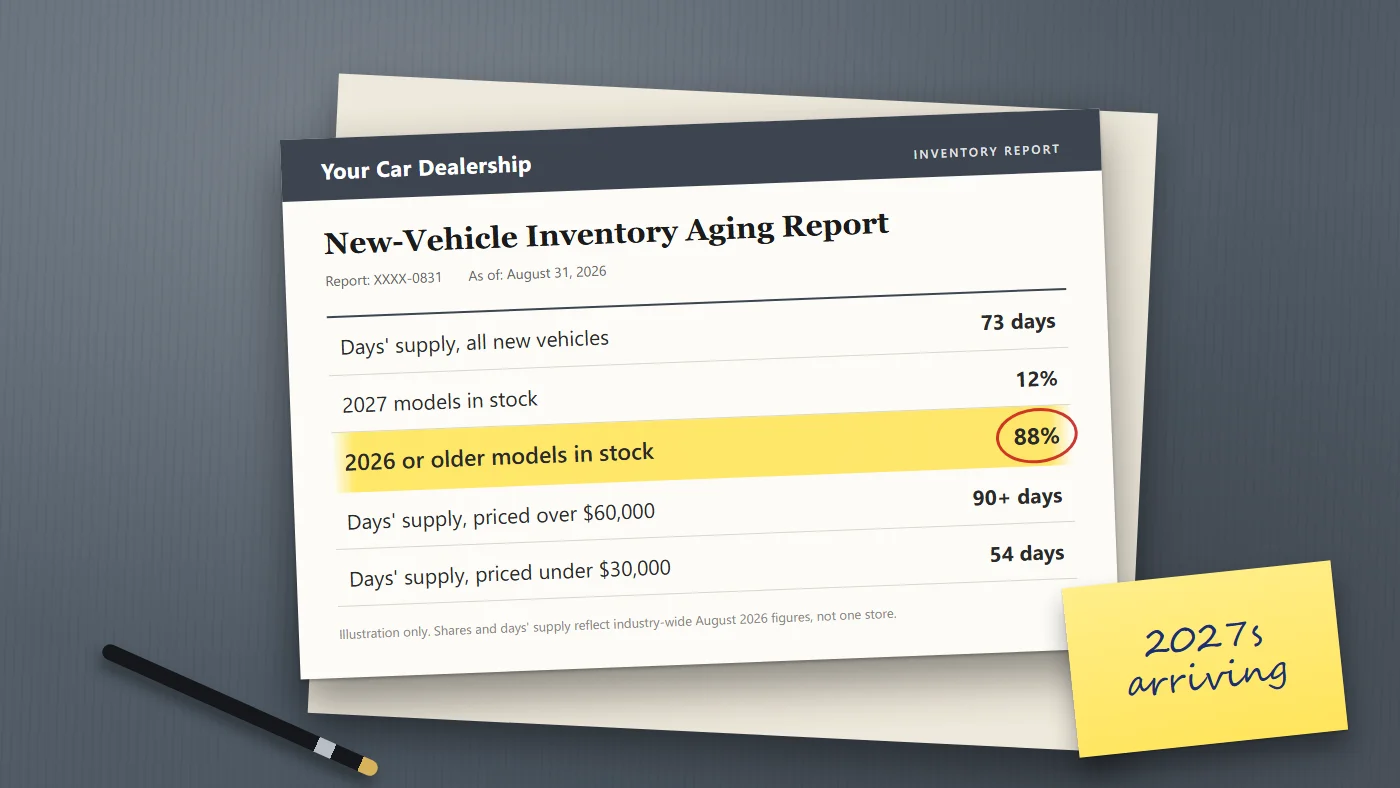
In August 2026, dealers had 73 days' supply of new vehicles, the lowest since April 2025. Vehicles priced above $60,000 sat at more than 90 days' supply. Vehicles at $30,000 or less were at 54 days.
That last line is the most useful number here. Supply is the pressure behind every discount. A $65,000 SUV that's been on the lot for three months is a candidate for a real deal; a $28,000 compact that'll sell in seven or eight weeks with no help isn't.
Why is the changeover running late this year?
Every fall the new model year arrives, and last year's version becomes the leftover. It's often mechanically identical. It's also worth a little less the day the new one shows up, and both the dealer and the automaker financing the inventory know it.
In 2026 the changeover is behind last year's pace. At the end of August, 2027 models made up 12.4% of new-vehicle inventory, up from 5.6% in July. At the same point in 2025, the new model year was already 23% of inventory. Nearly nine in ten vehicles on dealer lots at the end of August were still 2026s, or older.
Read cautiously, that means the pressure to clear 2026 models hasn't fully arrived yet, and the widest gaps between a 2026 and its 2027 twin are most likely still ahead of us, somewhere between October and the end of December, the last stretch of the calendar year. It may also mean a clearance that's spread thinner and later.
Spring offered a preview. In April 2026, the supply of remaining 2025 models fell 36% in a single month, and by month-end about 93% of inventory was 2026 product. Cox said automakers used targeted incentives to move specific inventory, particularly older model-year vehicles, while protecting pricing on newer units. Targeted. The money went to the vehicles that were piling up, not across the board.
Expect the same this fall. The 2026 models that get real support will be the ones a brand has too many of, and you can find those without inside information.