The average new vehicle sold in the United States in August 2026 went for $50,089, according to Kelley Blue Book's monthly transaction-price report. That's 1.9% more than a year earlier and about $500 below the record of $50,612 that Cox Automotive now lists for last December. For a household on a fixed income, a purchase that size gets planned for months, and every plan runs into the same question. When are the discounts real?
A year of data gives a plain answer: discounts never disappear, and they never get dramatic either. Cox Automotive, which owns Kelley Blue Book, tracks how much of the transaction price is covered by manufacturer incentives, meaning rebates, subsidized financing and lease support. Over the past twelve months that share, as first reported each month, has moved between 6.4% and 7.5%. On a $50,000 vehicle, that's a range from about $3,200 to about $3,750.
So for the average buyer, the gap between the best and worst month was a few hundred dollars. Not a few thousand. The bigger swings happen on particular vehicles at particular dealers, and those depend mostly on how long a specific car has been sitting unsold and whether a newer version of it has shown up. The calendar matters less than the model year.
Below you'll find the last twelve months of incentive data, what the model-year changeover does to prices, and how to spot the vehicles dealers actually want to move this fall. You won't find a price for any specific vehicle. The data can't support one.
What the last twelve months looked like
Cox publishes its transaction-price report about ten days after each month ends, and when you line the months up, a pattern does show, though it's a much softer one than the "year-end blowout" ads would have you believe.
| Month | Average transaction price (as first reported) | Incentives as share of price (as first reported) |
|---|
| September 2025 | $50,080 | 7.4% |
| October 2025 | $49,766 | 6.5% |
| November 2025 | $49,814 | 6.7% |
| December 2025 | $50,326 | 7.5% |
| January 2026 | $49,191 | 6.5% |
| February 2026 | $49,353 | 6.9% |
| June 2026 | $49,758 | 7.0% |
| July 2026 | $49,855 | 6.4% |
| August 2026 | $50,089 | 6.5% |
Cox revises its numbers as more sales data comes in, so a later report can show a slightly different figure for the same month. The broad pattern holds either way.
December had the highest incentive share and the highest price at the same time. Sounds like a contradiction until you look at who buys in December. Cox reported that nearly 20% of December buyers chose luxury vehicles, the peak for the year, and its executive analyst Erin Keating said prices are typically elevated in December because of that high-end mix. Rich incentives and expensive cars arrived together, so the December discount was real but spread across a lot of $70,000 vehicles.
January fell back. Prices dropped more than $1,100 from December, a typical seasonal pattern according to Cox, and incentives fell as automakers cut them to help protect margins. The quiet month after the holidays isn't automatically a cheap one.
Summer 2026 was tighter than summer 2025. July incentives were 6.4% of the price, against 7.3% a year earlier; August was 6.5% against 7.2%. Automakers spent less to move cars this summer because they didn't have to. Inventory was falling for a third straight month, and the sales pace in August rose 3.3% from July.
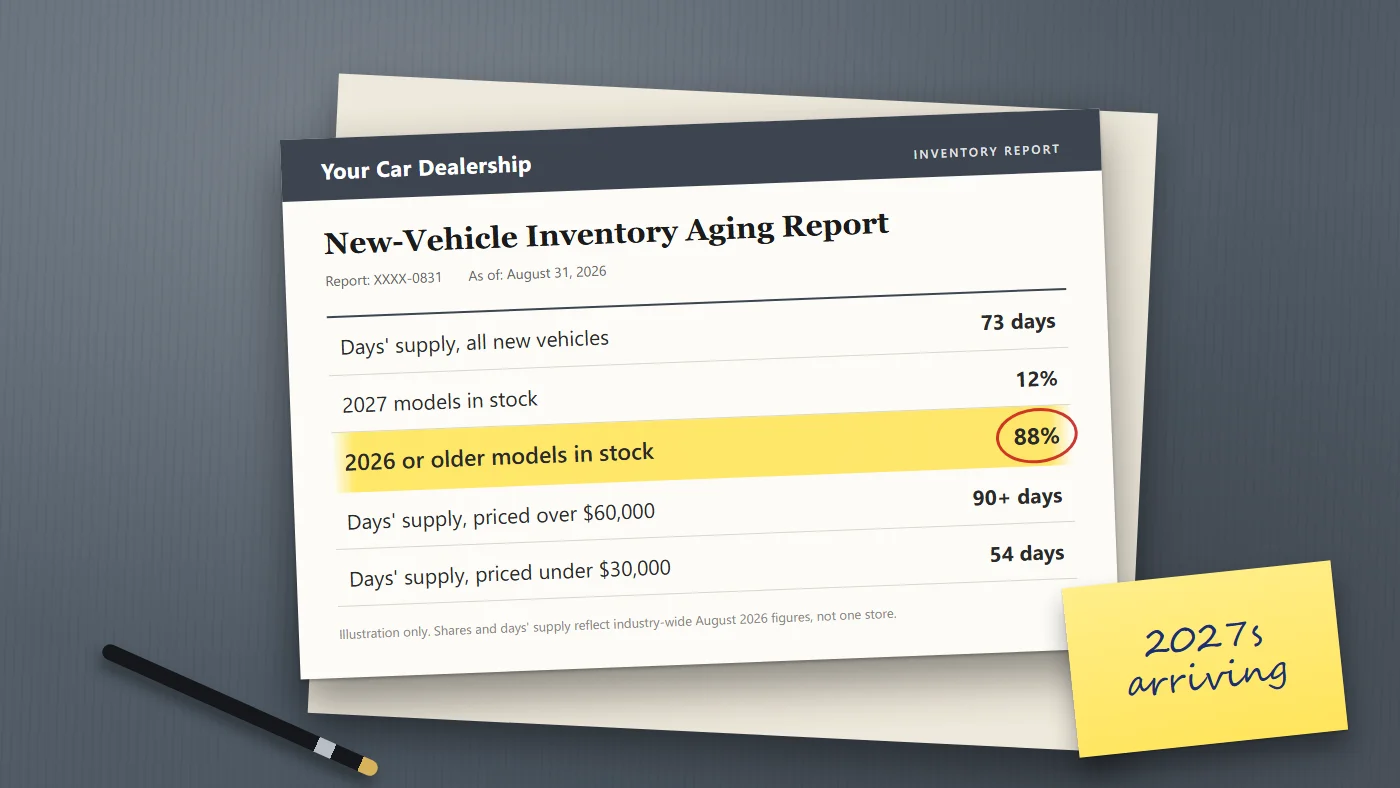
In August 2026, dealers had 73 days' supply of new vehicles, the lowest since April 2025. Vehicles priced above $60,000 sat at more than 90 days' supply. Vehicles at $30,000 or less were at 54 days.
That last line is the most useful number here. Supply is the pressure behind every discount. A $65,000 SUV that's been on the lot for three months is a candidate for a real deal; a $28,000 compact that'll sell in seven or eight weeks with no help isn't.
Why is the changeover running late this year?
Every fall the new model year arrives, and last year's version becomes the leftover. It's often mechanically identical. It's also worth a little less the day the new one shows up, and both the dealer and the automaker financing the inventory know it.
In 2026 the changeover is behind last year's pace. At the end of August, 2027 models made up 12.4% of new-vehicle inventory, up from 5.6% in July. At the same point in 2025, the new model year was already 23% of inventory. Nearly nine in ten vehicles on dealer lots at the end of August were still 2026s, or older.
Read cautiously, that means the pressure to clear 2026 models hasn't fully arrived yet, and the widest gaps between a 2026 and its 2027 twin are most likely still ahead of us, somewhere between October and the end of December, the last stretch of the calendar year. It may also mean a clearance that's spread thinner and later.
Spring offered a preview. In April 2026, the supply of remaining 2025 models fell 36% in a single month, and by month-end about 93% of inventory was 2026 product. Cox said automakers used targeted incentives to move specific inventory, particularly older model-year vehicles, while protecting pricing on newer units. Targeted. The money went to the vehicles that were piling up, not across the board.
Expect the same this fall. The 2026 models that get real support will be the ones a brand has too many of, and you can find those without inside information.
How to find the vehicles dealers want gone
- Sort the inventory by model year. Every dealer's website lists new vehicles with the model year, and most let you filter. Look for 2026 models where the 2027 version is already on the same lot. The two cars side by side are the dealer's own comparison, and the older one has to be priced to make sense.
- Check how long a listing has been up. Some listing sites show days on lot. If not, note the stock number and check back in a week. A car that was there three weeks ago and is still there is a car the dealer's thinking about.
- Look at the brands with the most stock. Cox's August report put Stellantis brands, Buick and Lincoln at the high end of days' supply, and Toyota, Lexus and Honda at the low end, with Toyota at 33 days. A brand with 30 days of supply doesn't need to discount. One with 90 or more does, and its dealers know it.
- Check the manufacturer's own offers page. Automakers list current rebates, financing rates and lease offers by ZIP code, usually with an end date. Many offers change around the start of a month and run through the last day of a month or quarter.
- Price the same vehicle at three dealers. Inventory differs, and so does pressure. A dealer with six leftover 2026s of one model will move on price sooner than a dealer with one.
- Ask for the out-the-door price in writing. Advertised discounts often sit next to fees added back at signing. A written total, including taxes, documentation fees and everything else, is the only figure you can compare.
A few things the calendar really does affect
Most "best day to buy" advice is folklore. Two calendar effects have a real mechanism behind them.
Month, quarter and year-end targets. Many dealerships and salespeople work toward monthly and quarterly sales goals set by the manufacturer, and some bonuses depend on hitting a number rather than on the profit from any one car. When a store is a few units short in the last days of a month, a thin deal beats no deal. So the last week of a month, and especially of a quarter, tends to be a better time to negotiate than the first. No guarantee, though. A dealer that's already hit its target has no reason to move.
Model-year and holiday promotions. Automakers tend to schedule advertised offers around the changeover and around fall holiday weekends. Are those offers better than the ones in a quiet week? Depends on the model. Treat the advertised price as where the negotiation starts.
The weather, the day of the week and the time of day matter less than a salesperson's target and a manager's inventory report. Show up when they need you, with a number in hand.
Rebates, cheap financing and the trade-off between them
Automakers often offer a choice: a cash rebate, or a reduced rate through their own finance arm. You usually can't have both. Which one's worth more? That depends on the loan.
Bankrate works through an example worth borrowing. Take a $41,500 vehicle financed over 60 months. At 0%, the payment is $692 and you pay no interest at all. Now run the same loan at 6.35%, which happens to match Experian's average new-car rate for the second quarter of 2026, and the payment climbs to $809. Over the five years, interest comes to $7,045. That's the figure a cash rebate would have to beat, and rebates that big are rare. On a shorter loan, or a smaller balance, the rebate wins more often.
Two cautions, though. Subsidized rates go to strong credit, and Bankrate says the best ones usually take a score of 781 or higher, even if competitive rates sometimes turn up above 670. The other caution is that true 0% is scarce. How scarce? Of the new-vehicle buyers who financed in the second quarter of 2026, only 1.2% got it, by Edmunds' count. You're far more likely to see a low rate on a 36- or 48-month term than zero on 60 or 72.
The Consumer Financial Protection Bureau's advice for the finance office fits every one of these deals. Get preapproved for a loan from a bank or credit union before you shop, so you know what rate you can get on your own. Then compare the automaker's rate against it, and the rebate against the interest you'd save. I'd negotiate the price first, the trade-in second and the financing last, as three separate numbers.
Where prices aren't falling
Is anything actually getting cheaper? Not new cars in general. The average transaction price in August 2026 was 1.9% higher than a year earlier, and the average sticker price rose 2.2% over the same stretch.
Monthly payments haven't eased either. Cox's affordability index put the typical one at $770 in August. The average loan rate on Cox's own measure was 9.49%, and Cox figures a household at the median income would need 35.5 weeks of pay to buy the average new car. That's more than half a year of work.
If you were hoping to spend under $30,000, you've probably noticed the problem already. Those cars were only 7.5% of sales in November 2025, a slide from 10.3% the year before, and this August the low price bands had some of the thinnest supply anywhere on the market. If your budget sits at the low end, then, waiting for a clearance won't help as much as widening the search to a nearly new used car, where the market sets prices instead of an automaker's incentive calendar.
Electric vehicles are the exception. In August, incentives on EVs ran 12% of the transaction price. That's down from 14.6% a year earlier, but it's still nearly double the industry average. The average EV price, meanwhile, fell 2.7% over the year. If an EV fits the way you drive, the leftover 2026s in that segment are where the biggest supported discounts have been.
Shopping the 2026 clearance
If you plan to buy before year-end, start by narrowing it to two or three models. Then check which of them are built in U.S. plants. It's a small step with a possible tax payoff, because interest on a loan for a new, U.S.-assembled vehicle bought for personal use may be deductible through 2028. With the list set, search for leftover 2026 versions within driving distance and compare what each dealer wants for the 2026 against the 2027 on the same lot.
Look at the automaker's current offers for each model while you're at it, lease deals included if you keep cars only a few years. Lease support can be where a manufacturer puts its biggest subsidy on a slow seller. Those numbers look harder to compare than they are, once you have the residual value and the money factor in writing.
Bring a preapproved loan; it's your floor. Ask each dealer for a written out-the-door price on a specific stock number, and make your best offer in the last week of the month. If nobody takes it, the 2027s will still be there in January, and the leftover 2026s will be three months older.
This article is general information, not financial, legal, tax or medical advice.