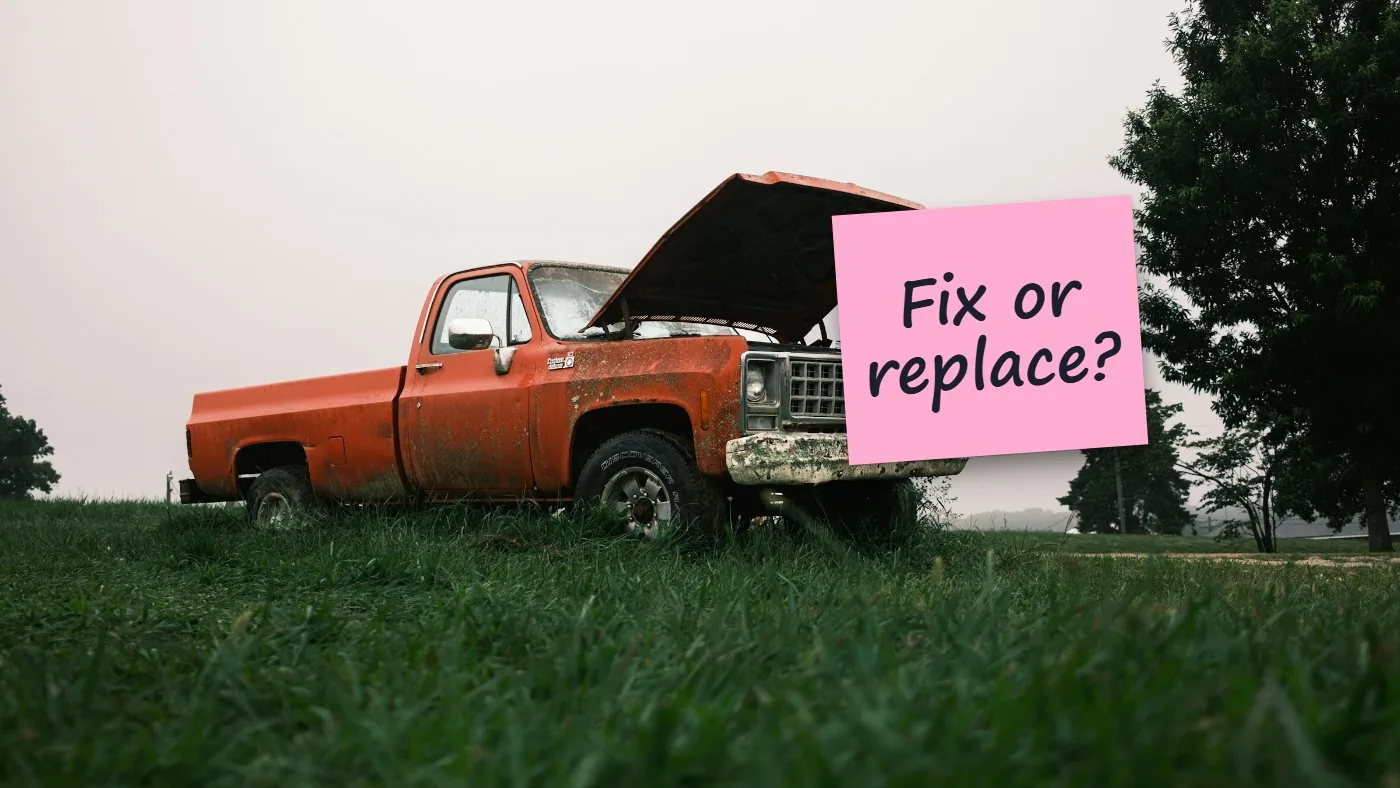
You know the call. The shop has found the problem, and the fix is a remanufactured transmission, meaning a used unit restored to working condition, at $3,200 with labor, on a 12-year-old sedan with 141,000 miles that might bring $5,500 on a good day. Is it time to stop pouring money into it?
There’s a rule of thumb for that moment, and you’ll hear it from mechanics, relatives and car-buying websites alike. If a repair costs more than half of what the car is worth, replace the car. This quote comes to 58% of the value. So you’d walk away.
That rule compares the repair with the wrong number, though. It weighs $3,200 against what a stranger would pay for your car, when the real alternative is what the next car would cost you every month. Used-car loan payments averaged $542 in the second quarter of 2026, according to Experian, which tracks auto lending nationwide. For financed new cars, Edmunds, a separate tracker, counted an average of $787 a month in the third quarter.
About 6 months. That’s how many average used-car loan payments add up to a $3,200 repair. Measured against the average new-car payment, it’s about four.
Put that way, the question gets smaller. If the fixed car keeps running for more than half a year, the repair has already beaten the payments, and that’s before sales tax, a bigger insurance bill and a newer car’s falling value enter the picture.
It doesn’t settle every case. Some old cars aren’t worth saving at any price, and the second half of this article covers how to spot one. But a big number on a repair estimate deserves arithmetic, not a gut reaction.
Why repair quotes keep climbing
You aren’t imagining it. In August 2026 the government’s price index for motor vehicle maintenance and repair stood 5.2% above its level a year earlier, by the Bureau of Labor Statistics’ measure. Overall consumer prices rose 3.4%.
More people are getting these calls because the cars on the road keep aging. S&P Global Mobility’s most recent count, from 2025, put the average American car or light truck at 12.8 years old, and passenger cars alone at 14.5.
None of that makes an old car a money pit. Most of what a car costs to own shows up early, as depreciation, the value it loses every year, and by year 12 most of that loss is behind you, with the value only drifting down slowly from there. An old car that runs, even with occasional repairs, is often the cheapest one you’ll ever have.
What a replacement costs, month by month
Price is only the start. AAA’s 2026 Your Driving Costs study figures a new car costs $12,863 a year to own and run, or about $1,072 a month. That covers depreciation, financing, insurance, fuel, maintenance, and taxes and registration, at 15,000 miles a year over five years.
Gas isn’t the biggest line in AAA’s math. Neither is insurance. It’s depreciation, at $4,422 a year, money that never leaves your checking account, so it’s easy to forget. An old car mostly stopped charging you that years ago.
Used cars cost less, but maybe not as much less as you’d hope. Cox Automotive, the company behind Kelley Blue Book, put the average used-car listing at $27,239 in August. That’s up 7% from a year earlier.
Cheap cars are the tightest part of the market. Cars listed under $15,000 made up 15.1% of used inventory in August, down from 20.6% a year before.
Borrowing adds its own cost. Used-car loans carried an average rate of 11.19% in the second quarter, Experian says, against 6.35% for new. And a lender will almost always require collision and comprehensive coverage (the parts of a policy that pay to fix your own car) on a car it finances, so if you’ve been carrying liability only on the old one, the insurance bill climbs right along with everything else.
So replacing a car isn’t one expense. It’s a new monthly bill, plus tax and fees on day one, plus a few hundred dollars a month in value the newer car quietly loses.
Where the 50% rule goes wrong, and where it’s right
Under the rule, the car’s market value works as a ceiling on sensible spending. But market value is only what a buyer would hand you. What it costs to replace the car is a different figure, nearly always a bigger one, because the next car comes with a markup, its own unknown history and, often, a loan.
It also skips what the car’s worth broken. Say the sedan brings $3,000 as it sits, with a bad transmission everyone can see, and $5,500 once it’s fixed. Then $2,500 of the $3,200 comes back as value the day the work is done. Even if you sold the car a month later, the repair would have cost you about $700.
Where the rule earns its keep is a car failing in several places at once. A $3,200 transmission on a car with a rusted frame and a leaking head gasket isn’t one repair. It’s the first of three.
So the math that helps comes down to two numbers: how many months the fixed car has to last, and what else is likely to break before then.
Take the sedan from the top and run it forward 24 months. Say the replacement is a used car at $25,000 plus $1,750 in tax and fees, the old car goes in as a $3,000 trade-in, and the rest is financed at 11.19% for five years, which comes to $519 a month. That price is a little under the average used listing. A cheaper car or a bigger down payment would narrow the gap, so swap in your own numbers.
| Next 24 months |
Fix and keep |
Replace it |
| Repairs |
$4,700 |
$400 |
| Loan payments |
$0 |
$12,456 |
| Added insurance |
$0 |
$1,800 |
| Total out of pocket |
$4,700 |
$14,656 |
| Car’s value at the end |
about $4,000 |
about $20,000 |
| Still owed on the loan |
$0 |
about $15,800 |
In the repair column: the $3,200 transmission, plus $1,500 set aside for whatever breaks next. Insurance assumes $75 a month for the collision and comprehensive coverage the lender would require.
Doesn’t the newer car leave you with more? Barely. You’d have about $4,200 of equity in it (its value minus the loan balance), against a $4,000 old car you own outright. You’d also have spent nearly $10,000 more to end up in the same spot. It would take roughly $10,000 of further repairs on the old car, beyond the $1,500 already set aside, to erase that lead. One more failure the size of the transmission wouldn’t do it, but a car with several problems lined up can get there, which is why step 2 matters so much.
When replacing is the better call
On a car that’s otherwise sound, the math will usually favor the repair. These are the cases where I’d stop spending:
- Rust in the frame, subframe or brake lines. It’s a safety problem, and it tends to spread past what any single repair can fix.
- A second major failure in a year. If the car already had one big repair recently, the six-month test isn’t theoretical anymore.
- Flood damage, or electrical faults a shop can’t pin down after a couple of tries.
- A quote bigger than the car’s repaired value, on a car you’d want to sell soon. You won’t get that money back.
- A trip you can’t miss. If the car gets you to medical appointments or a grandchild’s school pickup, a breakdown costs more than the tow.
If you do replace it, don’t let the dealer fold the old car’s problem into a vague trade-in number. Get the written as-is offer from step 3 and hold it up against the trade-in figure. And look hard at buying something cheaper outright, or close to it. The payment you skip is the biggest saving in this whole exercise.
Paying less for the same repair
A second opinion is the cheapest step you can take. The FTC suggests one for any expensive or complicated repair, and a different shop may find a smaller fix or price the same job lower. It’s also the surest way to learn what a transmission repair really costs where you live. It costs a morning. Many shops charge for diagnostic time, so ask up front what the diagnosis costs and if it’s credited when you go ahead with the work. Bring the first estimate.
Parts are where quotes differ most. New parts can come from the carmaker or from an independent company, and the FTC notes that your state may require the shop to tell you when non-original parts are used. Remanufactured parts are restored to working condition. Salvage parts come off another vehicle, unaltered. On a 12-year-old car, a good remanufactured or used part can make sense when the shop stands behind it.
Labor is the other half. Some shops bill a flat rate taken from a published guide to how long the job should take, and others bill the hours the technician actually works. Ask which, and ask for your old parts back. State law may require the shop to return them.
Buying a newer car with factory warranty left on it? You don’t have to pay dealer prices for routine service to keep the coverage. It’s illegal for a dealer to deny warranty coverage because routine maintenance or repairs were done somewhere else, the FTC says, a rule that comes from the federal Magnuson-Moss Warranty Act. Keep every receipt.
Getting real numbers before you decide
The inputs for those two numbers, from the car’s value to a competing repair quote, can be collected in an afternoon without setting foot on a lot. Pricing guides give you a range; a written offer gives you a fact.
I’d get the loan preapproval first, a lender’s conditional offer before you shop, from a credit union or bank. It shows the rate you’d really pay on a used car, and it gives a dealer’s finance office a number to beat. Shop the rate before you shop the car.
While you’re at it, price certified pre-owned cars, which usually carry an extra warranty backed by the manufacturer, against plain listings under $15,000 near you. Cheap cars move faster than the rest of the market. Cars in that price band had about 29 days of supply in August (how long listings would last at the current sales pace), Cox Automotive found, about two weeks less than the market as a whole. Have the loan quote in hand before you shop.
Put the shop’s written estimate next to one real loan quote and divide. That’s how many months the old car has to last.
This article is general information, not financial, legal, tax, insurance or medical advice, and it is not a substitute for the advice of an attorney.