Hit a Deer? Which Part of Your Car Insurance Pays, the Deductible, and Whether Your Rate Goes Up
A deer strike usually lands on a different part of your policy than a fender bender, with its own deductible, and that changes both what you pay now and what happens at renewal.
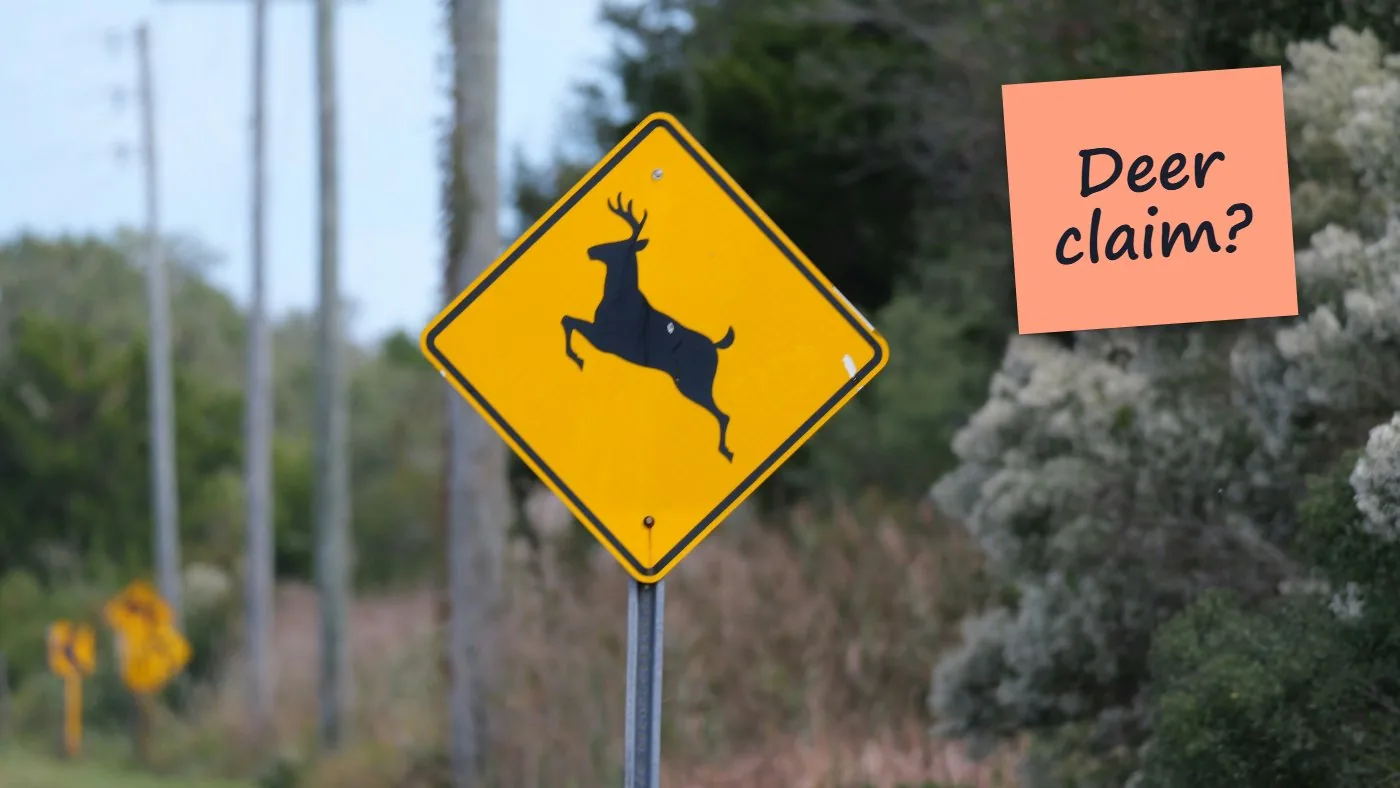
It’s a little after five on a November evening, the light’s almost gone, and something brown steps out of the tree line. There’s a thud, the hood buckles, and the deer is gone before you’ve stopped shaking.
Most drivers assume a crash is a crash, so it must be collision. Usually it isn’t. Hitting an animal is paid under comprehensive, the part of the policy that also handles theft, hail, fire and flood. That one detail decides which deductible you pay and, often, what happens at renewal.
It’s common: drivers filed about 1.65 million animal-collision claims between July 2025 and June 2026, on State Farm’s estimate. November is the worst month, dusk to dawn the worst hours, and West Virginia the worst state at 1 in 46 drivers a year against 1 in 145 nationally.
Which part of your policy pays
Collision covers your car hitting another car or an object, a tree, a pole, a guardrail. Comprehensive covers nearly everything else, animals included. Each has its own deductible, and the two don’t have to match.
What happened
Usually paid by
Deductible
Counts against you?
You hit a deer
Comprehensive
Comprehensive
Often not; varies
You swerved into a tree
Collision
Collision
More likely
A deer cracked the windshield
Comprehensive
Sometimes waived
Often not; varies
You carry liability only
Nothing for your car
None; you pay the repair
No claim to count
The second row surprises people. Miss the deer, clip a guardrail, and you’ve had a collision with an object, with a bigger deductible and, where state law allows, a surcharge at renewal.
Liability-only drivers have it worst. Liability pays for damage you do to others. When the other party is a deer, there’s nobody to file against, and the repair is yours.
Continued
The first hour, in order
Get out of traffic if the car will move. Well onto the shoulder, hazards on. If it won’t move, leave the hazards on and call for help.
Leave the animal alone. A frightened, wounded deer can hurt you.
Call the police. A report number is the simplest proof that an animal, not a ditch or a mailbox, did the damage, and your insurer may ask for it.
Photograph everything before it’s cleaned up. Damage from several angles, hair or blood on the bumper and grille, the road, the deer if it’s safe. Note the mile marker and the time.
Check before driving on. A cracked radiator, a dangling bumper or a dead headlight makes the car unsafe after dark. When in doubt, tow it.
Report it the same day, and say you hit an animal, in those words. That’s what routes the claim to comprehensive.
If the deer ran into you broadside while you were moving, the answer is the same. Comprehensive covers contact with an animal and doesn’t care who hit whom.
One note for the next time, from the Insurance Information Institute: brake firmly but stay in your lane. The serious crashes tend to happen when drivers swerve into another vehicle or lose control. It’s also the coverage advice. Hit the deer and it’s comprehensive; hit the tree and it’s collision.
Will your rate go up?
Usually not for one deer, though nobody can promise it and the rules aren’t national.
A deer strike generally isn’t anyone’s negligence, and comprehensive claims often aren’t surcharged the way at-fault collisions are. Some states say so outright: Pennsylvania’s insurance commissioner reminded drivers that under state law a crash with a deer is not-at-fault and can’t carry a surcharge. The NAIC notes more broadly that in some states insurers can’t raise premiums for accidents that weren’t your fault.
What still moves is your filing history. The claim lands in the shared claims database insurers check when they quote you, and how often you file affects both price and whether the insurer renews you at all. One comprehensive claim is a line in that file. A deer this year, hail next spring and a stolen catalytic converter after that is a pattern.
Ask your own agent directly: “If I file a comprehensive claim for a deer, can my rate go up? And a collision claim?” Your state insurance department’s consumer line will tell you what the law where you live allows.
A ten-minute policy check, before November
Pull up your declarations page, the summary sheet at the front of the policy, and look for four lines.
Comprehensive on each car. If you dropped it to save money, the deer is your expense. A middle option suits deer country: keep comprehensive, drop collision. Comprehensive is usually the cheaper of the two and it covers what careful driving can’t prevent.
The comprehensive deductible. If yours is $1,000 and $500 costs only a little more a year, that’s often a fair trade in a high-risk state. Ask your insurer for both prices.
Glass. Some insurers cover windshield repair with no deductible at all.
Towing and rental reimbursement. Both are optional add-ons. For rental, ask how many days and what daily limit, because a repair can outlast the coverage.
While you’re at it, pick a body shop now rather than at the roadside, and ask your insurer whether you can use the shop of your choice and whether it will pay that shop’s estimate.
Run the numbers before you file
The decision is arithmetic, and it starts with the deductible.
The clear case. The body shop quotes $3,400 for a bumper cover, grille, headlight assembly and a bent radiator support. On a $500 comprehensive deductible you pay $500 and the insurer pays $2,900. On a $1,000 deductible you pay $1,000 and the insurer pays $2,400. File it.
The close case. A smaller deer leaves a cracked grille and a dented fender, and the estimate is $650. On a $500 deductible the claim gets you $150. The NAIC’s advice is that when a repair costs little more than the deductible, you may want to pay it yourself and keep the claim off your record.
But get the shop to look first. Pull off a bumper cover and they can find a cracked bracket, a bent condenser or a sensor knocked out of line, and a $650 job turns into a $2,000 one. On an open claim the shop sends the insurer a supplement for the extra work; on a cash job that money is yours.
The old-car case. A 13-year-old sedan worth about $4,000 takes the same $3,400 hit. That’s 85% of its value, at or past the point where many insurers declare a total loss and pay actual cash value minus the deductible. On a $1,000 deductible that’s a $3,000 check, not a repair. If the valuation looks low, ask the adjuster for a written explanation and check the policy for an appraisal clause.
Glass alone is its own case: some insurers repair a windshield with no deductible at all, so call before paying a glass shop out of pocket.
Home and auto insurance, escrow and mortgages, car loans, debt, credit and taxes
Edited by
The Moneystretching editorial team. A human editor checks every figure, date and rule against the sources before an article is published. How we check articles
Sources
Insurance Information Institute, NAIC, State Farm animal collision data, Pennsylvania Insurance Department. Full list with links