Same house. Same thermostat setting. Same two people running the same loads of laundry. The electric bill is higher than it was a year ago anyway, and last year's was higher than the year before.
So are you running more stuff? Probably not. Nationally, households bought a little less electricity this June than last June, about 0.2 percent less, going by the federal Energy Information Administration's numbers. Your usage likely held steady. It's the price of each kilowatt-hour that moved.
18.34 cents per kilowatt-hour. That was the average U.S. residential price in June 2026, per the EIA. A year earlier it was 17.47 cents. That's up 5.0 percent, and Maryland, Virginia, New York and Pennsylvania each saw more than 10 percent.
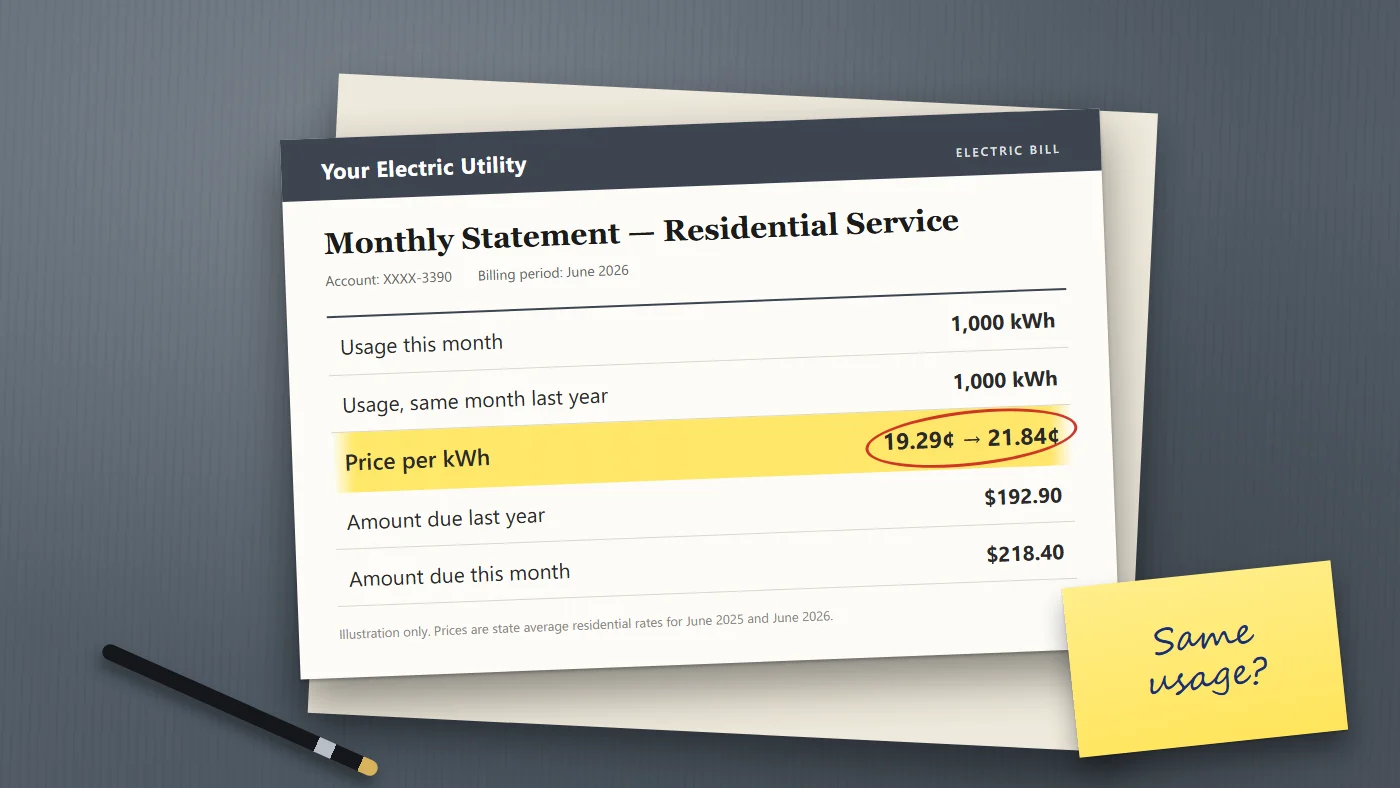
What does less than a penny do to a real bill? Picture a home that buys the national average, about 899 kilowatt-hours a month. On that house, the 0.87-cent gap comes to roughly $8 a month. Annoying, not ruinous. But few homes sit right on the average. In Maryland, a house using 1,000 kilowatt-hours paid about $25 more in June than it had a year before. Keep that up for twelve months and you're out around $300.
Hawaii had it worst. Prices there jumped nearly 29 percent. A couple of states went the other way, too: in Florida and Connecticut, prices actually fell.
Don't count on a break soon. For 2026 as a whole, the EIA expects the average residential price to land at 18.2 cents, which would be 5.2 percent above 2025. And next year? Its outlook, from September 2026, has 18.6 cents. Those are forecasts, of course, and the agency redoes them every month.
That leaves three questions. What's pushing the price up, and which part of your own bill grew? And with the federal tax credits for solar and efficiency upgrades gone, which fixes still earn their keep?
What's pushing the price up
There isn't one cause. Several are stacking on top of each other.
Demand is growing again. For years, U.S. electricity use barely grew. Not anymore. The EIA now forecasts record consumption in 2026 and 2027, rising nearly 2 percent a year, and it points to data centers and manufacturing. Keep an eye on the data centers. Back in 2023 they used about 4.4 percent of the country's electricity. By 2028 their share could be anywhere from 6.7 to 12 percent, says a Department of Energy report prepared by Lawrence Berkeley National Laboratory.
More demand raises the price of having enough power plants. Live somewhere between New Jersey and Illinois? Your grid may be run by PJM, which covers 13 states and the District of Columbia. Each year it holds an auction to lock in enough generating capacity for when it's needed. For the year that began in June 2026, that price cleared at $329.17 per megawatt-day. Why so steep? Forecast peak demand had jumped by more than 5,400 megawatts, according to PJM, driven largely by data center expansion, electrification and economic growth. Its own estimate of what that does to households: 1.5 to 5 percent on some customers' bills.
That cost gets spread across everyone on the system, households included. It's one reason several of this year's steepest increases, in Maryland, Virginia, Pennsylvania and Ohio, happened inside PJM's territory.
The grid itself is being rebuilt. Utilities are replacing old poles, wires and substations and hardening lines against storms and wildfires. State regulators approve those costs, and they show up in the delivery portion of your bill, often as separate riders. You won't see a line that says new poles, but you're paying for them.
Fuel still matters. Natural gas is the largest source of U.S. power generation. When gas prices rise, the supply part of your bill follows within months.
How much more, state by state
These are EIA average residential prices for June 2026 against June 2025, with the dollar change for a home using 1,000 kilowatt-hours that month. Monthly state figures are preliminary and get revised.
| State | June 2025 | June 2026 | Change | On 1,000 kWh |
|---|
| Maryland | 19.29¢ | 21.84¢ | +13.2% | +$25.50 |
| Virginia | 15.23¢ | 17.22¢ | +13.1% | +$19.90 |
| New York | 26.55¢ | 29.49¢ | +11.1% | +$29.40 |
| Pennsylvania | 19.69¢ | 21.73¢ | +10.4% | +$20.40 |
| Ohio | 17.50¢ | 19.19¢ | +9.7% | +$16.90 |
| Illinois | 18.29¢ | 19.89¢ | +8.7% | +$16.00 |
| Texas | 15.26¢ | 15.94¢ | +4.5% | +$6.80 |
| California | 33.59¢ | 34.74¢ | +3.4% | +$11.50 |
| Florida | 15.35¢ | 15.10¢ | -1.6% | -$2.50 |
| U.S. average | 17.47¢ | 18.34¢ | +5.0% | +$8.70 |
A state average hides a lot. Your own increase depends on your utility, your rate plan and how much you use in the hottest and coldest months, and two neighbors on different utilities can see very different numbers.
It also hides where the increase landed on the bill. Some of it's in the supply price. Some is in delivery. And some sits in a fixed monthly charge and a string of small riders with names like "grid modernization" or "storm recovery," billed no matter how carefully you use power. The bill itself rarely explains any of them.
You can't do a thing about a capacity auction. You can find out which part of your own bill grew, and that tells you which fix is worth the trouble. That's the next section, and all it takes is two bills and a calculator.
Find the line that moved
Pull up this month's bill and the one from the same month last year. Most utilities keep 12 to 24 months online. Use the same month because weather swings usage more than anything else.
- Compare kilowatt-hours first. If usage is within about 5 percent, the price moved and you didn't. If usage jumped, look for a cause inside the house: a failing heat pump or AC compressor, a water heater element, a well pump, a dehumidifier running nonstop, or a new EV in the garage.
- Divide the total by the kilowatt-hours. That's your all-in price per kilowatt-hour. Do it for both bills. The comparison tells you what happened to your bill, which the state average can't.
- Split supply from delivery. Supply, sometimes called generation, is the power itself. Delivery, also called distribution or transmission, is the wires. In many states they're separate lines, and supply is the part you may be able to shop for.
- Look at the fixed monthly charge. It's often called a customer charge or basic service charge. You pay it before you use anything, many utilities have raised it, and using less won't touch it.
- Read the riders. Storm recovery, fuel adjustment, grid modernization and efficiency surcharges usually run a few dollars each. Circle any that are new since last year.
- Check the meter read. If the bill says "estimated," that's the utility's guess. A run of low estimates followed by a real read produces one very large bill. You can ask for a corrected bill and a payment arrangement.
Fixes that cost little or nothing
Ask about rate plans. Many utilities offer time-of-use rates, with cheap power overnight and on weekends and pricey power on weekday evenings. If you're home during the day and can run the dryer, dishwasher and water heater off-peak, it can lower the bill. If your heaviest use lands in the late afternoon and evening, it can raise it. Ask the utility to run your last 12 months through both plans. Most can.
Ask about budget billing. It'll spread your yearly cost into equal payments. It won't save money, but it takes the sting out of the one huge summer bill.
Get a home energy audit. Many utilities offer one free or at a steep discount, and some include a blower-door test that finds air leaks. The auditor's list is ranked by payback. I'd trust it over any contractor's sales pitch.
Seal and insulate. Air sealing plus added insulation saves an average of 15 percent on heating and cooling costs, by ENERGY STAR's estimate. Measured against your total energy costs, that's about 11 percent. Results vary by climate and house. Attic insulation, plus sealing around the attic hatch, plumbing stacks and rim joists, usually comes first.
Look at the water heater. It's one of the biggest electricity users in most homes. Setting the tank to 120 degrees and insulating the first few feet of hot water pipe costs almost nothing.
Can you shop for your electricity?
In some states, yes. Where there's retail electric choice, including Texas, Ohio, Pennsylvania, Illinois, New York, New Jersey and Maryland, among others, you can buy the supply portion from a competing company. The utility still delivers the power and sends the bill.
It pays to compare electricity rates here. It's also where people get burned. A few ground rules:
- Start with your state utility commission's official comparison website. It lists licensed suppliers and the utility's own default price, often called the price to compare.
- Compare fixed-rate offers over the full term. A low teaser rate that turns variable after three months often costs more over a year than the default.
- Check for a monthly fee, an early termination fee, and what happens when the contract ends. Many roll to a variable rate unless you act.
- Don't let a door-to-door or phone salesperson rush you. Never hand over your bill or account number just to "check eligibility."
If the best fixed offer isn't clearly below the utility's default price, staying put is a perfectly reasonable choice.
Bigger projects: solar, windows, heat pumps
The math changed for all three, because two federal tax credits are gone. The solar one, the Residential Clean Energy Credit, used to cover 30 percent of an installation. It isn't available after December 31, 2025, the IRS says. The Energy Efficient Home Improvement Credit ended on the same date; it had paid part of the cost of windows, insulation and heat pumps. So if a salesperson promises you a 30 percent federal credit on a 2026 purchase, they're working from an old script.
State and utility incentives are a separate story. They vary widely, and they haven't all gone away. Some states still offer rebates, property tax exemptions for the added home value, sales tax exemptions, or credits for the power you send back to the grid. Look up solar incentives by state on your state energy office's website, and confirm each one with the agency that runs it.
Solar. Before incentives, the average runs about $2.60 per watt. For a 12-kilowatt system, that's roughly $31,000. (Those figures come from EnergySage, a marketplace that tracks installer quotes.) It puts the average payback at about 10 years, though that may not fully reflect the lost federal credit. Your own number hinges on your electricity price, how your utility credits exported power, and your roof. At 30 cents a kilowatt-hour the case is far stronger than at 15.
Get at least three quotes for the same system size and ask for the price per watt so you can line them up. Ask each installer for projected yearly production, the export credit rate they assumed, and the payback with no federal credit. Offered a lease or a power purchase agreement? Check the yearly price escalator and what happens when you sell the house. If the roof has less than 10 years left, replace it first.
Windows. New energy efficient windows make a house more comfortable and quieter. As a pure bill cutter they're slow, because a whole-house replacement runs well into five figures, so they make the most sense when the old windows are single-pane or failing anyway. Storm windows and air sealing get part of the benefit for far less.
Heat pumps. If you heat with electric baseboards, an electric furnace or an aging heat pump, a modern heat pump can cut heating use substantially. It's a major purchase. Get several quotes and ask your utility about rebates before you sign, because some require pre-approval.
If the bill is already past due
Call the utility before the due date, not after a shutoff notice. Most will offer a payment plan, and many run their own hardship funds.
Two federal programs run through the states. LIHEAP helps pay heating and cooling bills, and the Weatherization Assistance Program pays for efficiency work on the home. Eligibility is based on income and varies by state, and USA.gov links to each state's office at usa.gov/help-with-energy-bills. There's only so much money, and it often runs out. Apply early in the season.
Many states also restrict shutoffs during extreme heat or cold, or for households with a serious medical need. The rules differ by state, and your utility commission's consumer line can tell you what applies.
Tonight, take this month's bill and last year's, divide each total by its kilowatt-hours, and write the two numbers on a sticky note on the fridge. If usage moved, look inside the house first. If the price moved, go after your rate plan, your supplier and your attic before you spend a dollar on the roof.
This article is general information, not financial, legal, tax or medical advice.