"Full coverage" isn't a real insurance term. It's shorthand for a policy with liability coverage, which pays other people when you cause a crash, plus two coverages that protect your own car. Collision pays to fix or replace your car after a crash. Comprehensive handles theft, hail, flood, fire, a fallen tree or a deer.
Those two have a ceiling that most people never look at. The most they'll ever pay is what your car was worth the moment before the loss, minus your deductible, a figure insurers call actual cash value. It isn't what you paid for the car, and it isn't what a replacement costs on a dealer lot. It drops every year. Your premium often doesn't.
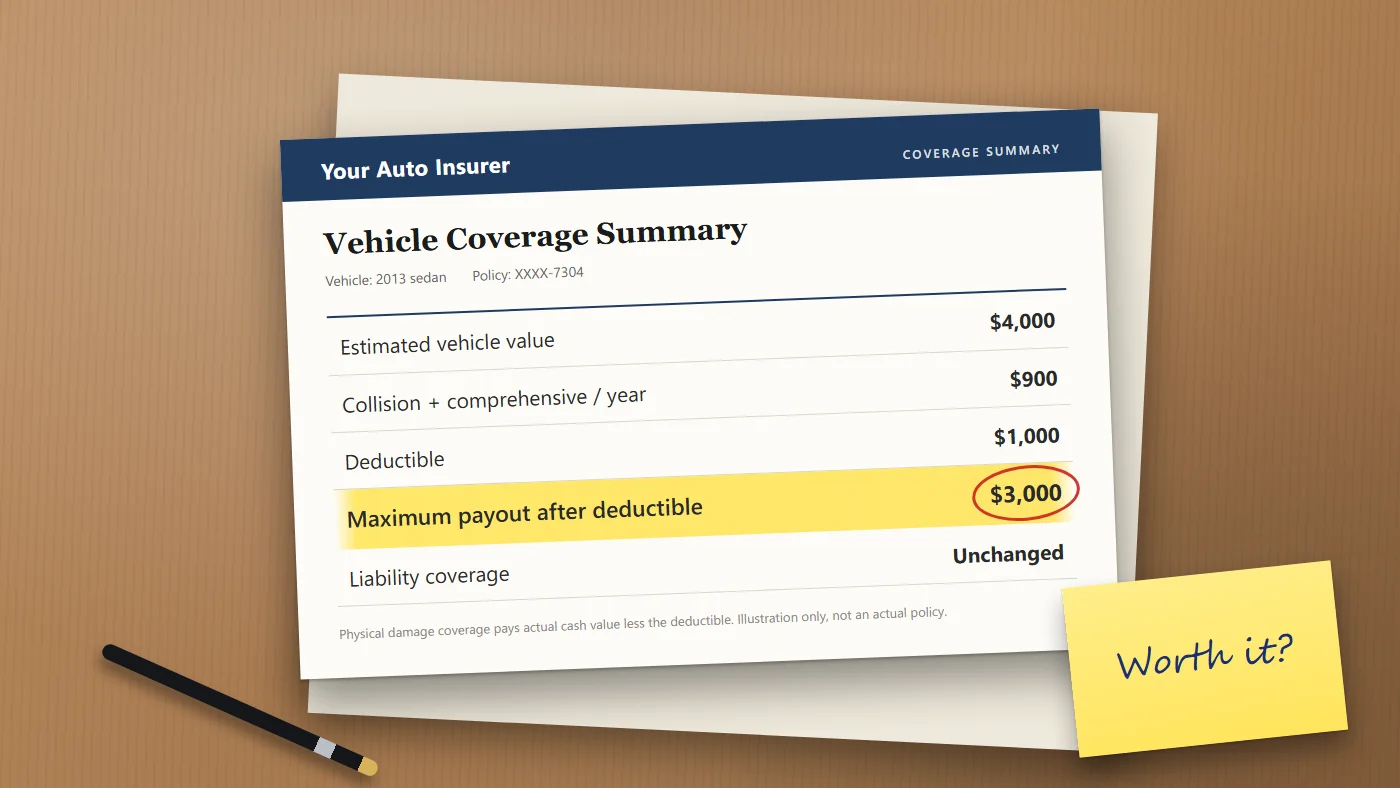
Take a 13-year-old sedan worth $4,000, with a $1,000 deductible, and say collision and comprehensive together run $900 a year. If that car's destroyed tomorrow, the biggest check the insurer can write is $3,000. You'd pay that much in premiums in three years and four months. By then the car's worth less.
That's the part people miss when they renew on autopilot, because the premium arrives as a familiar number on a familiar bill, while the car's value, which sets the most you could ever collect, never shows up on any statement the insurer sends you.
Now think about how often you'd actually use it. Consumer Reports, citing the Insurance Information Institute, says the average driver files a collision claim about once every 18 years. In the example above, 18 years of premiums comes to $16,200, for a payout capped at $3,000 and shrinking.
That's the case for running the numbers. It isn't a case for dropping coverage on every old car, and a good part of this article is about when you shouldn't.
10 times. The Insurance Information Institute's guideline: if your car is worth less than 10 times what you pay each year for collision and comprehensive, buying that coverage "may not be cost effective."
The one-minute rule
Find the yearly cost of collision plus comprehensive on your policy. Multiply by 10. If the result is more than the car is worth, the coverage is a candidate for cutting.
That's all of it.
Consumer Reports says the same thing from the other side: consider dropping the two coverages when their annual cost equals or exceeds 10% of the car's book value, or when the vehicle is more than 10 years old. The National Association of Insurance Commissioners, which represents state regulators, tells drivers to "consider lowering or eliminating physical damage coverages on older vehicles," unless a lender requires them.
At a single premium level, it plays out like this.
| Car's value | Collision + comprehensive per year | Premium as share of value | Max check with $1,000 deductible | What the rule says |
|---|
| $15,000 | $900 | 6% | $14,000 | Keep it |
| $9,000 | $900 | 10% | $8,000 | Borderline; try a higher deductible |
| $6,000 | $900 | 15% | $5,000 | Consider dropping collision |
| $4,000 | $900 | 22.5% | $3,000 | Strong candidate to drop |
These are illustrations, not quotes, and your premium won't match. What matters is the ratio.
More drivers hit this point every year. The average vehicle on American roads is 12.8 years old, according to S&P Global Mobility's most recent count, and passenger cars alone average 14.5. Millions of people are insuring cars well past the age where the math starts to tip.
Why do old cars get totaled so easily?
Because on an older car, almost any real crash ends in a total loss.
An insurer totals a car when the repair bill gets close to what the car's worth, and the exact trigger varies by state. With body shop labor, parts and sensor recalibration priced where they are now, it doesn't take a bad wreck to produce a repair estimate of several thousand dollars, and on a car worth $4,000 that's a total. CCC Intelligent Solutions, a claims technology company that tracks the repair business, reports that a record 23.1% of claims in 2025 ended as total losses. It points to repair costs rising against vehicle values and to an aging fleet.
Think about what that means for the policy you're paying for, year after year, on a car that's already past its tenth birthday. With an older car you aren't really buying repair coverage. You're buying a one-time check for the car's value minus your deductible. Weigh that number against the premium.
How much money is on the table nationally? Insurify puts the average full-coverage policy at $2,241 a year and the average liability-only policy at $1,181, in its September 2026 figures. That's a gap of about $1,060 across all cars. On an older, cheaper car your own gap will probably be smaller, since collision premiums fall as a car loses value. They just don't fall as fast as the car does.
The rule gives you a yes-or-no starting point. The actual decision has a few more parts, and one of them can stop you from dropping anything at all.
When you shouldn't drop it, whatever the math says
You still owe money on the car, or you lease it. Your lender or leasing company almost certainly requires collision and comprehensive until the loan's paid off. Drop them and the lender can buy its own coverage and bill you for it. That coverage is expensive, and it protects the lender, not you.
You couldn't replace the car. Call it the honest test. If the car were gone tomorrow, could you buy another one from savings without borrowing at a high rate or falling behind on bills? If not, a $3,000 check isn't small money, and it may be worth keeping the coverage another year while you build a cushion.
You live where comprehensive claims are common. Hail country, flood zones, high-theft cities and deer country all change the odds. The Insurance Information Institute estimates 1.7 million animal-collision insurance claims between July 2024 and June 2025, and October through December is the peak. Those are paid under comprehensive, not collision.
The car's worth more than you think. Used car prices jumped after 2020, and trucks and SUVs in particular can hold value well past the 10-year mark. Don't guess. Look it up.
Is there anything between full coverage and nothing?
Yes. Two things, and most people skip right past them.
The first is a higher deductible. The Insurance Information Institute says going from a $200 to a $500 deductible could cut collision and comprehensive costs by 15% to 30%, and a $1,000 deductible can save 40% or more. On an old car, though, a big deductible also eats a big share of the most you could ever collect. Put a $1,000 deductible on a $4,000 car and you're really insuring $3,000.
The second is keeping comprehensive and dropping collision. Collision is usually the pricier of the two. Comprehensive tends to cost much less, and it covers the losses careful driving can't prevent: theft, weather, fire, animals, vandalism. Many insurers will sell comprehensive without collision, though far fewer go the other way.
What if someone else hits you? If the other driver's at fault, their liability coverage owes you for your car even if you don't carry collision. The difference is speed and hassle. With collision, your own insurer pays you and then goes after the other company. Without it, you're dealing with the other driver's insurer yourself.
How to run the numbers on your car
- Find the two premiums. Pull out your declarations page, the summary at the front of the policy. Each car has its own lines for collision and comprehensive. Most policies run six months, so double the figures for a yearly cost.
- Look up what the car's worth. Use two online pricing guides and enter the real mileage, trim and condition. Look at private-party or trade-in value, not dealer retail. Then check local listings for the same year and model with similar miles. You want a realistic selling price, since that's close to what an insurer would pay.
- Subtract your deductible. Value minus deductible is the biggest check you could ever get. Write it down.
- Apply the rule. Multiply the yearly collision and comprehensive cost by 10. If the result is higher than the car's value, the coverage is a candidate for cutting. Close call? Price a higher deductible first.
- Check the title. If a lender's listed on the title or you're still making payments, stop here and get the lender's written requirements before you change anything.
- Ask yourself the savings question. Could you replace this car from cash on hand? If not, think about keeping at least comprehensive, and pick a date to look again.
- Call your insurer and ask for three prices. The same policy with a higher deductible, with comprehensive only, and with liability only. Ask what happens to rental reimbursement and roadside coverage under each, because some insurers only sell those alongside collision or comprehensive.
- Get the change in writing. Ask for the effective date and a revised declarations page. If you paid the term up front, the unused premium is normally refunded pro rata.
What to do with the money you stop paying
Dropping coverage only works if the savings don't vanish into the month. The idea is to become your own insurer for that car. Not glamorous. Cheaper, though.
Cut $900 a year and you can move $75 a month into a separate savings account with the car's name on it. In three years that's $2,700 plus interest, close to the most the insurer would ever have paid in the example above, and if nothing happens to the car, the money's still yours.
This is also a good moment to look at the other half of the policy. A lot of people carrying full coverage on an old car have thin liability limits at the same time, which is backward. Liability is what protects your house and savings if you hurt someone. Consumer Reports recommends at least $100,000 per person, $300,000 per crash and $100,000 in property damage, and it suggests 250/500/250 if you have substantial assets. If I were trimming an old car's coverage, I'd put part of the savings toward those limits first.
Keep uninsured and underinsured motorist coverage. In some states it comes with a property damage option that can pay for your car when an uninsured driver hits you. Rules and availability vary, so ask your insurer what your state allows.
Shop the stripped-down policy, too
A liability-only or comprehensive-only policy isn't the product you shopped for years ago, and because each company weighs age, mileage, location and claims history in its own way, the insurer that was cheapest on full coverage for a newer car may turn out to be nowhere near the cheapest for liability on an old one. So shop it again.
Once you know which version you want, get quotes for exactly that version from at least three companies. Match the liability limits, uninsured motorist limits, drivers and annual mileage line for line. If one quote comes in far below the rest, check whether the limits were quietly dropped to the state minimum.
Bring two facts to every quote: the car's current value from step 2 and your real yearly mileage. Older cars owned by people over 50 often get driven a lot less than the policy assumes, and mileage is one of the inputs you're allowed to correct.
A few mistakes to avoid
Don't drop liability or let the policy lapse. Nearly every state requires liability insurance, and a gap in coverage tends to raise your price later.
Don't use the dealer retail price as the car's value. It overstates what an insurer would pay and makes the coverage look like a better deal than it is.
Don't forget the second car. It happens all the time: a household runs the numbers on the oldest vehicle in the driveway, feels good about the savings, and never looks at the 11-year-old one parked right next to it, which may fail the rule by an even wider margin.
And don't judge by the premium alone. A $400 premium looks cheap until you notice it's more than 13% of a $3,000 car.
Run this once a year, a few weeks before renewal, with the latest value from step 2 written next to the premium.
This article is general information, not financial, legal, tax or medical advice.