On January 7, 2025, the Consumer Financial Protection Bureau finalized a rule that would have taken medical bills off credit reports entirely. Lenders would have been barred from using medical debt to decide if you get a loan. It made headlines for about a week.
It never took effect. Industry trade groups sued, and the Bureau, under new leadership, ended up agreeing with them. On July 11, 2025, a federal court in the Eastern District of Texas vacated the rule in a case called Cornerstone Credit Union League v. CFPB, holding that it went beyond the Bureau's authority under the Fair Credit Reporting Act.
If you only caught the first headline, you might think medical debt can't touch your credit anymore. That's not the law. Medical collections can still show up on your reports, and lenders can still see them.
You're far from unprotected, though. Three credit bureau policies keep most medical bills off reports. About fifteen states have passed their own bans. Federal tax rules limit what nonprofit hospitals can report and when. And you still have the same right to dispute a wrong entry that you've always had. None of these works automatically in every case, and each one has an edge where the protection stops.
15 million people, $49 billion. That's how much medical debt in collections was still sitting on Americans' credit reports after the credit bureaus made their changes, according to a CFPB report using June 2023 data.
Before those changes, the CFPB's estimate was $88 billion. The bureaus' policies swept out the small bills. What remained were the big ones, and the average medical collection left on reports rose from about $2,000 to more than $3,100.
Four layers that still protect you
| Layer | What it does | How firm it is |
|---|
| Credit bureau policies | Paid medical collections, collections under $500 and collections less than a year old are kept off reports | Voluntary. The bureaus adopted them and could change them |
| State laws | In about fifteen states, medical debt may not be reported or used in credit decisions | Law in those states, but a 2025 federal interpretation questions whether states can do this |
| IRS rules for nonprofit hospitals | No credit reporting for at least 120 days after the first bill, and only after a written 30-day warning | Federal regulation, applies to nonprofit hospitals only |
| Fair Credit Reporting Act | Right to dispute anything inaccurate, with an investigation that generally has to finish in 30 days | Federal law, applies to everyone |
The three credit bureau rules
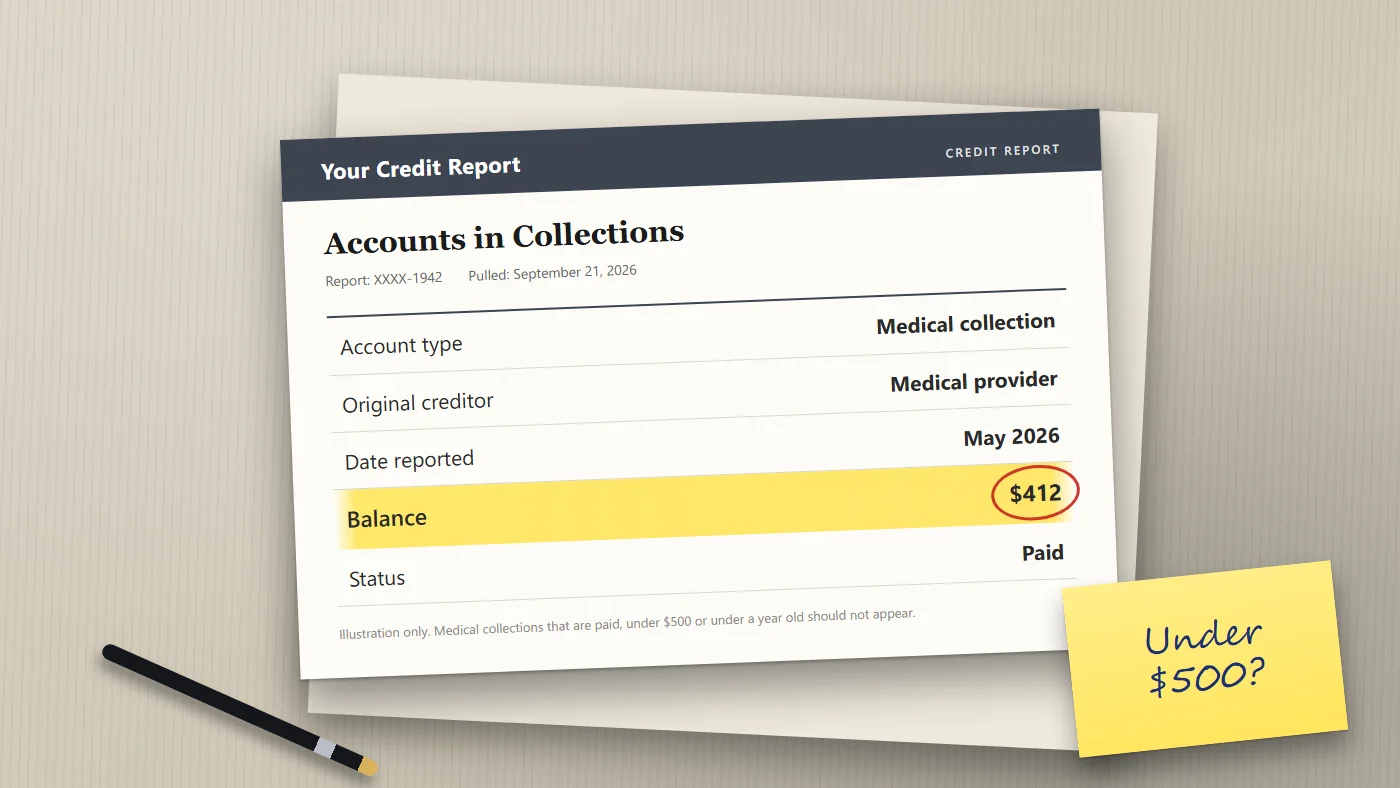
Equifax, Experian and TransUnion made three changes between July 2022 and April 2023. The CFPB summed them up in a blog post whose title says it all: anything already paid or under $500 should no longer be on your credit report.
Paid medical collections come off. That's unusual. A paid credit card collection can sit on your report for up to seven years. A paid medical collection should disappear.
Nothing under $500. Since April 11, 2023, medical collections with a balance below $500 aren't supposed to appear at all, paid or unpaid.
Nothing in the first year. An unpaid medical bill shouldn't show up as a collection until at least a year has passed. The old practice was about six months. The extra time lets you sort out insurance, appeal a denial or apply for a hospital's financial assistance.
Two limits matter here. These are company policies, not statutes; they've held since 2022 and 2023, but no law makes the bureaus keep them. And they only cover debt reported as a medical collection. Paid the hospital with a credit card, a personal loan or a medical credit card? That balance is now ordinary debt, and none of the three rules touches it.
Nothing here erases the debt, either. A $400 bill that can't appear on your report is still owed. A collector can still call about it and, in some cases, sue.
Where state law goes further, and the new doubt
Experian's consumer guidance lists fifteen states that bar medical debt from being reported or used in credit decisions: California, Colorado, Connecticut, Delaware, Illinois, Maine, Maryland, Minnesota, New Jersey, New York, Oregon, Rhode Island, Vermont, Virginia and Washington. The details differ. California's law, SB 1061, was signed in September 2024 and took effect in 2025; it bars credit reporting agencies from including medical debt in reports and bars lenders from counting it against you. New York has its own Fair Medical Debt Reporting Act.
Then there's a complication. On October 28, 2025, the CFPB published an interpretive rule saying the Fair Credit Reporting Act generally preempts state laws that touch broad areas of credit reporting, reversing a 2022 interpretation that had said the opposite. An interpretive rule is the agency's reading of the law. It isn't a court ruling. As far as we could confirm, the state laws remain on the books and in force, but expect the question to be fought out in court.
Live in one of those states and see a medical collection on your report? You've got an extra ground for a dispute. Anywhere else, the three bureau rules are your main protection.
Rules only help if your own reports follow them. Checking takes about an hour and costs nothing, and the dispute process has a few turns that are easy to get wrong.
How to check your reports and dispute a medical entry
- Pull all three reports. Go to AnnualCreditReport.com, the only site authorized to provide the free reports federal law guarantees. You can check weekly at no cost. Get all three, because collectors don't always report to every bureau.
- Find the collections section. Medical collections usually appear under the name of a collection agency, not the hospital. Look for an "original creditor" line naming a medical provider, lab or ambulance company.
- Test each entry against the three rules. Was it paid, by you or by insurance? Is the balance under $500? Is it less than a year old? A yes to any of those means it shouldn't be there.
- Check it against your own records. Match the entry to a bill and an explanation of benefits. Look for a debt your insurer already paid, a bill still under appeal, an amount that doesn't match, or an account that isn't yours.
- Dispute with the bureau in writing. The CFPB suggests including your contact details, the account number, a clear explanation of what's wrong, a copy of the report with the item marked, and copies of supporting documents. Send copies, never originals. Certified mail with a return receipt gives you a date.
- Dispute with the company that reported it. Send the same package to the collection agency or provider. Furnishers generally must investigate and respond within 30 days, and if they can't verify the entry, they have to correct or remove it and tell the bureaus.
- Check again. Pull the report after 30 to 45 days. If the item's still there and you believe it's wrong, file a complaint with the CFPB at consumerfinance.gov/complaint or call (855) 411-2372.
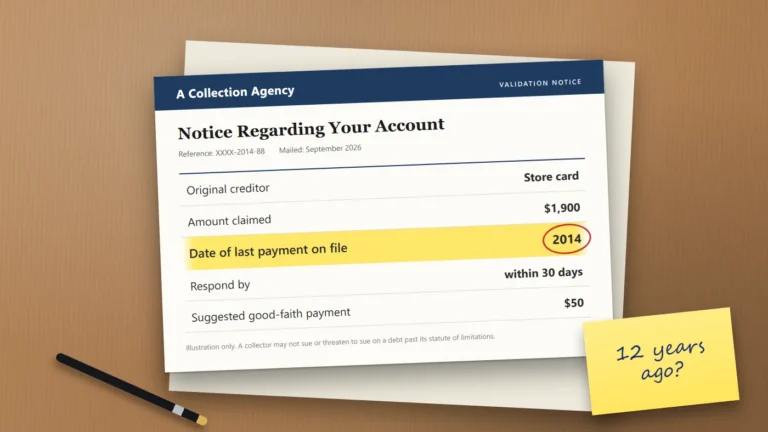
A collector that just contacted you about a medical debt you don't recognize starts a separate clock. Write to it within 30 days of its first notice and ask it to validate the debt. It has to pause collection until it responds.
What if the debt is real and over $500?
Sometimes the entry is accurate. It's over $500, more than a year old and unpaid. You still have moves.
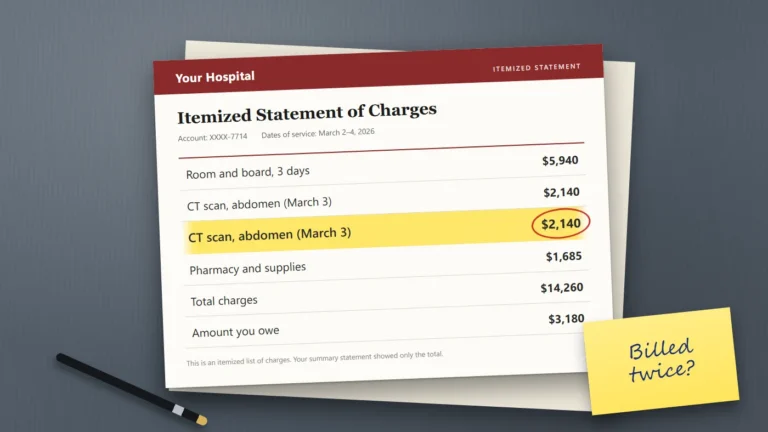
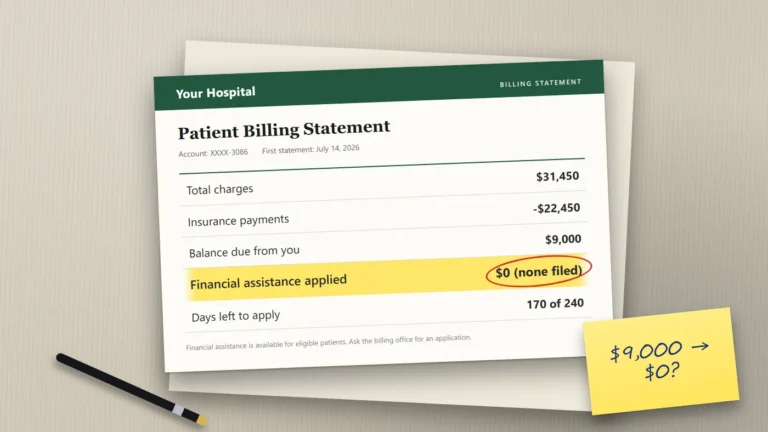
Start by asking whether the bill should be smaller. If it came from a nonprofit hospital, you generally have 240 days from the first bill after discharge to apply for the hospital's financial assistance, and an approval requires the hospital to reverse credit reporting it already did. Ask for an itemized bill and check it for errors. If insurance denied the claim, appeal.
Paying a medical collection also works differently from paying other collections. Under the bureaus' policy, a paid medical collection comes off your report. If you negotiate a lower amount, get the agreement in writing before you pay, ask that the account be reported as paid in full or resolved, and keep the letter somewhere you'll find it in three years.
Timing matters too. Planning to apply for a mortgage or refinance in the next year? Clearing or correcting a medical collection first can count for more than it would otherwise.
And find out which score is in play. Not all credit scores treat medical debt the same way. According to Experian, VantageScore 3.0 and 4.0 don't count medical collections at all, while FICO 9 and FICO 10 give unpaid medical collections less weight than other collections.
Mortgage lending has long relied on older FICO versions that don't draw that line. So a medical collection may barely move the score you see in a free app and still weigh on the score a lender pulls. Ask any lender which version it uses. It's a fair question, and a good loan officer won't mind it.
Mistakes that make it worse
Moving the bill onto a card. Once a hospital bill becomes a credit card balance, it loses the one-year delay, the $500 floor, the paid-removal rule and any state protection. A missed card payment can be reported after 30 days.
Treating a small bill as gone. Under $500 means invisible on your report. Not forgiven.
Paying a collector before checking the debt. Validate first. Insurance may already have paid, or the hospital's assistance policy may cover it.
Making a small "good faith" payment on a very old debt without checking your state's rules. In some states a partial payment can restart the period in which a collector may sue.
Paying for help versus doing it yourself
Everything above is free. So what do paid services add?
Credit repair companies dispute items on your behalf. They have no legal power you lack, and they can't lawfully remove accurate information. Under the federal Credit Repair Organizations Act, they can't charge you until the promised work is done, and you get three business days to cancel a contract. If you hire one because you don't have the time, compare fees and read the contract for both of those terms. A company that guarantees it can remove collections from a credit report is promising something it doesn't control.
Credit monitoring earns its cost at certain moments more than others: while a dispute is pending, while an account sits with a collector, or in the months before a big loan application. Many banks and card issuers include a basic version at no charge. Paid versions add alerts from all three bureaus and, often, identity theft features.
If the debt is large and you can't pay it, look at the debt before you look at the report. Hospital financial assistance, a billing advocate or a nonprofit credit counselor can change the amount you owe, and the credit report follows from that.
If I had one free hour this week, I'd spend it on the three reports. A medical collection that's paid, under $500 or less than a year old breaks the bureaus' own rules, and a written dispute is how you get it taken off.
This article is general information, not financial, legal, tax or medical advice.