Four thousand dollars. That's roughly where a clinic quote for two prescription hearing aids starts these days, and it often goes higher. Consumer Reports, in its buying guide updated in February 2026, says pairs "can cost upward of $4,000." Buyers back that up. In a late-2025 HearingTracker survey of more than 1,100 people, those who bought at a clinic without insurance paid $4,727 a pair on average.
There's a cheaper shelf now, though. Since October 17, 2022, adults have been able to buy hearing aids off the rack, in a store or online, with no exam, no prescription and no fitting appointment. A Food and Drug Administration rule made that possible. What do they go for? About $500. Over-the-counter buyers in that same survey averaged $502 a pair, and Consumer Reports has found several self-fitting models under $1,000.
And Original Medicare? It sits this one out. Straight from Medicare.gov: "Medicare doesn't cover hearing aids or exams for fitting hearing aids." Whatever it won't cover lands on you.
So the bill's yours, and the two price tags can land thousands of dollars apart. Why such a gap? Mostly, it isn't the hardware. When a clinic gives you one number, a lot is riding inside it: the hearing test, programming the aids, fitting them, and follow-up visits that can stretch on for years. Buy over the counter and you get the device and an app. That's it.
Below: what each price includes, who pays for any of it, and how to compare quotes. Which type suits your hearing is a question for you and a hearing professional. This one's about the money.
What a $4,000 quote is made of
Most clinics sell "bundled," one price for the devices and the professional time around them. What does that time buy? Consumer Reports spells it out: aids programmed to your hearing, sometimes shaped to your ears, lessons on using them, and the right to come back when the fit or the programming needs fine-tuning.
That service has real value. It's also why two quotes for the same device can sit $1,500 apart, since one clinic may throw in three years of visits, a loss-and-damage policy and a supply of batteries while the clinic down the road includes 60 days of visits and nothing more.
You can ask any clinic for an itemized, or "unbundled," quote. It splits the device price from the service package.
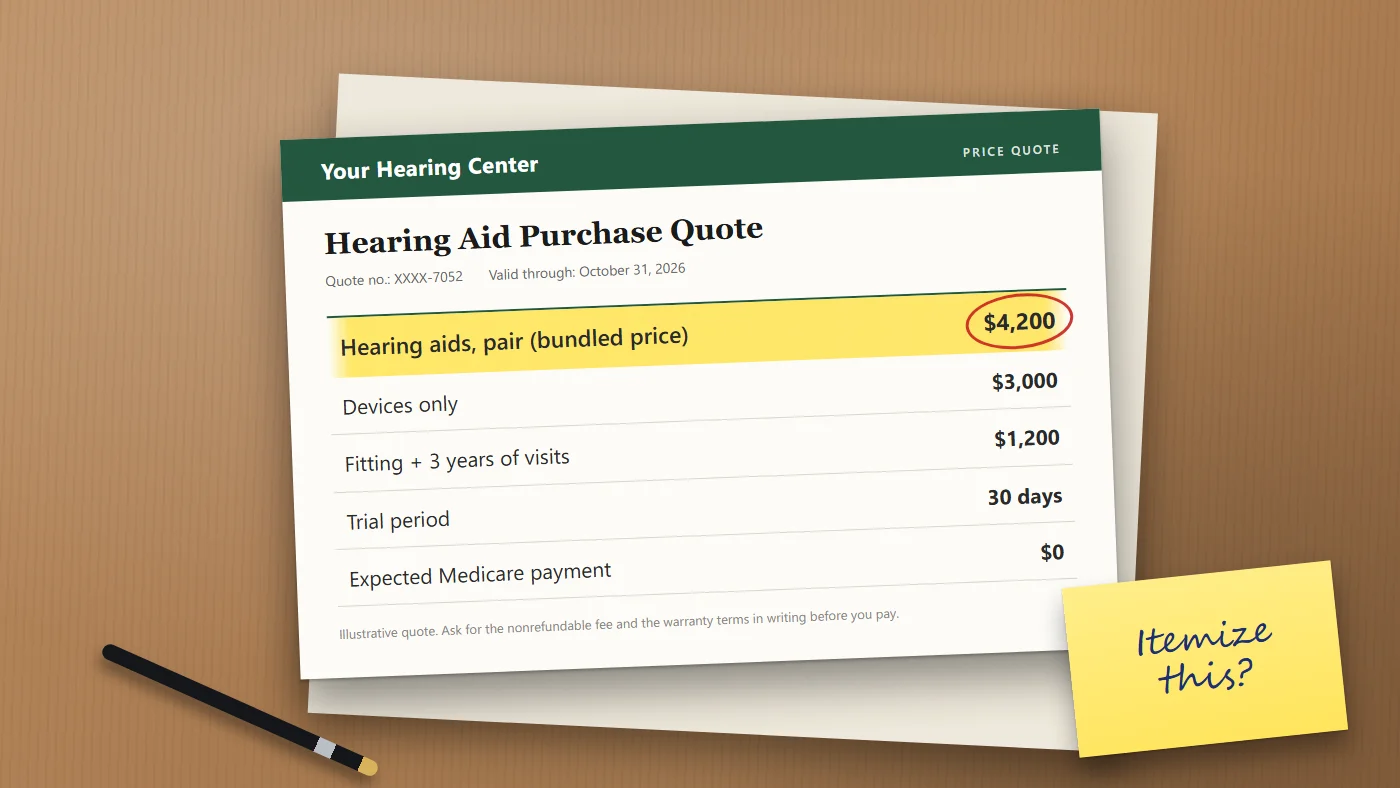
Say a clinic quotes $4,200 for a pair. Itemized, that turns into $3,000 for the devices and $1,200 for the fitting plus three years of office visits. Now you can hold the $3,000 up against another seller's device price and decide for yourself what the visits are worth. The numbers are made up. The method isn't.
What does "over-the-counter" actually mean?
If you're 18 or older and your hearing loss seems mild to moderate to you, the over-the-counter shelf was built with you in mind. That's the group the FDA wrote the category for (the National Institute on Deafness and Other Communication Disorders describes the same limits). You buy in a store or online and fit the aids yourself. Nobody asks for an exam.
Anything outside that range goes to the other legal category, prescription aids. Licensed hearing professionals sell and program those, and they can be set for any degree of hearing loss.
Two details on the box affect your wallet. First, the outside package has to state the maker's return policy, or say there isn't one. The FDA doesn't require a return window or a warranty, so terms differ by brand and store. Second, the OTC shelf holds two kinds of device: self-fitting models you tune with a phone app, and preset models with a few fixed programs. Consumer Reports says the preset ones are generally cheaper.
The number to remember: Original Medicare pays $0 toward hearing aids. In Medicare Advantage, about 4 in 10 enrollees had a yearly dollar cap on hearing aid coverage, and it averaged $960 (KFF's review of 2021 plans).
Who pays for any of it
Original Medicare. Nothing for the aids, and nothing for fitting them. Exams are another story. If your doctor orders a diagnostic hearing and balance exam to check if you need medical treatment, Part B covers it. You can also see an audiologist once every 12 months without a doctor's order for non-acute conditions, such as hearing loss that crept up over years. Your share of a covered exam is 20% of the Medicare-approved amount, after the Part B deductible ($283 in 2026).
Medicare Advantage. Nearly everyone in an individual plan has access to some hearing benefit, meaning exams, aids or both; KFF puts it at 95% for 2026. The details decide what it's worth. In the 2021 plans KFF reviewed, most enrollees could get new aids covered only so often, usually one set a year. About 40% also had a dollar cap. It averaged $960. And some plans send you to a contracted vendor.
Everyone else. Medicaid is a state-by-state question: some states cover hearing aids for adults, some don't. Veterans enrolled in VA health care may be able to get them through the VA. A few states go further and require insurance plans to cover hearing aids for adults, each with its own rules. Consumer Reports names eight: Arkansas, Connecticut, Illinois, Maine, Minnesota, New Hampshire, Rhode Island and Washington. HSA or FSA money can go toward hearing aids, too, and if you itemize, the IRS counts the aids and their batteries as medical expenses.
That gets you to the starting line. Any savings come from how you shop once a quote is in hand.