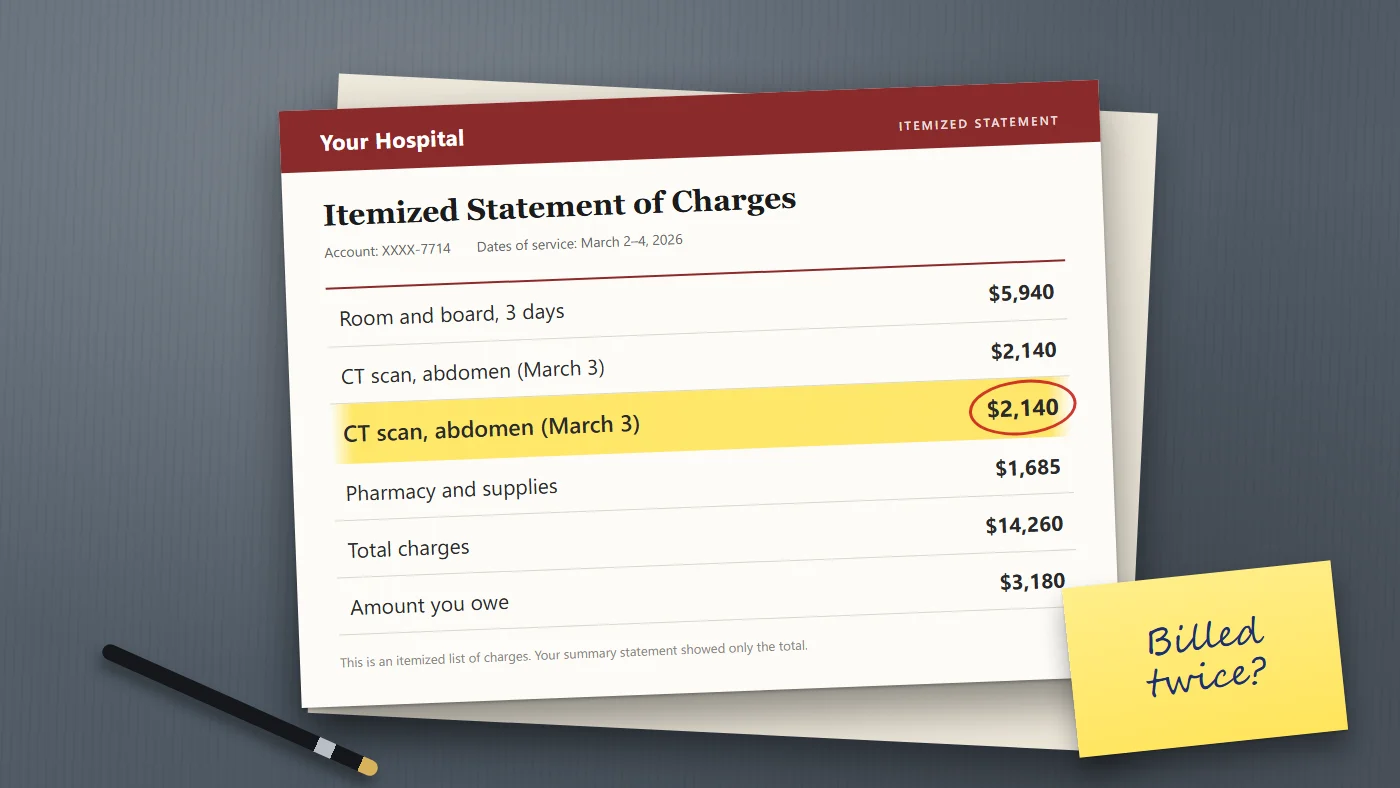
Picture a statement of the kind hospitals mail out every day. The numbers here are made up, but the format isn't: "Hospital services: $14,260. Insurance adjustments and payments: $11,080. Amount you owe: $3,180." Below that sit a due date and a tear-off payment slip.
So what are you supposed to check? Three totals and a deadline. You can't tell whether you were charged for two nights or three. You can't tell whether the scan that got canceled still landed on your account, or whether your insurer was even billed under the right member number.
For that you need the long version, which hospitals call an itemized bill or itemized statement. Once it's in your hands, the guessing stops. Every charge gets its own line, so that canceled scan either shows up with a date of service and a price next to it, or it doesn't. Next to each price you'll see the billing code the hospital used, a few words about what the charge was for, and how many units it counted. A quick ER visit might fit on half a page. Surgery with a hospital stay often runs several pages.
Most hospitals won't mail it unless you ask. So ask. You don't need a lawyer or a special form. A phone call usually does it, a short letter if the call goes nowhere, and federal law is on your side either way.
How often are hospital bills wrong?
There's a number that floats around online: 80% of medical bills contain errors. Trace it back, though, and you end up at companies that sell bill-review services, not at an audit anyone can inspect. We looked for a credible national study behind it and didn't find one, so we won't pass it along as fact.
That doesn't mean your bill is clean.
Think about who ends up fighting a medical debt collector. When people with Medicare complained to the Consumer Financial Protection Bureau about one between 2020 and 2022, more than half said the debt itself was inaccurate. The exact share was 53%. For people with a second layer of coverage, say Medicare plus a supplement, it went up to 61%. Makes sense: each extra insurer adds a handoff between billers, and handoffs are where things slip.
53%. In more than half of the medical debt collection complaints the CFPB received from people with Medicare between 2020 and 2022, the person said the bill was inaccurate.
Doubt alone keeps plenty of bills sitting unpaid. The same CFPB report cites a 2022 survey where 44% of adults said they hadn't paid a medical bill in full because they weren't sure it was accurate.
What about claims somebody actually audits? Medicare checks a sample of its own fee-for-service claims every year. For fiscal year 2025, the Centers for Medicare & Medicaid Services estimated that 6.55% of those payments were improper, or about $28.83 billion. Mostly it's paperwork: missing or insufficient documentation, plus coding problems. The count also includes underpayments, not just overpayments. None of that proves your bill is wrong. It does show that billing mistakes are routine, even on claims the government reviews.
And no, the hospital probably isn't out to cheat you. A single stay can generate hundreds of charge entries, keyed in by different departments at different hours by people who never see the whole account. Errors are exactly what you'd expect from a setup like that, and the itemized bill is how you find them.
Your right to the billing records
You may hear that hospitals "must give you an itemized bill." Close, but not quite, and the difference matters if a billing clerk pushes back.
Your leverage comes from HIPAA, the federal privacy law. It lets you see and get a copy of your records in what the rule calls the designated record set. That phrase sounds like lawyer talk until you read how the regulation defines it for a health care provider: your medical records and your billing records. The line-by-line charges? Billing records. They're yours to see.
How long can the hospital sit on your request? Generally 30 calendar days. If it needs more time, it gets one extension of up to 30 more days, and it has to tell you why in writing. It's allowed to insist that you ask in writing, and it can charge a reasonable, cost-based fee for copies. An unpaid balance, though, isn't a reason it can use to turn you down, according to HHS guidance.
You'll rarely have to quote any of this. HIPAA never uses the words "itemized bill" and doesn't dictate a format; what it guarantees is access to the underlying records. Nearly every hospital billing system can print an itemized statement in minutes, and most billing offices will do it on a plain phone request. Nobody has to bring up the regulation number or the word HIPAA.
Live in Texas? You've got more. Since September 1, 2023, a provider that wants payment from a patient has to send a written itemized bill first, with a plain-language description of each service or supply, the billing codes sent to the insurer, and the amount due for each one. Until it does that, it can't pursue debt collection. Other states have their own rules, and they differ, so your state attorney general or insurance department is the place to ask.
Getting the document is the easy part. Reading it is where the money is, and that goes faster when you know which handful of errors keep turning up.