If you buy your own health insurance and you're between 50 and 64, this was probably the most expensive year you've had. The extra premium tax credits that had been in place since 2021 expired at the end of 2025. KFF found that people who signed up for 2026 marketplace coverage saw the amount they pay, after tax credits, rise 58% on average. Paid-up enrollment fell from 21.8 million people to 19.2 million.
Now the 2027 numbers are coming in. Insurers have filed proposed rates in all 50 states and Washington, D.C., and across 276 insurers the median proposed increase is 15%, according to the Peterson-KFF Health System Tracker. Proposals run from a 1% cut to a 54% increase. Insurers point to higher prices for hospital care, doctor visits and drugs, and to a sicker pool of customers after healthier people dropped coverage this year.
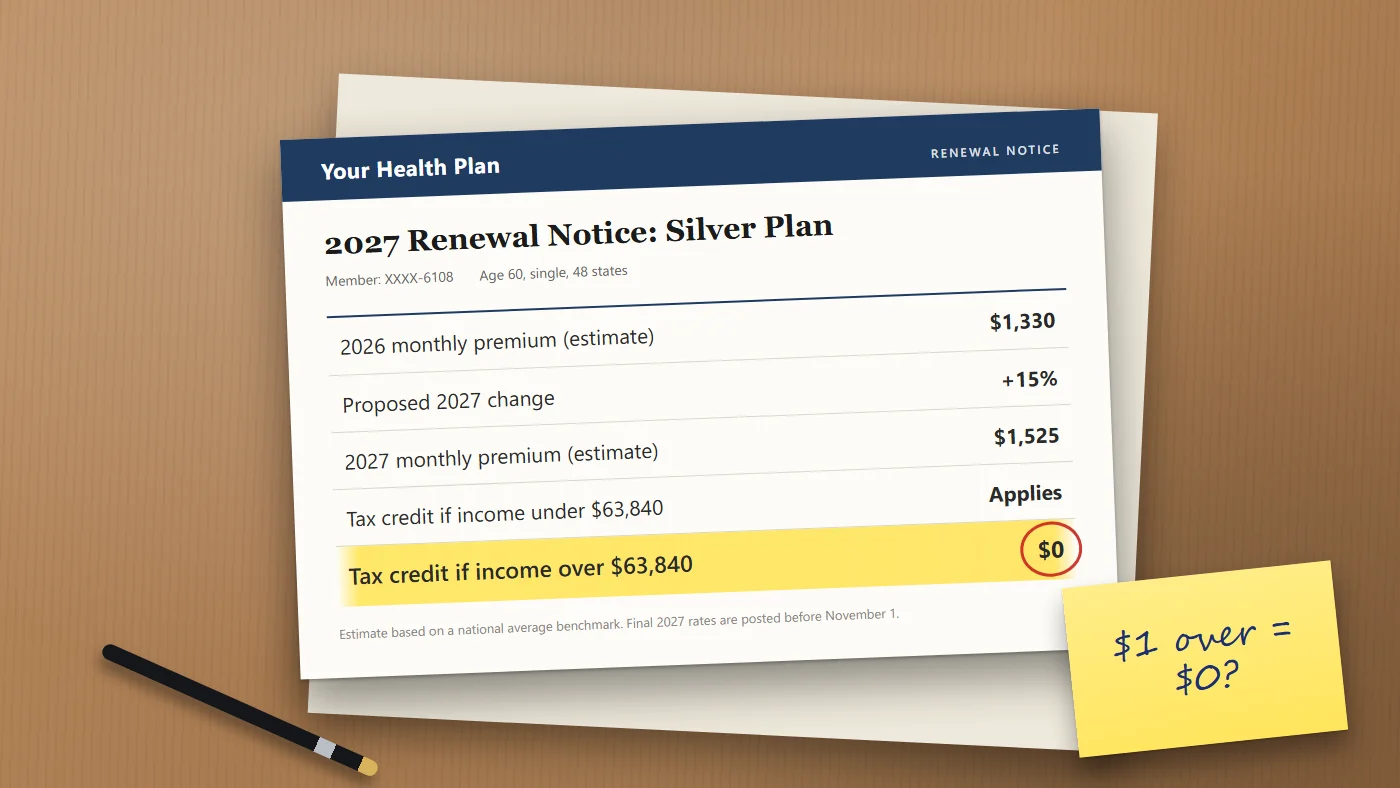
15%. That's the median premium increase ACA marketplace insurers have proposed for 2027, on top of a median 20% increase that was finalized for 2026, according to the Peterson-KFF Health System Tracker.
These are requests, not final prices. State regulators review them, and some get trimmed. Some go the other way. Last year the median proposal was 18% and the final figure landed at 20%. Final rates normally show up shortly before open enrollment starts on November 1.
For this age group, though, the rate increase is only half the story. Often it's the smaller half. The bigger one is a line on the income scale.
Why this lands hardest between 50 and 64
Two rules combine.
The first is age. HealthCare.gov puts it plainly: premiums can be up to three times higher for older people than for younger ones. A 15% increase on a 62-year-old's premium is a lot more dollars than 15% on a 30-year-old's.
The second is the subsidy cutoff. From 2021 through 2025 there was no upper income limit for the premium tax credit; if the benchmark plan cost more than 8.5% of your income, the credit covered the difference. That ended on December 31, 2025. The IRS now states the rule the old way: you may qualify if your household income is at least 100% but no more than 400% of the federal poverty line.
At 400%, the credit doesn't taper off. It stops.
For 2027 coverage the line is set with the 2026 poverty guidelines, because the marketplace uses the guidelines in effect when open enrollment begins.
| Household size | 400% of poverty line for 2027 coverage (48 states and D.C.) |
|---|
| 1 | $63,840 |
| 2 | $86,560 |
| 3 | $109,280 |
| 4 | $132,000 |
Alaska and Hawaii have higher figures.
What can one dollar over the line cost?
The prices below aren't quotes. They're our estimates. KFF reports that the national average benchmark silver plan for a 40-year-old costs $625 a month in 2026. Run that through the federal default age curve and the same plan for a 60-year-old comes to roughly $1,330 a month, or about $15,900 a year. If 2027 rates rise 15%, that's about $1,525 a month, or $18,300 a year.
Now take a single 60-year-old with $63,000 of income in 2027, just under the line. The IRS has set the 2027 cap at 10.22% of income for people between 300% and 400% of the poverty line, so her payment for the benchmark plan tops out around $6,440 a year. The tax credit covers the rest.
Give her $64,000 instead. The credit is zero, and she pays the full price. On these estimates that's about $18,300 against $6,440, a gap of close to $12,000 a year caused by an extra $1,000 of income. One dollar above $63,840 would do the same.
For a married couple it's worse. Two 60-year-olds pay two age-rated premiums, so the full price roughly doubles, while the line for a household of two only rises to $86,560. A couple with $86,000 of income would pay about $8,800 a year for the benchmark plan in 2027. At $87,000 they'd face the full price, around $36,600.
Your own numbers will differ, sometimes by a lot. Premiums vary widely by county, and a few states with their own marketplaces add state subsidies on top of the federal credit. The shape of the problem is the same everywhere.
There's a second effect, too. If your income is under the line, your payment for the benchmark plan is tied to your income, not the sticker price, so when rates rise 15% most of that increase is absorbed by a bigger tax credit. Over the line, all of it's yours.
So the most useful thing you can do before November 1 isn't guessing at premiums. It's working out where your 2027 income will fall and how much control you have over it. Many early retirees have more than they think, because they decide which accounts to draw from.
What to do before November 1
Most of this is homework you can do at the kitchen table with last year's tax return. Six steps, roughly in order.
- Start by estimating your 2027 income the way the marketplace counts it, which isn't quite the way you think of it at tax time. The figure is modified adjusted gross income. HealthCare.gov defines it as your adjusted gross income plus untaxed foreign income, non-taxable Social Security benefits and tax-exempt interest. In practice, pensions count, withdrawals from traditional IRAs and 401(k)s count, and so do capital gains. Social Security counts in full, even the part that isn't taxed. Qualified Roth distributions? Those don't.
- Find your line in the table above. Household size means the people on your tax return, not the people on the policy.
- How close are you? Well under the line, the rate increase will mostly land on the tax credit rather than on you, so put your time into picking a plan. Well over, go straight to plan shopping. If you're within a few thousand dollars either way, though, the next step can be worth a great deal.
- Near the line, look at the legal ways to lower countable income. These are the ones used most often, and a tax professional can tell you which fit: - An HSA does double duty. HealthCare.gov now says all Bronze and Catastrophic marketplace plans work with health savings accounts, and HSA contributions reduce your income for this purpose. The 2027 limit is $4,500 for self-only coverage and $9,000 for family coverage. Add $1,000 if you're 55 or older. - Still have earned income from work? Then contributions to a traditional IRA or a self-employed retirement plan are on the table. - Cover living expenses from Roth accounts or cash savings instead of a traditional IRA. - For one-time income, such as the sale of a property, a large capital gain or a Roth conversion, the year you take it is a choice. Make it on purpose.
- Report income changes during the year, because the cushion under a bad guess is gone. The IRS says that for tax years after 2025 there's no cap on repaying excess advance credits. Take the credit all year, land above 400% when the year closes, and you owe back every dollar at tax time. An unplanned IRA withdrawal in December can do it.
- Don't let the plan roll over on autopilot. Your county's benchmark plan can change from one year to the next, and your credit moves with it. Pull up the full list, make sure your doctors and hospital are in each network, and look up every prescription in each plan's drug list. Budget an evening.
Then mind the calendar, which got shuffled this year. On HealthCare.gov, enrollment for 2027 coverage opens on November 1, 2026. Want the new plan in place when the ball drops on New Year's Eve? Then you've got until the 15th of December to pick one. Miss that and you aren't locked out. You can still sign up through mid-January, January 15, 2027 to be exact, and your coverage would simply begin on February 1 instead.
You may have heard the season was getting cut short. A federal rule written in 2025 would have made mid-December the end of it, but a federal court tossed that change in June 2026, so HealthCare.gov still runs to January 15. States that run their own exchanges pick their own dates, which is one more reason to check yours. If it were my coverage, I'd treat December 15 as the hard stop anyway.
Leaving a job before 65?
The day employer coverage ends, you've got a choice to make, and the clock starts right away.
One option is COBRA, which lets you keep the employer's plan. After a job loss it usually runs for up to 18 months, and it generally applies to employers with 20 or more employees. What catches people off guard is the price. The Department of Labor says you can be charged up to 102% of the plan's full cost, which includes the share your employer used to pay. Plenty of people have never seen that figure before. It's a jolt.
The other door is the marketplace. Losing job-based coverage opens a special enrollment period, and you get 60 days to pick a plan. Retirement often comes with an income drop, which may put you under the 400% line for the first time in years.
Now the trap. Say you take COBRA and decide a few months in that it costs too much. If you drop it on your own outside open enrollment, HealthCare.gov says you generally have to wait for the next open enrollment to buy a marketplace plan. COBRA running out counts as a qualifying event. Deciding it's too expensive doesn't.
There are other COBRA alternatives. A spouse's employer plan usually lets you join within a limited window after you lose coverage, and some employers offer retiree health benefits. If your income will be low, Medicaid may be an option, depending on your state.
Short-term health plans are a different animal. They aren't ACA plans. They can turn you down or exclude conditions you already have, which matters at this age, and the federal ban on surprise bills doesn't apply to them.
Comparing plans once prices are posted
Compare on the whole year, not on the premium. That's twelve months of premium plus what you'd expect to pay under each plan's deductible and out-of-pocket maximum.
After 50, the big fork is usually Bronze with an HSA versus Silver. Bronze has the lowest premium and the highest deductible, and with an HSA the contribution can also help with the income line. Silver costs more each month and pays sooner. At or below 250% of the poverty line, Silver gets a boost you can't get anywhere else: cost-sharing reductions, which mean lower deductibles and come only on Silver plans.
Check networks by name. Your hospital, your specialists.
Then there's your 65th birthday. Medicare generally starts the first day of the month you turn 65, and marketplace tax credits stop once you're eligible for premium-free Part A. Turning 65 in 2027? Plan for part of a year.
You don't have to do this alone. HealthCare.gov and the state marketplaces list local assisters who help for free. Licensed agents and brokers can show you marketplace plans too, and the insurer generally pays their commission. Ask any agent two things: do they show every plan in your county or only some, and are the affordable health insurance options they present all ACA-compliant? Getting health insurance quotes from two sources, one of them the official marketplace site, is a sensible check.
Mistakes that cost the most
The expensive ones mostly come back to income. Guessing low and hoping is the first. With no repayment cap, an estimate that turns out too low becomes a tax bill.
People who claim Social Security at 62 get caught by the second: the whole benefit is added to marketplace income, the non-taxable part included.
Then there's the new roof. Pay for it with a large traditional IRA withdrawal late in the year, and it can push a household over the line and cost the entire year's credit.
Two more are about timing. A plan left to auto-renew may have changed its network, its drug list or its price relative to the benchmark. And dropping COBRA in the spring, outside open enrollment, usually leaves you with no way into the marketplace until fall.
The last is assuming the 15% applies to you. It's a national median of proposals. Your county's figure may be higher or lower, and if you get a tax credit, what you pay depends more on your income than on the rate filing.
Final 2027 prices should be visible when window shopping opens on the marketplace, shortly before November 1. Until then, the useful work is on your side of the table. Pull last year's tax return, add up what you expect to draw in 2027, and put that number next to your line in the table.
This article is general information, not financial, legal, tax or medical advice.