About 10 million U.S. owner families hold a timeshare, according to the industry's own trade group. Plenty of them signed years ago, when the kids were young and the sales presentation came with a free breakfast. Now the maintenance bill shows up every year, often a little bigger than the last one, for a week nobody uses anymore.
Will the resort buy it back for anything close to what you paid? No. Resale sites are crowded with identical weeks listed for a dollar and no takers. And the companies advertising "guaranteed timeshare cancellation" have a record that should worry you. In one case brought by the Federal Trade Commission and the Wisconsin Attorney General, a group of exit companies took more than $90 million from owners, mostly older adults. In April 2026 a federal court ordered the man who ran it to pay $140 million.
Yet there are legitimate ways out. The first one costs nothing. Even the FTC's own advice opens with a line most owners have never heard: start by contacting your timeshare company directly.
What follows walks through the exits in the order that costs you least, describes how a scam sounds on the phone, and takes on the question exit salesmen lean on hardest. Will your children be stuck with the fees?
$90 million and $140 million. The first is what the FTC says one group of timeshare exit companies took from consumers. The second is what a federal court ordered its operator to pay in April 2026: $95 million for consumer redress and a $45 million civil penalty. The FTC's complaint said the companies told owners they couldn't exit without paying, then denied nearly every refund.
Why can't you just sell it?
A timeshare isn't real estate in the usual sense, even when it comes with a deed. It's a crowded market with almost no buyers, and the few people who do want a week at your resort can usually get one from the developer in the lobby, with financing and a full sales staff eager to help, or on a resale site for next to nothing. The FTC puts it plainly: the market is overcrowded, and it might be hard, if not impossible, to sell a timeshare.
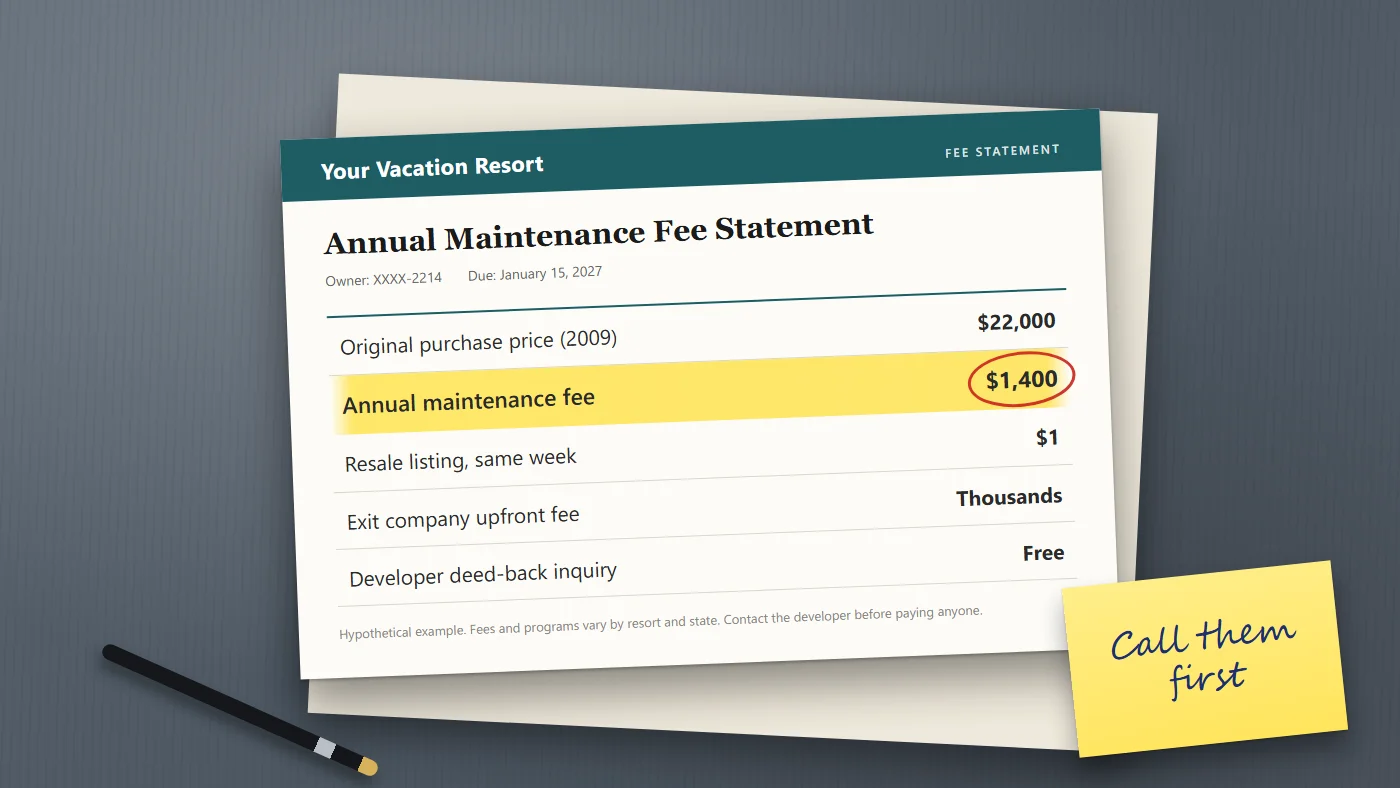
Say an owner paid $22,000 for a deeded week in 2009 and now pays about $1,400 a year in maintenance fees. On the resale market that week may be worth close to nothing. What she paid barely matters now. The $1,400 does, because it comes due every year for as long as she owns the week, plus any special assessment when the resort needs a new roof or a pool rebuilt.
Ten more years of that is $14,000, before a single increase.
That's why "we have a buyer for your unit" works so well as a lie, and why the FTC flags the "lots of buyers ready to purchase" pitch as doubtful.
The four exits, cheapest first
| Exit | Cost to you | Who it works for | Where it gets hard |
|---|
| Rescission (cancel the purchase) | Free | Buyers still inside the state's cancellation window | The window is short |
| Deed-back or buyback through the developer | Often free; sometimes a fee or one more year of dues | Owners who are paid up, with no loan balance | The developer decides, and not every resort has a program |
| Resale or giving it away | Low, if you pay nothing upfront | Desirable resorts and weeks | Most weeks sell for very little, and upfront-fee "listing" services are a red flag |
| Attorney-led exit | Legal fees | Owners with a real dispute: misrepresentation, fraud, an unenforceable contract | Costly, slow, and not a fit for "I just don't want it anymore" |
Even the Coalition for Responsible Exit, part of the owners' group ARDA-ROC, says it directly: you can exit your timeshare without an exit company, and the process is the same with or without one. Those words don't come from a consumer watchdog. They come from the industry.
Signed recently? Cancel now
Timeshare laws in many states give buyers a rescission period. In Florida, one of the biggest timeshare states, you have until midnight on the 10th calendar day after the later of two dates: the day you signed, or the day you received the last of the required documents. And that right can't be waived, by you or by anyone acting for you. Other states set their own windows, commonly somewhere between a few days and two weeks, so read the cancellation paragraph in your own contract.
Inside the window? Send a written cancellation exactly the way the contract says, usually by certified mail to a specific address. Do it today. Don't call the sales office first, and don't agree to an "upgrade" meeting.
A different rule covers contracts you signed with an exit company at a hotel seminar or in your living room. The FTC's Cooling-Off Rule gives you three business days to cancel many sales made at your home or at a seller's temporary location, like a rented hotel ballroom. Three business days, not ten. In the $90 million case, the FTC alleged that the companies pushed people into contracts they were told they couldn't cancel, in violation of that rule.
That covers the owners who moved fast. Everyone else has a longer road, and it starts with a phone call that costs nothing.
Step by step: the free exit first
- Pull the paperwork. Find the deed or membership certificate, the latest maintenance bill and any loan statement. Note whether the timeshare is deeded or a right-to-use membership, and whether you still owe on the purchase loan.
- Get current on fees. Nearly every developer program requires you to be paid up with no loan balance. If you're behind, ask about a payment plan before you ask about leaving.
- Call the developer, not the front desk. Ask for the department that handles ownership transitions, surrenders or deed-backs. Big developers run formal programs, while smaller resorts usually handle it through the homeowners' association. The Coalition for Responsible Exit keeps a "Find Your Timeshare Company" directory of developer contacts.
- Put three questions in writing. Do you have a deed-back, surrender or buyback program? What does it cost? What are the conditions? Keep the email or letter.
- If the answer is no, ask the homeowners' association. Some associations will take a deed in lieu of foreclosure, because a paid-up week they control is easier to manage than an owner who's stopped paying.
- Try the resale market with no money down. The FTC's rule of thumb is to work with a reseller that takes its fee after the timeshare sells. If a company wants money upfront, get its refund policy in writing first. Realistic prices are low. You're trying to stop the fees, not recover the purchase price.
- Consider giving it away. Family, a friend, or a charity that accepts timeshares. Whoever takes it has to understand they're taking on the fees. Transfers get recorded like any deed and usually carry a transfer fee from the resort.
- Only then consider paying someone. If you have a real legal dispute, such as a sales pitch that misrepresented the product, book a consultation with a licensed attorney in the state where the resort sits. A lawyer can tell you in one meeting whether you have a claim. An exit company can't.
If you only make one call this month, make it the one in step three.
What does the scam sound like?
It usually starts with an unsolicited call, a mailer or a free-dinner seminar invitation. From there the pitch tends to follow the same arc.
It opens with borrowed authority. In the FTC's case, the companies falsely used the logos of real timeshare companies and trade groups to suggest they were connected. Then comes the deadline: owners were told that if they didn't sign that day, they'd never be able to get out. Next comes the price: a big upfront fee, often several thousand dollars, wrapped in a "guarantee" and a money-back promise. And sometimes there's one more piece of advice, which the FTC lists as a warning sign: stop paying your mortgage or maintenance fees while the exit is "in process."
That last part does the real damage.
Stopping payment doesn't end the contract. It starts collections, late fees and, for deeded weeks, foreclosure, and all of it can land on your credit report. Even the owners' coalition puts it bluntly: the wrong advice can destroy your credit.
Two more tells are worth listening for. A company that promises to "contact the resort on your behalf" is charging you for a call you could make yourself for free. And a refund promise is only as good as the company's record of paying refunds; in the $90 million case, the FTC said the companies denied nearly every refund request, pointing to the pandemic or to lawsuits that didn't exist.
Before you pay anyone, the FTC suggests searching the company's name with the words "scam" or "complaint," and checking with your state attorney general and local consumer protection office. Then get every promise on paper.
A five-minute check before any contract
Still want help? Spend five minutes on these before you sign or pay.
- Who exactly is doing the work? If the answer is "our legal team," ask for the attorney's name, bar number and the state where they're licensed. A company that won't name a lawyer isn't offering legal work.
- What happens on day one? The only legitimate first step is contacting the developer. If the company describes something more mysterious, ask why you can't do that yourself.
- Is the fee due before or after the exit? After is the FTC's standard for resale. For any upfront payment, get the refund terms in writing, and note your three-business-day cancellation right if you signed away from the company's office.
- What are you told about the maintenance fees? Any advice to stop paying is the clearest warning sign in this business.
Will your kids inherit the fees?
Exit salesmen work this fear harder than any other. In the $90 million case, the FTC said the companies played on owners' worry that their heirs would be saddled with ever-rising fees. It deserves a straight answer. Two parts.
Debts don't vanish at death. Under the FTC's guidance, a deceased person's debts are owed by and paid from the estate, so if you die owning a timeshare, the unpaid fees can be billed to your estate, and your executor may have to sort out the week, whether by sale, surrender or transfer, before the estate can close.
But family members usually aren't required to pay a deceased relative's debts out of their own pockets, and the FTC says so just as clearly. The exceptions are narrow: someone who co-signed, a spouse in a community property state, or an executor who didn't follow the state's probate rules. A child who never signed the timeshare contract isn't personally on the hook just for being the owner's child.
State inheritance law also generally lets an heir refuse an inheritance, a timeshare included, by filing a disclaimer before the state's deadline. So tell your executor and your children, in writing, that they don't have to accept the timeshare unless they want it, and that the first call at that point should go to the developer about a surrender. Paying an exit company to "protect your kids" from an obligation they can decline makes little sense.
What to do this month
Pull the deed and the last fee bill. If you signed within the past couple of weeks, check your contract's cancellation deadline and mail the letter tonight. Otherwise, call the developer's ownership department and ask about deed-back in writing. If the answer is no, try a resale listing with no upfront fee, or a transfer to someone who actually wants the week.
Keep paying the fees while you work through it, and put the next due date on the calendar where you'll see it.
This article is general information, not financial, legal, tax or medical advice.