The CDC says more than 14 million older adults, about 1 in 4 people 65 and over, report a fall every year. In its recent data, falls among older people led to about 4.5 million emergency department visits a year, and about 1.4 million of those visits ended in a hospital stay. Add one more number: about 28% of adults 65 and older who live in the community live alone, according to the Administration for Community Living's 2023 profile.
Put those facts together and you've got the whole sales pitch for a medical alert system, a wearable button tied to a call center that answers around the clock. The pitch is simple. Pricing isn't.
The National Council on Aging, which reviews these systems and updated its cost guide in January 2026, puts the monthly monitoring fee at $20 to $60, with the average around $39.95. That's the number in the ads. The charge on your card can run much higher once a one-time equipment fee of up to $200, an activation fee of $25 to $100, fall detection at about $10 a month and a protection plan at up to about $7 a month get stacked on top.
Original Medicare doesn't pay for any of it. So this guide sticks to the money: what each fee buys, which ones you can decline, what a year really costs and what to check in the contract before the first charge. It won't tell you if you or a parent needs one. That's a family decision.
What does the monthly fee actually buy?
Monitoring. When the button's pressed, a call center operator answers through the device, talks to the wearer and calls a family contact or emergency services. That service is the product, and the hardware is mostly a way to reach it.
Systems come in two families. In-home systems use a base station plugged into a wall outlet, connected through a landline or a built-in cellular chip, with a button on a wrist or around the neck that works inside the home. Mobile systems are a single wearable with its own cellular connection and GPS, so the button works away from the house. They cost more.
NCOA's yearly estimates run $275 to $485 for an in-home landline system and $384 to $519 for a mobile one. Those assume the advertised monthly rate. The extras below are what push a real bill past them.
The number to remember: Monitoring is advertised at $20 to $60 a month. Add fall detection at about $10, a protection plan at about $7, and spread a $200 equipment fee over the first year, and a $30 plan can cost more than $60 a month in year one.
Five add-on fees, and which ones to push back on
Equipment: $0 to $200, one time. Some companies charge it, some waive it as an incentive, and some spread it into the monthly rate. Ask whether the device is bought or leased, and if it's leased, what you owe if it's lost or sent back late.
Activation or installation: $25 to $100. Not every company charges one. It's a fee to ask about dropping before you give a card number.
Fall detection: about $10 a month. People often assume it's included. It usually isn't. A sensor in the pendant or watch tries to spot a fall and call the center without a button press, but companies describe it as a backup to the button, not a replacement, and say it can miss falls or set off false alarms. Price the plan both ways.
Protection plan: $1 to about $7 a month. It covers loss or damage. Compare it with what the hardware costs to replace: if a pendant is $150 to replace and the plan is $7 a month, the plan only comes out ahead if you'd replace the device about every 21 months or sooner.
Accessories and caregiver apps. Wall buttons, lockboxes, a second pendant for a spouse, an app that shows a family member where the device is. Useful for some households. Optional for all of them.
It's the cable-bill pattern. The advertised price is real, and so are the add-ons, so write down the full first-year number before you hand over a card.
What a year costs, three ways
The table shows made-up but realistic first-year totals built from NCOA's published ranges. Your quotes will differ.
| Setup | Monthly fee | One-time fees | Add-ons per month | First-year total |
|---|
| In-home, no extras | $25 | $0 | $0 | $300 |
| In-home with fall detection | $30 | $50 activation | $10 fall detection | $530 |
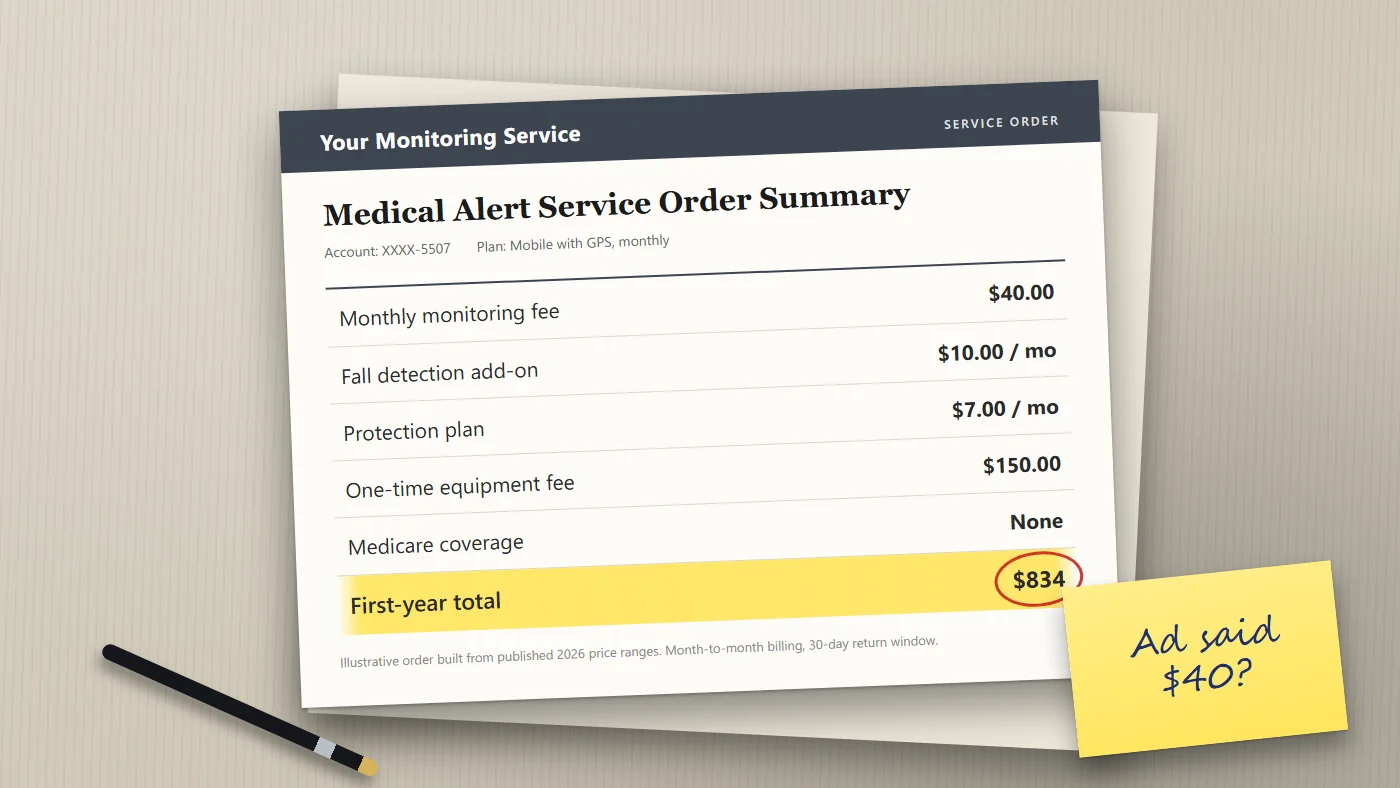
| Mobile with GPS, fall detection, protection plan | $40 | $150 equipment | $10 + $7 | $834 |
Between the cheapest and the fullest setup, the gap is $534 a year, and more of it comes from add-ons and the device than from monitoring itself. One-time fees hit hardest in year one, too. Comparing two offers? Look at the first 12 months and the second 12 months separately.
Is any of this covered? Barely. Original Medicare doesn't pay for medical alert systems. Some Medicare Advantage plans include one as an extra benefit, sometimes through a specific company. Long-term care insurance may cover part of the cost, though there can be a waiting period, and NCOA says eligible veterans may get a system free or at low cost through the VA. Everyone else pays full price.
That's what the ads leave out. The contract leaves out more.
The contract questions, step by step
None of these take long on the phone. What matters is asking them before you read out a card number, not after the box arrives.
- Get the full first-year price in writing, as one number in one email: the monthly fee, equipment, activation, fall detection, protection plan, shipping and any taxes. Ask for the regular rate too, the one that kicks in once a promotion ends.
- How you get out matters as much as what you pay going in. NCOA says some companies bill month to month with no penalty, while others require a three-month minimum, and a restocking fee of up to $50 can apply when equipment comes back early. So ask whether you can cancel only by phone, whether unused prepaid months are refunded, and who pays to ship the device back.
- The trial window. Return periods vary by company, and the small print decides whether a trial is worth anything. How long is yours? Does it start on the ship date or the delivery date? Does the equipment fee come back with the device?
- For an in-home system, ask whether the base needs a landline. Phone companies are retiring copper lines in many areas, and a landline system may have to be swapped for a cellular one later, with a new equipment fee. For a mobile device the question changes: which cellular network does it use, and has anyone confirmed coverage at your address?
- Say the button gets bumped while someone's gardening, and the center sends help nobody needed. Some companies, and some local governments, charge for repeated emergency dispatches that turn out to be accidental. Ask what that costs and how the center screens calls before it sends responders.
- Ask about price locks and annual prepay. Some companies discount a year paid up front, which is only a real discount if the refund policy returns the unused months when you cancel.
- Who gets called first? Most centers will call a family member or neighbor first if that's how you set it up. Confirm the contact list is free to change, and if you want a lockbox, get its price.
Afterward, keep the signed order form and the first three statements. If a charge doesn't match, those are what you dispute with.
Recurring charges and the law, in plain terms
A medical alert plan charges your card every month until somebody stops it. Legally, that makes it a subscription, and subscriptions come with rules.
If you sign up online, the company owes you a few things before that first charge. It has to spell out the recurring-charge terms clearly. It has to get your express consent. And it has to give you a simple way to stop the charges. Those requirements come from a federal law passed in 2010, the Restore Online Shoppers' Confidence Act.
You may have heard of "click-to-cancel." The Federal Trade Commission adopted a rule by that name in October 2024, meant to go further than the 2010 law. It never fully took effect. A federal appeals court struck it down on July 8, 2025, and in March 2026 the FTC asked for public comment on a new rulemaking, so that story isn't over.
Then there's your state. Many states have their own auto-renewal laws, and they don't match each other.
So what do you actually do with all that? Get the cancellation method in writing before you sign. When the time comes, cancel in writing and keep the confirmation, and screenshots of the sign-up page help, too. If the charges keep coming after you've canceled, dispute them with your card issuer, then file complaints with the FTC and your state attorney general.
What matters more than the brand
Most of the features in ads aren't the ones that decide whether a system works for a household.
Start with whether it'll get worn at all. A device in a drawer costs the same as one on a wrist. Systems now come as pendants, wristbands and watch-style devices, so if someone's likely to refuse a pendant, ask about the watch version and what it costs per month.
Charging is the quieter problem. Mobile devices need regular charging, and how often depends on the model. While it's on the charger, it isn't on anyone's wrist. Ask what the charging routine looks like and whether the base station has battery backup in a power outage.
Ask the company for its average answer time, too, and whether the center handles the language spoken at home. Test the button after setup. Then test it once a month, since tests are free.
Water resistance comes last on this list, not in importance. If the device has to come off for a shower, it's off for that part of the day, so check the rating before you buy.
Where a comparison search fits in
Once you've worked through the checklist with one company, doing two more takes about ten minutes. Don't lean on last year's comparison, because prices, trial windows and fees change often. Ask each company to email its current fee sheet with a date on it. That way you're comparing this month's prices and not a page somebody printed back in the spring.
What people type at this stage depends on who they're shopping for. A plain search for medical alert systems pulls up current monthly rates and which fees each company charges. Families buying for a parent tend to try best medical alert for seniors, then filter for month-to-month billing and a long trial window. When the wearer won't go near a pendant, fall detection watch is the search, and battery life and the fall-detection fee are the things to compare. Plenty of people who remember the old TV ads look up life alert cost, to see how the classic providers stack up against newer ones.
I'd put the full first-year number from each company side by side before looking at anything else. The lowest monthly rate in an ad is rarely the lowest year.
The short version
Monitoring runs $20 to $60 a month. The rest is extra, and in the examples above, equipment, activation, fall detection and a protection plan take year one from $300 to anywhere between $530 and $834. Original Medicare pays nothing. Some Advantage plans pay something.
Before the first charge, get two things in writing from any company you're considering: the full first-year price, and the cancellation terms.
This article is general information, not financial, legal, tax or medical advice.