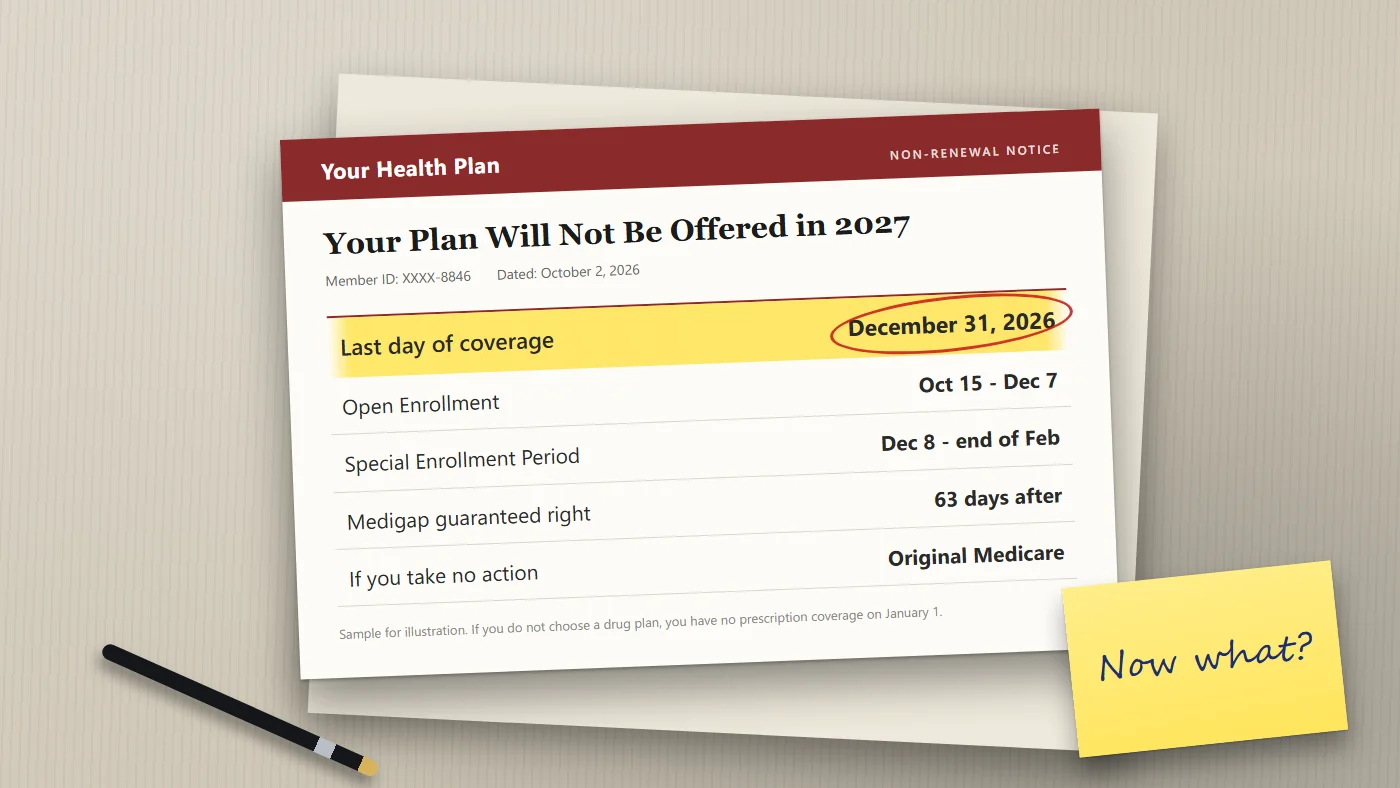
When an insurer decides not to offer a Medicare Advantage plan next year, federal rules make it tell members by mail at least 90 days before the plan ends. For a plan that stops on December 31, the letter is due by October 2. If your plan is going away in 2027, the notice is either in your mailbox now or about to be.
This used to be rare. Researchers at Johns Hopkins, writing in JAMA in February, found that from 2018 through 2024 about 1% of Medicare Advantage members a year were forced out of their plan because it closed or pulled out of their area. In 2025 it was 6.9%. For 2026 they estimated 10%, about 2.9 million people. In Vermont it was 92% of members, twelve states topped 20%, and rural areas took the worst of it.
Nobody has the 2027 count yet. It'll come after the federal government publishes next year's plan data and analysts add it up. Several big insurers have already said in public, including on calls with investors, that they're dropping more plans and leaving more counties for 2027.
If your plan's on the way out, two things are true at once. Your coverage works normally through December 31, so nothing changes at the doctor's office this fall. And if you do nothing at all, you'll start January in Original Medicare with no drug plan and no yearly limit on what you pay.
There's also something useful buried in that letter. It hands you a right most Medicare Advantage members don't have, and the right comes with a clock.
Three ways to check, fastest first
Call the number on your plan card. Ask one question: "Is my plan, in my county, being offered in 2027?" Give them the plan name and your ZIP code. It takes a few minutes, and you don't have to wait for the mail.
Look at the mail from your plan. A plan that's continuing sends an Annual Notice of Change by September 30. A plan that's ending sends a non-renewal notice. It says in plain words that your coverage ends December 31, lists other plans in your area and explains your special rights. The real one carries your plan name and member details. Be wary of look-alike mailers from sales agencies.
Check the Medicare Plan Finder. Starting October 1, Medicare.gov shows the plans available in your ZIP code for 2027. If yours isn't listed, or isn't listed for your county, you've got your answer.
"Ending" comes in three versions, and they don't work the same way.
- The plan is terminated. The insurer stops offering it anywhere. You get the rights described below.
- The plan leaves your county. It carries on elsewhere, but your area is cut from its service area. For you, the effect and the rights are the same as a termination.
- The plan is merged into another one. The insurer moves you automatically into a different plan it sells. You're not left without coverage, but the new plan can have a different network, drug list and out-of-pocket maximum. KFF found that for 2026, on top of 2.6 million people in terminated plans, another 1.3 million were in plans being consolidated. Your Annual Notice of Change will name the new plan. Read it like a plan you've never seen.
For 2026, about 1 in 10 Medicare Advantage members, roughly 2.9 million people, were forced to find a new plan. From 2018 through 2024 the rate averaged about 1 in 100.
What happens January 1 if you do nothing?
Medicare.gov puts the default in one sentence: you'll be enrolled in Original Medicare if you don't join another Medicare Advantage plan before your current plan ends.
Original Medicare is solid coverage, and most doctors and hospitals in the country take it. The default version has two holes, though. It doesn't include Part D, so you'd have no prescription coverage unless you pick a drug plan yourself. And it has no annual cap: after the Part B deductible, $283 in 2026, you owe 20% of most outpatient bills with no upper limit, and the hospital deductible is $1,736 per benefit period.
Say you land in Original Medicare by default and need a $4,000 outpatient procedure early in the year. Using 2026 numbers, you'd pay the $283 deductible plus 20% of the remaining $3,717, about $743, for roughly $1,026 in all. Nothing caps the next bill either.
Going without drug coverage can cost you later, too. If you go 63 days or more without Part D or other creditable coverage, a late enrollment penalty gets added to your drug premium for as long as you have Part D.
All of it's avoidable. You've got three real options, each with its own deadline, and one of them opens a door that people leaving Medicare Advantage usually find locked.
Your three options and their deadlines
| Option | Enroll by | Coverage starts | Watch for |
|---|
| Join another Medicare Advantage plan | December 31 for a January 1 start. Special window runs December 8 to the last day of February | First of the month after you enroll | A new network. Confirm each doctor and drug before you sign |
| Original Medicare plus a Medigap policy plus a Part D plan | Medigap: apply from 60 days before your plan ends until 63 days after | Medigap starts when your old plan ends, if you apply in time | The Medigap premium, and picking a drug plan separately |
| Original Medicare plus a Part D plan only | December 31 for a January 1 start | January 1 | No cap on your 20% share of medical bills |
Two details in that table matter more than the rest.
The special enrollment period for people whose plan isn't renewed runs from December 8 through the last day of February. It exists so you're not stuck if you miss December 7. But coverage from a new plan starts the month after you enroll, so if you wait until January to choose, you spend January in Original Medicare with no drug coverage. Enroll by December 31 to avoid a gap. Better still, decide during regular Open Enrollment, October 15 to December 7, while agents and counselors still have time for you.
And the Medigap clock runs from the day your coverage ends, not the day the letter arrives. For a December 31 end date, the 63 days run out on March 4. Circle it.
The Medigap right the letter gives you
Slow down here. This is where the letter is worth real money.
Medigap, also called Medicare Supplement Insurance, pays most or all of the 20% that Original Medicare leaves to you, and it lets you see any doctor who takes Medicare, with no network and no referrals. Getting in is the hard part. After your first six months on Part B, insurers in most states can ask about your health and turn you down or charge more because of it. KFF counts four states, Connecticut, Maine, Massachusetts and New York, that require insurers to sell Medigap to people 65 and older regardless of health, either all year or during a set period each year, and Minnesota has since passed a law adding an annual window for people 65 to 70.
A plan termination sets that rule aside for you. Under federal law, when your Medicare Advantage plan leaves Medicare or stops serving your area, you have a guaranteed issue right. An insurer selling Medigap in your state has to sell you a policy, can't charge more because of your health, and can't make you wait for coverage of a pre-existing condition. Medicare lists the policies you can buy with this right as Plans A, B, C, D, F, G, K or L, and C and F are open only to people who became eligible for Medicare before 2020.
The right only works if you go back to Original Medicare, and you have to apply no later than 63 days after your coverage ends. Keep the non-renewal letter. The Medigap insurer will want a copy as proof.
Is Medigap the better choice? Not for everyone. It has a monthly premium that rises over time; KFF found the average Plan G premium was $164 a month in 2023, from $140 in D.C., Hawaii and New Mexico to $236 in New York, and quotes for new buyers vary by age, ZIP code and insurer. You'd also pay for a separate Part D plan and give up extras like dental allowances. What you get back is predictable costs and no networks. If you've ever wondered whether you could go back to Medigap, this letter is the rare moment when the answer is yes without a health questionnaire.
Under 65 and on Medicare because of a disability? Medigap rules then depend heavily on your state. Call your state insurance department before you count on this option.
What to do, in order
- Confirm the facts. Call the plan and ask whether your plan is ending, leaving your county or being merged. Write down the date, the rep's name and what they said.
- Put the letter somewhere safe. You may need it to prove your right to Medigap or to a special enrollment period.
- List your doctors, hospitals, drugs and pharmacies. Exact drug names and doses. Every replacement plan gets measured against this list.
- Settle the big question first. Another Medicare Advantage plan, or Original Medicare with Medigap? The second costs more each month and less when you're sick; the first is the reverse. Your health, your budget and how much you travel all belong in that decision.
- Compare plans against your list. The Medicare Plan Finder covers Medicare Advantage and Part D plans. Medigap benefits are standardized by letter, so Plan G from one insurer covers the same things as Plan G from another. Price and rate history are what differ, which is why quotes from several insurers are worth the phone time.
- Call your doctors' billing offices. Don't lean on the online directory alone. Billing can tell you whether they'll be in network for the exact plan you're considering in 2027.
- Enroll by December 7 if you can, and by December 31 at the latest. Going the Medigap route? Apply as soon as you've chosen, and ask for a January 1 start date.
- Get it in writing. You should have an enrollment confirmation and a new card before January. If about two weeks go by and nothing has shown up, pick up the phone.
Comparing replacement plans in your area
When a big plan leaves a county, the insurers that stay know thousands of people are shopping at once, and your mailbox will show it. Medicare's marketing rules say agents aren't supposed to cold-call you about Medicare Advantage or Part D plans. If one does, hang up.
Hold every plan to the same test. Are your doctors and hospital in network? What do your drugs cost over a full year? Then check the hospital copay per day and the maximum out-of-pocket amount.
That last number does most of the sorting. Federal rules let a plan set its in-network maximum as high as $9,250 in 2026, and plenty sit well below it. Extras go at the bottom of the list, since they're the easiest part of a plan to cut the following year.
Few plans left in your county, as in a lot of rural areas? Then I'd price Medigap seriously while the guaranteed right is open. You may not get another chance without a health questionnaire.
The most neutral help is free. Your State Health Insurance Assistance Program, or SHIP, offers counseling at no cost and has nothing to sell; 1-800-MEDICARE can connect you to it. A licensed independent broker is the other route (federal rules cap what insurers pay them). Ask which insurers they represent in your county and whether they can quote Medigap as well as Medicare Advantage.
Mistakes that are hard to fix later
Don't count on the insurer moving you somewhere. It only does that in a merger. If your plan is terminated or leaves your county, the only place anyone enrolls you is Original Medicare.
Letting the 63 days slip past is the one you can't undo. Once they're gone, so is the guaranteed Medigap right, and in most states the health questions come back.
Choosing in January is allowed. It also means at least a month without drug coverage.
Then there's the first $0 plan that lands in the mailbox. A zero premium tells you nothing about whether your doctors are in it.
And don't let the letter go out with the junk mail. It's your proof of a right that's worth real money.
If the letter did come, the two dates to write on the calendar are December 31, to start the year fully covered, and early March at the outside for Medigap. If nothing has arrived by the first week of October, call the number on your card and ask the question from the top of this page.
This article is general information, not financial, legal, tax or medical advice.