Original Medicare will pay for heart surgery, cancer treatment and a week in the hospital. A cleaning, though? Nothing. The same goes for a filling, a crown, dentures, a routine eye exam, a pair of glasses or a hearing aid. Look any of those up on Medicare.gov and the answer comes back in one form or another: you pay all of it.
It catches people off guard every year. You may have paid the Medicare payroll tax through 40 years of work. Then the first big bill of retirement comes from a dentist, and Medicare isn't part of the conversation at all.
If that's you, you've got plenty of company. Nearly half of everyone on Medicare had no dental coverage of any kind when the health policy group KFF last took a detailed count, in 2019. That was 47%, or about 24 million people. Roughly the same share hadn't sat in a dentist's chair all year. And when people who went without needed dental, hearing or vision care were asked why, 70% pointed to the cost.
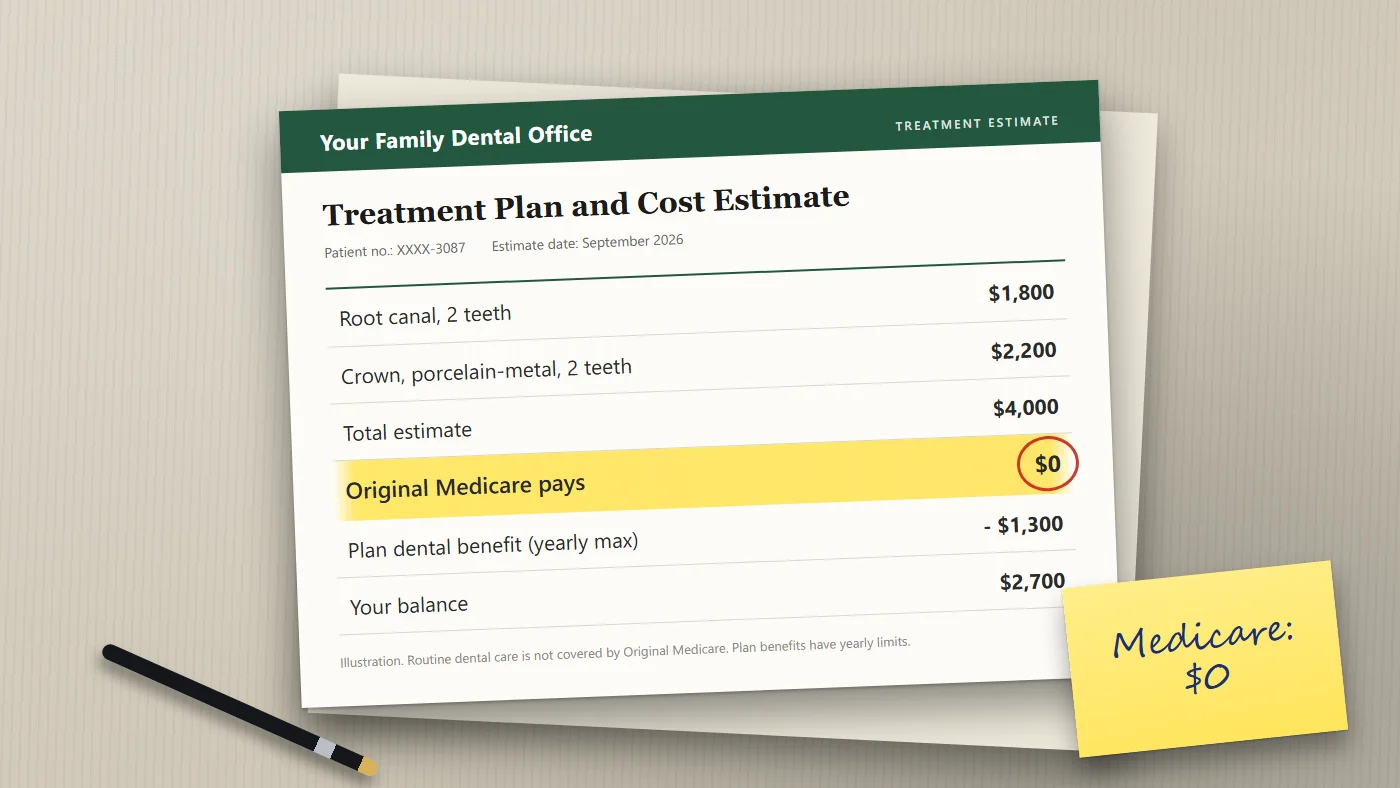
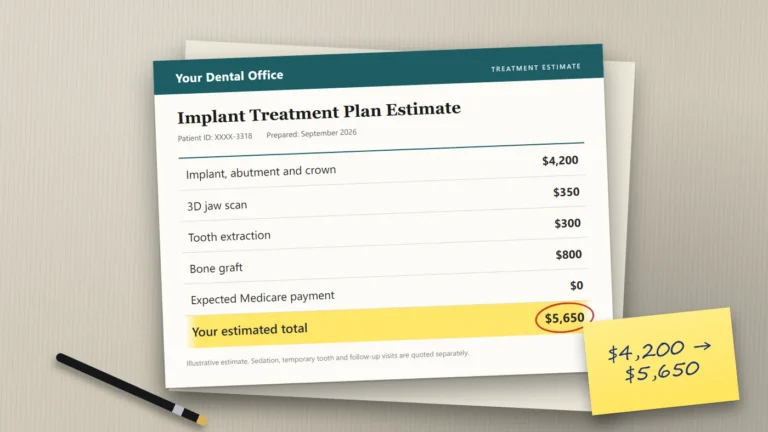
So put a price on it. Say you need a root canal and a crown on two teeth. The root canal alone can run $900 to $1,175, depending on the tooth. Then comes the crown, somewhere from $1,091 to $1,440 depending on what it's made of. (Those figures are Orlando, Florida prices from one large insurer's online cost tool.) Do it twice, once per tooth, and you're looking at something like $4,000 to $5,200. Your city and your dentist will push those numbers around. With Original Medicare alone, every dollar of it is yours.
The number to know: $0. Original Medicare pays nothing toward routine dental care, eyeglasses or hearing aids. So what do people end up spending? Among Medicare enrollees who used dental care, the average out-of-pocket bill for the year was $874. One in ten paid more than $2,000 (KFF, looking at 2018 data).
Teeth aren't even the most expensive per person. Hearing care came in higher in that same KFF analysis: $914 on average, for the people who paid for it. Vision was far lower, at $230.
What Medicare pays for, and the narrow exceptions
Why the hole? It was there on day one. When Medicare was created in 1965, routine dental, vision and hearing care didn't make it into the law, and in all the years since, Congress hasn't put them in.
| Service | What Original Medicare pays | The exception |
|---|
| Cleanings, fillings, extractions, crowns, dentures, implants | $0 | Dental care tied to certain covered treatment, such as an exam before a heart valve replacement or organ transplant, or treating a mouth infection before chemotherapy |
| Routine eye exams, eyeglasses, contact lenses | $0 | One pair of standard glasses or contacts after cataract surgery with a lens implant. You pay 20% after the Part B deductible |
| Hearing aids and fitting exams | $0 | Diagnostic hearing and balance exams are covered under Part B |
Eye disease is a different matter. Cataract surgery, glaucoma tests for people at high risk, yearly diabetic eye exams and treatment for macular degeneration all fall under Part B. What's excluded is the routine exam for glasses, and the glasses.
Doesn't Medigap fill that in? No. A Medicare Supplement policy pays your share of what Medicare covers, and when Medicare pays nothing, a standard Medigap plan pays nothing too. Some insurers sell dental or vision add-ons next to their Medigap policies, but that's a separate product with its own price tag.
Why "my plan includes dental" is only half an answer
If you do have this coverage, odds are it came with a Medicare Advantage plan. Nearly all of them offer something now. KFF's 2026 review of individual plans found some kind of dental benefit in 98% of them. Vision was even more common, at 99%, and hearing matched dental. Many of these plans don't cost you extra, either: two-thirds of the ones with drug coverage charge no premium beyond Part B.
Watch that word "some." Once KFF dug into plan details, using 2021 data, the limits looked like this:
- Dental: the plan's yearly payout topped out at about $1,300 on average. About 59% of enrollees had a cap of $1,000 or less. For major work, the most common cost share was 50%.
- Hearing: an average yearly limit of about $960, often one set of aids per year or every few years, through the plan's own supplier.
- Vision: about $160 a year toward eyewear, on average. For 45% of enrollees, the allowance was $100 or less.
Now run the $4,000 example through a plan like that. Paying 50% of major work, it would owe $2,000. The yearly cap stops it at $1,300, and you pay the other $2,700. That's real help. It just isn't what most people picture when an ad says dental is included.
And none of it is fixed. Say your dental cap is $2,000 in 2026; nothing stops the plan from making it $1,000 in 2027. You'd find out from the Annual Notice of Change, which your plan has to send by September 30.
The useful question, then, isn't "Do I have dental, vision or hearing coverage?" It's how many dollars that coverage pays in a year, for which services, at which offices. There are five common ways to get it, and each answers that question differently.
Five ways retirees cover dental, vision and hearing
1. A Medicare Advantage plan with the benefits built in. Often there's no extra premium. You trade that for the yearly caps above, a dental network that may not include your dentist, and a bigger change: Medicare Advantage runs all of your care, not just your teeth. Picking a whole health plan for a $1,300 dental benefit gets things backward. If you're already in Medicare Advantage, though, comparing the dental, vision and hearing allowances among plans in your county can pay off.
2. A stand-alone dental insurance plan. Anyone can buy one, including people on Original Medicare with Medigap. Premiums depend on the plan, your age and where you live. Most have a yearly maximum, often somewhere between $1,000 and $2,000, and many make you wait six to twelve months before they'll pay for major work like crowns, bridges or dentures. Plans that advertise no waiting period usually make up for it with a higher premium or a lower first-year maximum. Implants are often excluded or limited. Read the schedule of benefits before you buy, not after.
3. A dental savings plan. It's a membership, not insurance. You pay a yearly fee and get set discounts at participating dentists, with no yearly cap and no waiting period, which helps if you need a lot of work soon. Nobody else pays any part of the bill, though. Ask the dentist's office for the exact discounted price of your procedure before you join.
4. Stand-alone vision insurance. These usually cover a yearly exam plus an allowance for frames or contacts, for a low monthly premium. Add up twelve premiums and set that against what an exam and glasses cost at a warehouse club or an online retailer. With a basic prescription, paying cash often comes out close. Progressive lenses, a high prescription or a habit of breaking frames can tip the math the other way, so run it with your own numbers from last year's receipts rather than the plan's brochure.
5. Paying directly, on purpose. Some retirees put aside a set amount each month instead of buying coverage. Still have a Health Savings Account from your working years? You can spend it tax-free on dental work, glasses and hearing aids after you're on Medicare. You just can't add new money to it.
Hearing aids got cheaper to reach
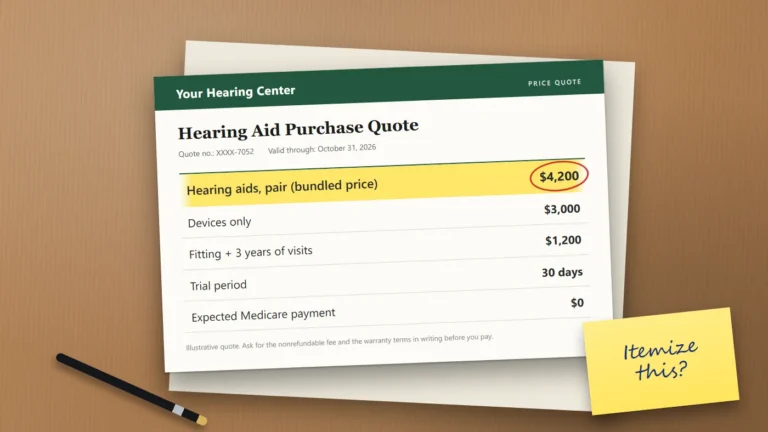
For decades, the only way to buy hearing aids was through a licensed professional, and a pair could cost several thousand dollars. Among Medicare enrollees who paid for hearing care in 2018, the top 10% spent $3,600 or more in that one year, going by KFF's numbers. Then, in 2022, the FDA created a category of over-the-counter hearing aids. If you're an adult, 18 or older, and you believe your hearing loss is mild to moderate, you can now buy them in a store or online. No exam. No prescription or fitting appointment either.
Over-the-counter models are generally priced well below prescription aids. They aren't meant for severe loss, and you fit and adjust them yourself. If your hearing loss came on suddenly, affects one ear, or comes with pain or dizziness, see a doctor first. Part B covers a diagnostic hearing exam.
Two more routes get missed. Veterans enrolled in VA health care may be able to get hearing aids through the VA. And if you're in a Medicare Advantage plan, check its hearing benefit before you shop on your own, since some plans offer aids at fixed copays through a contracted supplier.
How to choose, step by step
- List what you expect to need in the next 12 months. Ask your dentist for a written treatment plan with procedure codes and prices. Do the same for glasses and hearing.
- In Medicare Advantage? Open your Evidence of Coverage. Find the dental, vision and hearing sections and write down the yearly maximum, your cost share for major services, and whether you have to use network providers.
- Call your dentist's office. Ask which plans they take, including Medicare Advantage dental networks and savings plans. A plan your dentist doesn't accept is worth a lot less to you.
- Price the stand-alone options. For each dental plan, note the yearly premium, the yearly maximum, the waiting period for major work and the percentage paid. Subtract the premium from the most the plan could pay. That's your best case.
- Compare in the right window. Medicare Advantage changes happen during open enrollment, October 15 to December 7, for coverage starting January 1. Stand-alone dental and vision plans can usually be bought any time of year.
- Ask for the cash price. Plenty of dental offices discount payment in full or run their own membership plan. Ask before treatment.
If I were facing a big dental estimate, step 1 is where I'd start, because every comparison after it depends on having the codes and prices on paper.
Lower-cost care that doesn't depend on insurance
Not every fix is a policy. Some of the biggest savings come from where you get the care.
- Dental schools. Students treat patients under licensed dentists' supervision, often at a steep discount. Appointments take longer.
- Community health centers. Federally funded centers charge on a sliding scale by income, and many have dental clinics. You can search at findahealthcenter.hrsa.gov.
- Medicaid. If your income is low enough to qualify for both Medicare and Medicaid, your state's program may cover some dental, vision or hearing care. Adult dental benefits vary a lot by state.
- The medical expense deduction. It only helps if you itemize, and only for the part of your medical and dental costs above 7.5% of your adjusted gross income. Dental treatment, dentures, eyeglasses, contact lenses and hearing aids all count, per IRS Publication 502. A year with a very large dental bill is the year it can matter.
Mistakes that cost the most
- Buying dental insurance the week you need a crown. A waiting period can mean the plan pays nothing for it.
- Reading the premium and skipping the yearly maximum. A $1,000 cap doesn't go far against a $4,000 treatment plan.
- Switching to Medicare Advantage just for dental. In most states you may not be able to get a Medigap policy back later without answering health questions.
- Assuming next year's benefit matches this year's. Check the Annual Notice of Change every September.
- Skipping the written estimate. Without codes and prices, you can't compare any of these options.
Nothing in the 2027 rules adds routine dental, vision or hearing to Original Medicare. Ask your dentist for the written treatment plan this month, put each option's yearly maximum in the next column, and the gap you'd pay yourself will be sitting right there in the last one.
This article is general information, not financial, legal, tax or medical advice.