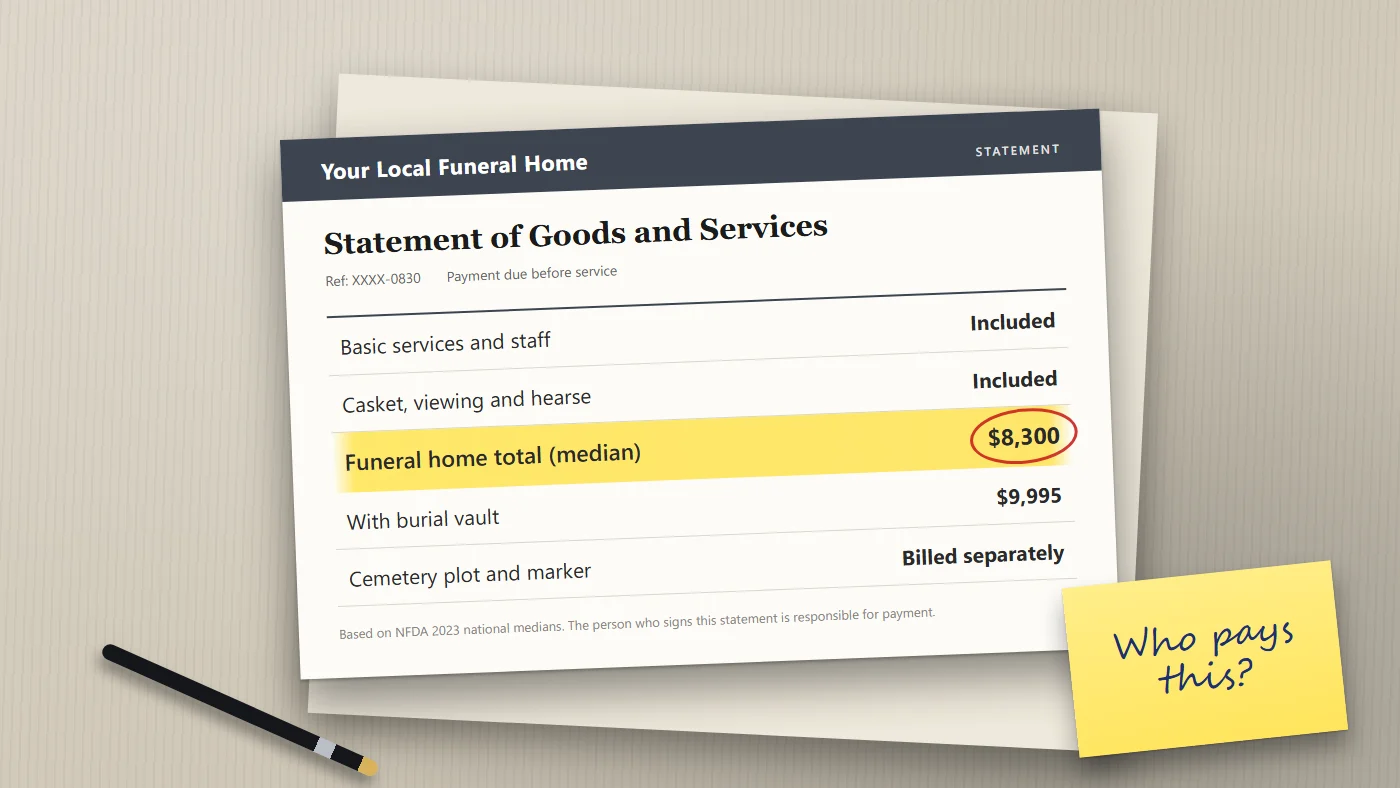
A funeral with a viewing and burial had a median price of $8,300 in the National Funeral Directors Association's 2023 price study, the latest it has released. That covers only the funeral home's side of things: the basic services fee, embalming, a metal casket, the viewing and the hearse. Add a burial vault, which many cemeteries require, and the median climbs to $9,995. Three years of inflation later, you should expect local prices to be higher.
None of that includes the cemetery. The plot, the fee to open and close the grave, the headstone, flowers and the obituary are billed separately and can add thousands. A funeral with a viewing followed by cremation had a median of $6,280.
Someone has to agree to pay within days of a death, usually before an estate is opened and often before any bank account is released. Many funeral homes ask for payment, or for a life insurance policy they can bill, before the service. And the person who signs the funeral home's contract is the person on the hook for it.
That's the problem final expense insurance is sold to solve. It's a small whole life policy, usually $5,000 to $25,000, with no medical exam, that pays your beneficiary fast so nobody has to put a funeral on a credit card. For some people it's a sensible buy. For others it's an expensive way to save $10,000. Your age, your health and what you already have decide which.
What happens when nothing is set aside?
A family member sits down with a funeral director, picks services and signs. If there's a life insurance policy, many funeral homes will take an assignment of part of the death benefit and wait for the insurer to pay them. If there isn't, the family pays by card, check or loan and tries to get reimbursed from the estate later.
Your estate is responsible for your funeral costs. But an estate can take months to open, gather assets and pay its bills, while the funeral home usually wants its money, or a policy it can bill, before the service is held. Social Security pays a one-time $255 death payment to a surviving spouse or eligible child, and it has to be claimed within two years. That amount hasn't changed since 1954, which tells you roughly how far it goes against an $8,300 bill.
When a family really can't pay, the options shrink quickly. Direct cremation with no service costs far less than a traditional funeral. Some counties and states run small burial assistance programs, with rules and amounts that vary a lot by location. Veterans may qualify for VA burial benefits. None of it is what most people would pick. That's where the insurance pitch comes in.
What a $10,000 policy costs by age
How much, then? Two 2026 rate surveys give a realistic range. The low end is the cheapest policy in a quote survey dated March 9, 2026, for non-tobacco users. The high end is the average across carriers in MoneyGeek's analysis for nonsmokers. Both are for policies with health questions and no waiting period.
| Age at purchase | Woman, $10,000 policy | Man, $10,000 policy |
|---|
| 50 | $24 to $30 a month | $31 to $38 a month |
| 60 | $33 to $42 a month | $43 to $53 a month |
| 70 | $53 to $64 a month | $70 to $84 a month |
| 80 | $98 to $125 a month | $135 to $164 a month |
| 85 | $136 to $155 a month | $178 to $203 a month |
The premium is locked for life once you buy, which sounds reassuring until you notice how fast the starting price climbs while you wait: in the carrier-average data, rates jump 44% for women and 45% for men between 75 and 80 alone.
Men pay roughly 30% more than women of the same age, since women live longer on average. Tobacco pushes the price higher still. Much higher. And these are prices for someone in reasonable health; a history of heart trouble, cancer or diabetes complications can bump you into a pricier kind of policy, covered below.
Now the math the brochures skip.
A 70-year-old woman paying $64 a month puts in $768 a year, so a little past the 13-year mark she's paid more than the $10,000 her family would get. An 80-year-old man at $164 a month crosses that line in just over five years.
That doesn't make the policy a bad deal. Insurance is for the years before you've saved the money. If she dies in year three, her family gets $10,000 after she paid about $2,300. But if you already have $10,000 you could set aside and leave alone, buying the policy is basically a bet that you'll die sooner than the insurer expects.
Which kind of policy you qualify for changes that math more than anything else, and it comes down to how you answer a short list of health questions.
Simplified issue or guaranteed issue?
There are two main types, and agents don't always say which one they're quoting.
Simplified issue policies ask health questions but skip the exam. The insurer checks your prescription history and other records, and if you're approved, the full death benefit applies from day one. The prices in the table are for this type.
Guaranteed issue policies ask nothing about your health, and nobody's turned down, usually from somewhere around 45 or 50 up to 80 or 85 depending on the company. You pay for that twice. First, the premium's higher: MoneyGeek puts the average for a $15,000 guaranteed policy at $113 a month for a 70-year-old woman and $145 for a man, against roughly $80 and $105 for the cheapest simplified issue policies of the same size. Second, nearly all of them have a graded benefit, which means that if you die of an illness in the first two years, your beneficiary gets back the premiums you paid (some insurers add interest) instead of the death benefit. Accidental death is usually covered in full from the start.
So who should buy guaranteed issue? People who've been declined, or would be, because of a serious diagnosis. If you take a few common medications and haven't been in the hospital lately, you can often qualify for a policy with health questions, a lower price and no waiting period. Plenty of people buy guaranteed coverage off a TV ad or a mailer and never find that out.
Every life policy also has a contestability period, typically the first two years, during which the insurer can pull your application after a death, compare it with your medical and prescription records, and deny the claim if the answers were materially false. Answer the health questions accurately, even when it raises the price.
Seven steps before you buy
- Price the funeral you actually want. Under the FTC's Funeral Rule, funeral homes have to give you prices over the phone and hand you a written General Price List in person. Call three. You can buy only the items you want, and you can supply a casket or urn bought elsewhere without paying a handling fee. The gap between a full traditional service and a simple cremation can run many thousands of dollars, and it sets how much coverage you need.
- Add the cemetery. Ask for the plot price, the opening and closing fee, any vault requirement and the marker. None of it is in the funeral home's quote.
- Count what you already have. Life insurance from a former employer or union, an old paid-up policy, savings, the $255 Social Security payment. A bank account with a payable-on-death beneficiary goes to that person without probate, which makes it an easy way to earmark funeral money.
- Find the gap. If the funeral you priced is $11,000 and you have $4,000 set aside, you're shopping for about $7,000 to $10,000 of coverage, not $25,000.
- Try for a policy with health questions first. Ask each agent or company directly: is this simplified issue or guaranteed issue, and is there a waiting period or graded benefit?
- Compare the same amount across several insurers. In the table, the gap between the cheapest price and the average runs from about 14% to 28% for identical coverage. Confirm the premium is level for life, the death benefit never drops, and the policy builds cash value. Then look up the company and the agent on your state insurance department's license search.
- Tell your beneficiary where the policy is. A policy nobody knows about pays nobody. If a family ever has to go looking, the National Association of Insurance Commissioners runs a free Life Insurance Policy Locator.
When the policy arrives, read it. You'll have a free-look period, at least 10 days in most states and longer in some, to send it back for a full refund.
When it's worth it, and when it isn't
It tends to make sense if you have little or no savings you could leave untouched, no other life insurance, a preference for a traditional burial and the health to qualify without a waiting period. It also suits people who know that money sitting in checking will get spent on a new roof or a car repair long before anyone needs it for a funeral, because a premium works as forced saving with a payout that shows up exactly when it's needed.
It tends not to make sense if you already have a life policy of any size that'll still be in force, or if you can put $8,000 to $12,000 into a payable-on-death account today. It's also a poor fit if you're in your 80s and the premium would squeeze your monthly budget. A lapsed policy pays nothing. These policies most often fail because the owner stops paying a few years in.
Two look-alikes deserve caution. Prepaid funeral plans, sold by funeral homes, lock you into services at one provider, and the FTC notes that state protections for that prepaid money vary widely. Ask what happens if you move, cancel or the business closes. And mailers promising a "state-regulated" or "new benefit" program for seniors are insurance ads, not government programs. Apart from the $255 payment, VA burial benefits for eligible veterans and FEMA funeral help (up to $9,000) after deaths caused by a declared disaster, there's no federal program that pays for funerals.
How do I compare quotes without getting burned?
If you've worked through the steps and the answer's yes, the shopping part is simple. These policies are close to identical from one company to the next. What differs is price, underwriting and the waiting period.
Get quotes on the same face amount from at least three insurers, or from an independent agent who represents several, and give each one the same health information. For every quote, write down:
- the monthly premium
- whether the full benefit applies from day one
- whether the premium is guaranteed never to rise
- the company's financial strength rating
If one quote is far cheaper than the rest, find out whether it's a term policy that ends at 80 or a policy whose benefit shrinks with age. Both exist. Both get sold as "burial insurance."
Planning on cremation? Price that first. A direct cremation with a memorial gathering later can cost a fraction of the $6,280 median for a full service with cremation, and a smaller bill might mean a $5,000 policy, or none.
If you've been declined elsewhere, compare guaranteed issue policies on two points: the price per $1,000 of coverage and exactly what's paid during the first two years.
Before you sign anything
Price the funeral, subtract what you have, and insure the gap and nothing more. If you're going to buy, doing it in your 60s or early 70s costs far less than waiting, and a policy you qualify for with honest health answers beats one with a two-year wait.
If I could get people to do one thing, it'd be the phone calls in step 1. Three funeral homes, one written price list each. Then put the policy, or the payable-on-death account details, in the same folder as your will and tell the person who'll be making that first call where it is.
This article is general information, not financial, legal, tax or medical advice.