Nobody wants to price out a nursing home. But if a parent or a spouse needed one next month, you'd want the number, so here it is. A shared room runs about $315 a day at the national median. Over a year that's $114,975. Want a private room? Closer to $129,575. Those medians come from CareScout's 2025 Cost of Care Survey, which came out in March 2026.
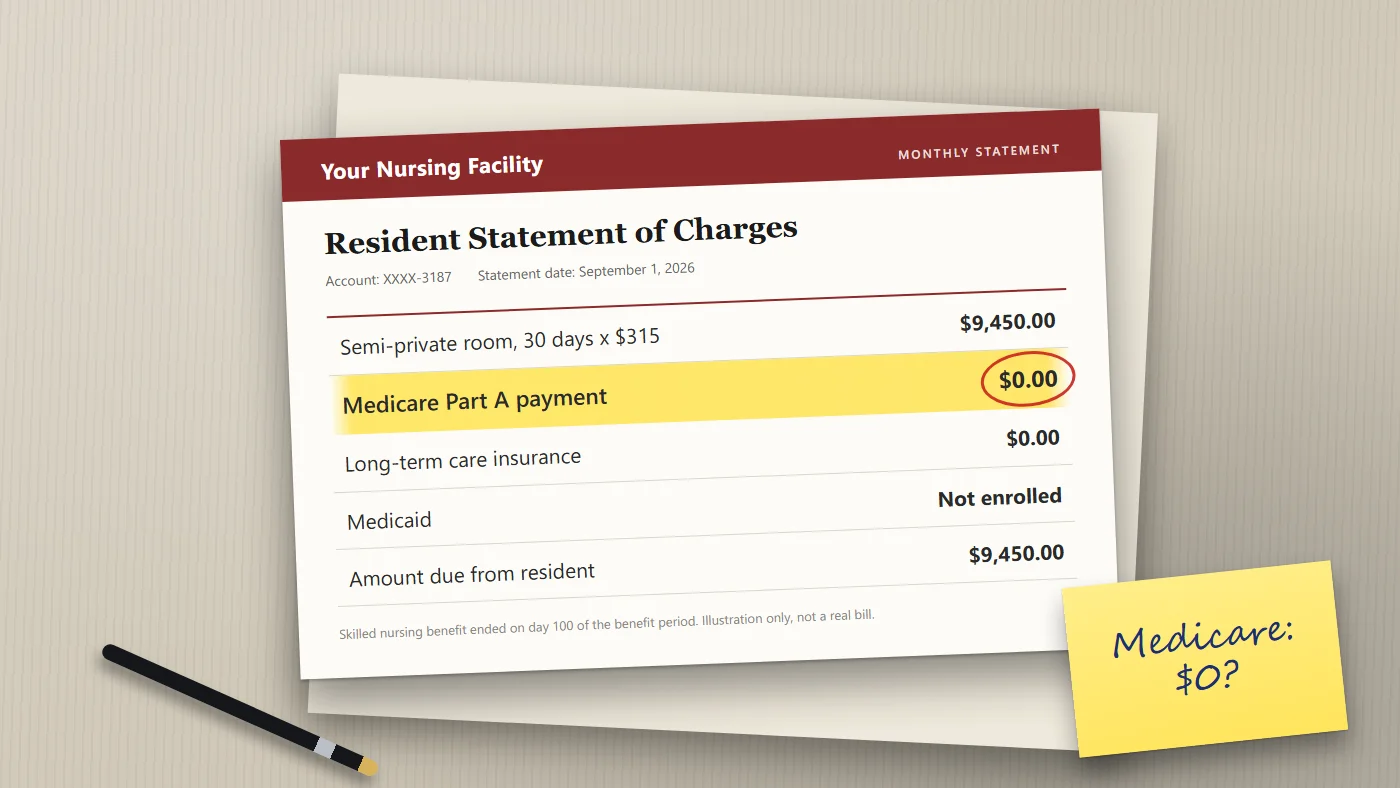
Now the part that catches families off guard. Medicare won't pay it. Its own website is blunt about that: "Medicare doesn't pay for long-term care." It'll cover a short stretch of skilled rehab after a hospital stay, and even that help stops on day 101.
So the money comes from somewhere else. First the family's savings. Then, when those run dry, Medicaid. That's how most nursing home stays end up getting paid, whether anyone planned it or not: of the roughly 1.24 million people in certified nursing facilities in July 2025, 63% had Medicaid as their main payer, KFF found.
A long shot? Probably not. If you're turning 65 now, your odds of needing some kind of long-term care are close to 70%, by the federal Administration for Community Living's estimate. And it's rarely quick. The average woman needs help for 3.7 years. For men it's 2.2. About one person in five will need it for more than five years.
For families, the bill starts before any invoice does. Maybe you're 55 and already driving to a parent's house twice a week. Then you're watching two things at once: their care now, and a preview of your own. You've got plenty of company, too, about 63 million family caregivers in 2025 by the count from AARP and the National Alliance for Caregiving. That's nearly 50% more than in 2015.
What care costs right now
Long-term care means help with ordinary life: bathing, dressing, eating, getting out of a chair, staying safe with dementia. It's custodial care, not medical treatment, and that label decides who pays.
The survey behind these national medians gathered more than 25,000 rates between July and November 2025.
| Type of care | Median rate | Per year |
|---|
| Nursing home, private room | $355 a day | $129,575 |
| Nursing home, semi-private room | $315 a day | $114,975 |
| Assisted living, one bedroom | $6,200 a month | $74,400 |
| In-home caregiver, 44 hours a week | $35 an hour | $80,080 |
| Adult day health care, 5 days a week | $95 a day | $24,700 |
Once you need most of a work week covered, care at home stops being a bargain; it costs more per year than a one-bedroom in assisted living. Assisted living, meanwhile, had the biggest increase of any category, up 5% in a year.
Prices swing by state and even by county. CareScout's lookup tool goes down to the ZIP code.
What does Medicare actually pay?
Part A covers a skilled nursing facility only when all of these line up. You were admitted to a hospital as an inpatient for at least three days in a row. You enter the facility within about 30 days of leaving. A doctor says you need daily skilled care, such as physical therapy or wound care.
Days spent in the hospital "under observation" don't count toward the three, even if you slept in a hospital bed the whole time. Ask the staff plainly: am I an inpatient?
If you qualify, the 2026 math per benefit period goes like this. Days 1 through 20 cost nothing beyond the $1,736 Part A deductible. Days 21 through 100 cost $217 a day. From day 101, it's all on you.
The number to remember: a full 100-day Medicare stay can still leave you with $17,360 in daily coinsurance (80 days at $217). After day 100, Medicare's share is $0.
Many Medigap plans pay that $217, so check yours. Medicare Advantage plans set their own copays for these days. Neither one pays for a permanent stay.
Coverage often ends well before day 100. Medicare pays while you need skilled care, and once the need drops to help with bathing and dressing and getting to the table, the benefit stops, whatever the calendar says. You do have the right to a fast appeal. The facility's notice explains how, and the window is short, so read it the day it arrives.
If you're married: what the healthy spouse keeps
Couples lose sleep over this one. One spouse moves into a nursing home, and the other watches the savings drain at about $9,600 a month.
Federal law does put a floor under the spouse who stays home, the one Medicaid calls the community spouse. Start with savings. In 2026 that spouse can keep as much as $162,660 in countable assets. The floor is $32,532, and your state's math decides where you land. The house, one car and personal belongings generally don't count while the spouse lives there.
Income gets a floor too. Since July 1, 2026, the at-home spouse's minimum monthly allowance has been $2,705, in every state but Alaska and Hawaii. The cap is $4,066.50.
The spouse in the nursing home gets far less room, usually $2,000 in countable assets. A few states go higher. California, which brought back its asset test in January, uses $130,000.
None of that makes the problem go away. It does mean "we'll lose everything" is usually wrong, and that the order in which you spend money matters a lot. Couples who learn the rules early tend to keep more than couples who learn them from the facility's billing office.
That's the price tag and the Medicare gap. The harder part is the decision: which of four ways to pay, what a policy costs at 55 or 65, and what to do while you still have choices.
Four ways families pay
Nearly everyone starts with their own money: savings, retirement accounts, a pension, the sale of a house. How far does it go? At $74,400 a year for assisted living, $300,000 lasts about four years. That's before prices go up.
Traditional long-term care insurance comes next. You pay a yearly premium, and if you later can't manage two of six daily activities or you develop a serious cognitive impairment, the policy pays a daily or monthly benefit until a lifetime pool runs out. Dollar for dollar, it buys the most coverage.
Its weak spot is pricing. Insurers can ask state regulators to raise rates on a whole block of policyholders at once, and plenty of older policies have taken big increases.
Hybrids suit people who can't stomach that. They're life insurance or an annuity with a long-term care rider. If you need care, the policy pays by drawing down the death benefit; if you don't, your heirs collect it. Premiums are often guaranteed, so there's no rate-hike risk. You pay for that certainty up front, often with a single lump sum or ten yearly payments.
Then there's Medicaid. It pays for nursing home care in every state, and for care at home through waiver programs that often have waiting lists. You'll need to meet strict income and asset limits, and the state combs five years of bank records for gifts. Rules vary by state, and our guide to the five-year look-back covers what they mean for a house.
Veterans may have a fifth source: the VA's Aid and Attendance benefit, which adds to a pension for wartime veterans and surviving spouses who need help with daily activities. A county veterans service officer can check eligibility for free.
What a policy costs in 2026
The most useful yardstick is a yearly price index from the American Association for Long-Term Care Insurance. Its 2026 edition prices a policy with $165,000 of initial benefits for a buyer in select health, using Illinois rates as of July 2026. Read them as averages, not quotes.
Start with a single man of 55. Level benefits cost him about $950 a year. Ask for benefits that grow 3% a year and the price is $2,200, more than double.
A single woman the same age pays about $1,500 for the level version and $3,750 with 3% growth. Women pay more because, on average, they collect more.
Couples do a little better. At 55, a couple pays about $2,080 a year for level benefits, less than that man and woman would pay separately. With 3% growth it's $5,050. With 5% growth, $8,575. At 65, with 3% growth, a couple pays about $7,030 a year combined.
The inflation rider is the expensive part. It's also what keeps a policy useful 25 years from now, when that $315 day will cost a lot more.
So why would two insurers quote the same person so differently? Each prices its own mix of ages, health classes and claims history, which is why a quote from one company tells you very little about what the next will charge the same 55-year-old. In the index, the priciest company charged some single buyers up to 29% more than the cheapest. For a couple at 65, the gap reached as much as 80%. Same coverage.
I'd get at least three quotes, ideally through an independent agent who works with more than one insurer.
Health counts as much as price. Insurers turn down a real share of applicants, and that share climbs each decade. Most people apply between their mid-50s and mid-60s, while they can still pass underwriting.
If you itemize, there's a small tax break. Premiums on a tax-qualified policy can count as a medical expense, up to an age-based cap. For 2026 the IRS lets someone 51 to 60 count up to $1,860.
From 61 to 70 the cap is $4,960, and past 70 it's $6,200. None of it helps until your medical costs clear 7.5% of adjusted gross income.
Looking at a hybrid instead? Ask for the monthly care benefit, how many years it lasts, what's left for heirs if you use half, and which numbers on the illustration aren't guaranteed.
A seven-step plan for this month
- Look up your ZIP code in CareScout's cost tool and note the local monthly figure for home care, assisted living and a nursing home.
- Add up what income could cover. Social Security, pensions, any annuity. Subtract that from the monthly cost of care. What's left is the gap savings or insurance must fill.
- Read what you already own. Some life policies include a chronic illness or accelerated benefit rider, and some old employer plans included long-term care coverage people forgot about. Call and ask.
- If you're 50 to 65 and in fair health, get quotes from at least three insurers for the same benefit amount and the same inflation option. Ask each for its rate increase history.
- See an elder law attorney first if care looks likely within five years. That means before you move money, add a child to a deed or pay a facility deposit. One consultation costs far less than a month of uncovered care.
- Without a durable financial power of attorney and a health care proxy, your family may need a court guardianship to pay your bills. Sign both now.
- Tour before there's a crisis. Visit two assisted living communities and ask for the full fee sheet, including care-level charges and the history of yearly increases. The base rent is rarely the real price.
Mistakes that cost families the most
Counting on Medicare tops the list. It covers rehab, not residence, and the 100-day limit is a ceiling most stays never reach.
Late gifts come next. One made inside Medicaid's five-year window can trigger a penalty period with no coverage at all. Made early, with proper advice, it's a different matter.
Some shop too late. Once dementia, Parkinson's or a stroke shows up in your records, traditional coverage is usually off the table.
Others buy coverage they can't keep. A policy dropped at 78 because the premium doubled paid out nothing. A smaller benefit you can carry for life beats a rich one you'll abandon, and when a rate increase arrives, insurers typically offer to trim the benefit to hold the premium near where it was.
Couples have their own version: they let the healthy spouse go broke first. Spousal protections only work if the application is handled correctly, and plenty spend down money the law would have let them keep.
Free help exists, too. SHIP, your State Health Insurance Assistance Program, offers free one-on-one counseling on Medicare, Medigap and long-term care insurance. The counselors don't sell anything.
For home care, meals, respite and caregiver support, the Eldercare Locator connects you with your local Area Agency on Aging. It's an Administration for Community Living service. Call 1-800-677-1116 on weekdays or go to eldercare.acl.gov.
Your state insurance department approves every long-term care policy sold there, publishes rate increase histories and takes complaints when a claim is slow or denied.
This week, look up your ZIP code in the cost tool and write the monthly number on the same page as your monthly income. The gap between those two lines is what every later decision is about.
This article is general information, not financial, legal, tax or medical advice.