A common family plan goes like this. Mom is in her late seventies and healthy, the house is paid off, and a friend says to put it in the kids' names now so a nursing home can never touch it. A deed gets signed. Everyone feels better.
Then the deed does its damage. When someone applies for Medicaid to cover a nursing home, the state reviews every gift and every below-market transfer from the previous 60 months. A house given away inside that window counts as a gift at full market value, and Medicaid refuses to pay for a stretch of time based on that value.
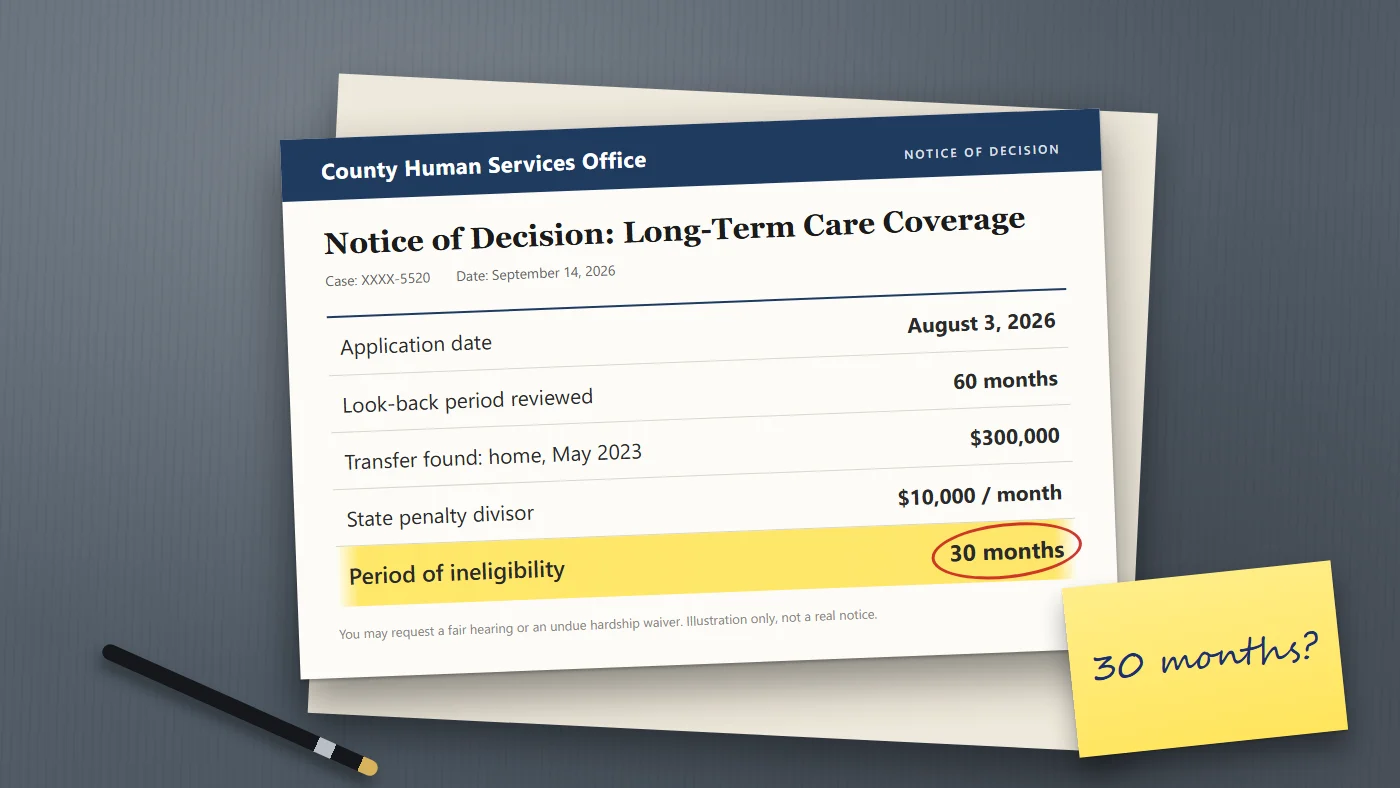
Say a widowed mother deeds her $300,000 home to her two children in 2023. In 2026 she needs nursing home care and has $40,000 left in savings. She spends that in about four months and applies. Her state divides gifts by $10,000, its figure for a month of private-pay nursing home care. Result: 30 months with no Medicaid payment. Not a dollar.
At the national median of $315 a day for a shared room, 30 months of care comes to about $287,000. She doesn't own the house that could have paid for it. Her children do. No law makes them give it back.
This isn't a niche problem. KFF's analysis of July 2025 data shows Medicaid is the primary payer for 63% of the roughly 1.24 million people in nursing facilities, so most families facing a long stay end up living under these rules.
There's a second rule fewer people have heard of. After a Medicaid recipient dies, the state has to try to recover what it spent on their care from the estate. For most people, the only thing of value left in that estate is the house.
How the look-back works
It's federal law, part of the Medicaid statute's section on transfers of assets. It applies when someone asks Medicaid to pay for nursing home care, and in most states for home and community-based waiver programs too.
Sixty months, counted back from the application date. California is the big exception. It brought back its asset test in January 2026, and its look-back runs 30 months before nursing home admission and counts only transfers made on or after January 1, 2026.
Every transfer for less than fair market value counts: the house deeded for $1, the $30,000 that went to a grandchild's tuition, the car signed over to a nephew. Add it all up and divide by the state's penalty divisor, roughly what a month of private-pay nursing home care costs there.
The formula: value of gifts ÷ state penalty divisor = months without Medicaid. A $300,000 house and a $10,000 divisor means 30 months. There's no maximum.
Divisors track local prices, so they vary a lot. California's is $14,440, which turns that $300,000 gift into 20 months (the state drops partial months). A state using $8,000 would impose about 37. A few states work with a daily figure instead.
Now the brutal part. That penalty clock doesn't start on the day of the gift, and it doesn't start when the family signs the deed or when anyone first notices a problem; it starts only when the parent is already in the nursing home, has applied and would qualify except for the gift. By then the savings are usually gone.
Can a nursing home take the house?
No. A nursing home is a business that sends bills. It can't seize a home, and Medicaid doesn't take title to houses from living people either.
What Medicaid decides is whether the house counts against the asset limit, which is $2,000 for a single applicant in most states. While a spouse lives there, it's usually exempt. It's also usually exempt if the applicant says she intends to return home, as long as the equity is under the state's cap. For 2026 that cap is $752,000 in most states and up to $1,130,000 in states that chose the higher figure. Starting in 2028, federal law holds the higher figure to $1,000,000 for homes that aren't on farmland.
So a single parent can often qualify for Medicaid and still own the house. The risk shows up later, at two points: if the state places a lien once the stay is considered permanent, and after death.
After death: estate recovery
Federal law requires every state to seek repayment from the estate of anyone who got Medicaid long-term care at 55 or older. That claim covers nursing facility care, home and community-based services, and related hospital and drug costs.
There are firm limits. No recovery while a surviving spouse is alive, or when the person leaves a child under 21 or a child of any age who's blind or disabled. Every state also has to offer a waiver when recovery would cause undue hardship.
How far does a state reach? Depends on the state. Some collect only from assets that go through probate. Others also go after homes held in joint tenancy, life estates and living trusts.
So giving the house away too late brings a penalty, and keeping it can mean a claim after death. What's left are five transfers the statute specifically allows, and the planning tools a lawyer can build around them.
Five home transfers the law allows
Federal law lists home transfers that carry no penalty at all, even the day before an application. Each one needs proof, and states ask for different paperwork.
| The home goes to | Condition |
|---|
| Your spouse | No other condition. The spouse at home can also keep up to $162,660 in other assets in 2026, depending on the state |
| A child under 21 | None beyond age |
| A child of any age who is blind or disabled | Disability generally must meet the Social Security standard |
| A sibling | Already has an equity interest in the home and lived there at least one year right before you entered the facility |
| A son or daughter who was your caregiver | Lived in the home at least two years right before you entered the facility, and provided care that kept you out of one |
The caregiver child exemption is the easiest one to lose on paperwork. It rests on facts from years back. States commonly want a doctor's statement that the parent needed nursing-home-level care during those two years, plus proof the child really lived there: tax returns, a driver's license, mail. Start collecting those records while the parent is still at home.
Two other exits exist. If every transferred asset comes back, the penalty is erased; some states shorten it for a partial return and some don't. And if a penalty would leave someone without medical care, food or shelter, you can ask for an undue hardship waiver. They're granted sparingly.
The tax bill nobody mentions
Giving the house away can also cost more in tax, and families usually find out when the children sell.
A gift carries over your cost basis. Most people don't know that. If your parents paid $60,000 in 1985 and the kids sell for $300,000, their taxable gain is figured from $60,000. The exclusion of up to $250,000 of gain on a home sale only applies to an owner who lived there two of the last five years, which the children usually didn't.
Inherit the same house, and IRS rules generally reset the basis to market value on the date of death. The children could sell for $300,000 and owe little or nothing.
So an outright gift can fail twice. It can set off a Medicaid penalty if care is needed within five years, and a capital gains bill even if it isn't.
What an elder law attorney actually does with a house
This is one of the few corners of personal finance where doing it yourself is genuinely risky. Rules are federal, details are set state by state, and a form that works in one state can backfire in the next. Families who want to protect a home usually end up comparing a handful of tools with a lawyer who does this work every week.
An irrevocable trust. Often called a Medicaid asset protection trust. The parent moves the house into a trust she can't undo, keeps the right to live there and names the children as eventual beneficiaries. That still starts a five-year clock. Done right, the house is outside her countable assets once those five years pass, and the trust can be drafted to keep the step-up in basis at death. A revocable living trust does none of this; Medicaid treats what's in it as still yours.
A life estate deed. She keeps the right to live in the home for life, and the children get the remainder. Only the remainder value counts as a gift, so the penalty exposure is smaller. It also starts a five-year clock, and some states pursue life estates in estate recovery.
A written caregiver agreement. If a child is providing real care, a contract at a fair hourly rate turns the payments into wages instead of gifts. It has to be in writing before the payments start, and the child owes income tax on them.
Spousal planning. When one spouse needs care and the other stays home, there are lawful ways to shift assets to the healthy spouse, raise the income allowance through a fair hearing when the standard amount won't cover the bills at home, and turn countable savings into things Medicaid doesn't count. It can work with no head start at all.
How do you pick the lawyer? I'd ask three questions on the first call. What share of the practice is Medicaid and long-term care planning? Do they file the Medicaid application themselves, or only draft documents? Is the fee flat or hourly, and what does it cover? State bar referral services and the National Academy of Elder Law Attorneys both keep searchable directories. If money's tight, legal aid programs funded under the Older Americans Act serve people 60 and older at no charge, and the Eldercare Locator at 1-800-677-1116 can point you to one.
If a parent may need care within five years
- Don't sign any deed yet. That includes adding a child's name to the title. It's a gift of part of the house, and it puts the home in reach of that child's creditors and divorce.
- List every gift and transfer from the last 60 months. Amounts and dates. The caseworker will find them in the bank statements, so your attorney should see them first.
- Check who lives in the house. A spouse, a disabled child, a sibling on the deed or a caregiver child can each change the answer completely.
- Look up your state's numbers. You need the penalty divisor, the home equity limit and the estate recovery rules. Your state Medicaid agency publishes them, often in its eligibility manual.
- Get powers of attorney in place now. The financial power of attorney should specifically allow gifting and trust funding. Without that wording, no one can do protective planning once a parent loses capacity.
- Book the legal consultation before choosing a facility. Admission papers often ask a family member to sign as "responsible party." Federal rules bar a nursing home from requiring a third party to personally guarantee payment as a condition of admission, so read before you sign.
- If a penalty has already hit, ask about a cure. Returning the asset, or part of it, may shorten or erase the penalty depending on the state.
Mistakes that cost families the most
Treating five years as a free loophole. Giving away a house means giving up control of it. If the child who holds title gets sued, divorces or dies first, the parent's home is caught in the middle.
Leaning on the gift tax exclusion. You can give $19,000 per person in 2026 without filing a gift tax return. That's a tax rule. Medicaid ignores it. A $19,000 check to a grandchild is a transfer like any other.
Selling the house to a child for $1. States look at market value, not the price on the deed.
Hiding a transfer. Applications are signed under penalty of perjury, and deeds are public records.
Waiting for the crisis. Even at the nursing home door, a good attorney can often protect something, especially for a married couple. With five years of lead time, the options are far wider.
And using another state's advice. The divisor, the treatment of life estates, the reach of estate recovery and even the length of the look-back in California all differ.
Before anyone signs a deed, pull the last five years of bank statements and the current deed, and bring both to one meeting with a lawyer who knows your state's rules.
This article is general information, not financial, legal, tax or medical advice.