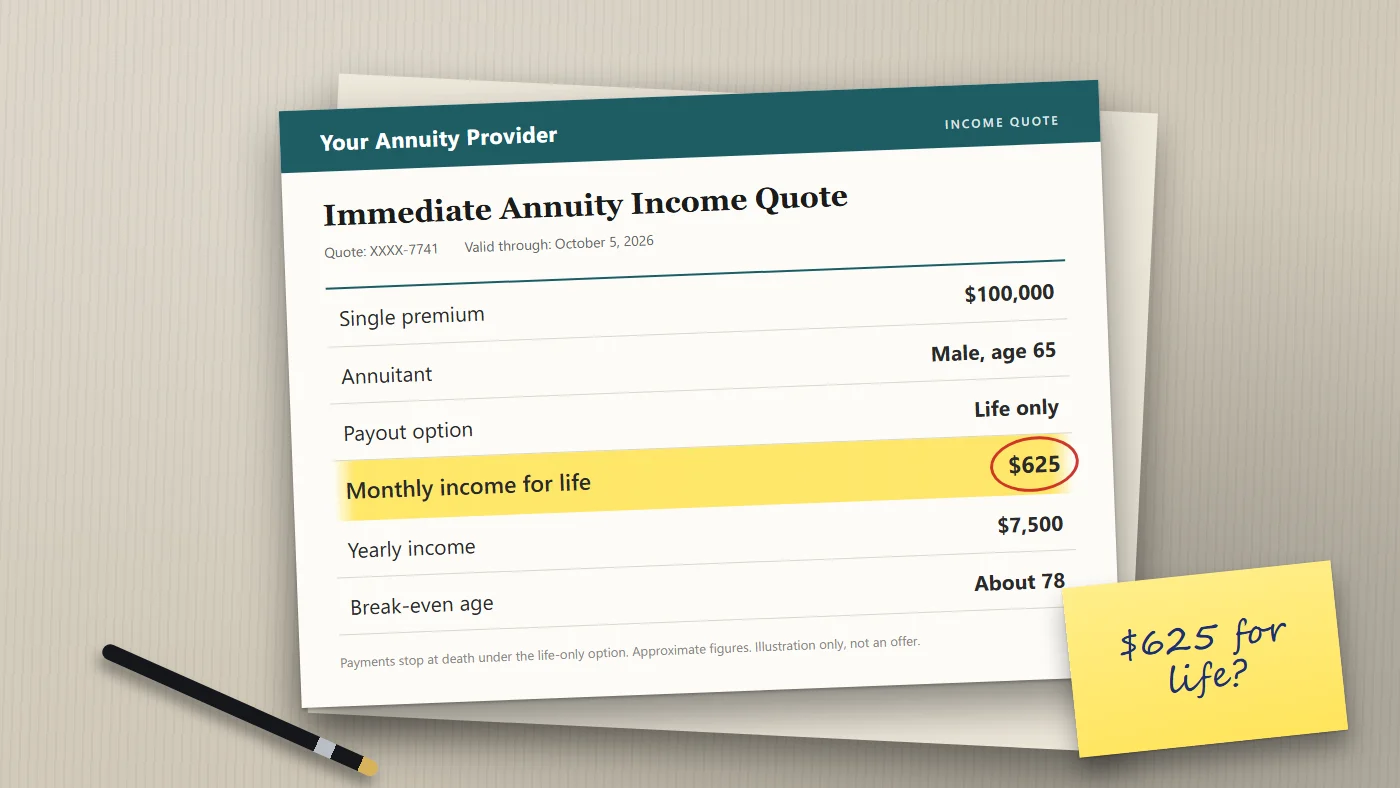
Picture $100,000 sitting in a savings account the year you turn 65. You could hand it to an insurer, and it would mail you a check every month for as long as you live. So what would that check actually be?
For a man, about $625 a month.
For a woman the same age, a bit less: about $590.
If that sounds modest for six figures, you're reading it right. It isn't built to make you rich; it's built to keep arriving in your 80s and 90s. Both estimates are for the plainest version of the product, a single premium immediate annuity that covers one life, and they come from an Annuity.org analysis. CBS News published it on September 2, 2026.
Can you do better by shopping? Sometimes. A survey of the best quotes on offer, dated July 29, 2026, had the same 65-year-old man at $689 a month. Call his realistic range $625 to $690. Treat every number in this article as approximate, though. Payouts drift up and down with interest rates, and your own quote will hinge on your age, sex, state and which insurer you ask.
Of all those, age moves the check the most.
Sign at 60 and the $100,000 gets you roughly $530 a month. Wait until 70, and it's about $750. By 75, about $920. The reason is a little grim: the older you are on the day you buy, the fewer checks the insurer expects to mail.
And plenty of people are signing. Americans put a record $123.9 billion into annuities in the second quarter of 2026. That's LIMRA's preliminary count, and it marked the 11th quarter in a row above $100 billion.
The worry behind all that money isn't hard to spot. If you're in your 60s, you may need savings to last 25 or 30 years. Few private-sector workers retire with a traditional pension now. And one bad market year, at the wrong moment, can take a bite out of a nest egg that never grows back. Savings can run dry at 88. An annuity for life is a contract to keep paying at 88, at 98 and beyond.
That promise costs something, and the monthly figure won't tell you what. Start with the table, then the fine print.
What $100,000 buys, by age
Figures assume life-only coverage and a first check right away, from the same Annuity.org analysis. All approximate.
| Age at purchase | Man, per month | Woman, per month | Man, per year |
|---|
| 60 | $530 | $503 | $6,360 |
| 65 | $625 | $590 | $7,500 |
| 70 | $750 | $703 | $9,000 |
| 75 | $920 | $859 | $11,040 |
| 80 | $1,150 | $1,080 | $13,800 |
Notice the women's column runs lower at every age. The insurer expects a woman to collect for more years, on average, so it slices the same money thinner.
Now take the man who buys at 65. His checks add up to $7,500 a year, and it's tempting to divide by $100,000 and call that a 7.5% return. Don't. Part of every check is your own money coming back; interest and risk pooling cover the rest. Break-even is the fairer yardstick.
Break-even math: $100,000 ÷ $7,500 a year = 13.3 years. A man who buys at 65 gets his own money back at about age 78. Every check after that is the payoff for living a long time.
What does that look like in a real budget? Say you're 65 and single. Your basic bills run $2,900 a month, and Social Security sends $2,300. You're $600 short, every month. An immediate annuity bought with $100,000 closes roughly that gap for life, and that's the job this product does well.
Die at 70 on a life-only contract and the insurer keeps what's left. Live to 95, though, and you'll have collected about $225,000. It's insurance against a long life, and it pays best for the people still here at 90.
What you give up for the check
Access to the money. With an immediate annuity, the $100,000 isn't yours anymore. You can't pull out $20,000 for a roof or a hospital bill, and in most contracts the decision can't be undone once a short free-look period, set by state law, has passed.
Protection from inflation. The check is usually flat. Run 3% inflation for 20 years, and that $625 buys about what $346 buys today. Some insurers will sell you a yearly raise of 2% or 3%. The starting check shrinks noticeably to pay for it.
Money for heirs. Life-only means exactly that. You can add protection, and each kind costs you monthly income. Go back to our 65-year-old man. Add a 10-year guarantee and his check slips to about $608, per the same analysis. Make it a couple, both 65, with a joint annuity that pays until the second death, and it's about $536.
For a married couple, that joint figure is usually the one that counts, because a contract written on the husband's life alone stops when he dies, and his widow can be left with less income and no lump sum.
A shot at better rates later. The payout's locked on the day you buy. If rates rise next year, new buyers get bigger checks and yours stays put; if they fall, you come out ahead, and since nobody can call that in advance, some buyers spread their purchases over several years.
None of this makes an annuity a bad idea. It just means "how much does it pay?" is the first question, not the last. Next come how much of your savings to lock up and which product you're really being shown, because most things sold as an "annuity" aren't the one in that table.
Most "annuities" are a different product
Go back to that record quarter and ask what people actually walked away with. Mostly not the product in the table. Immediate annuities took in about $4.0 billion of the $123.9 billion. Deferred income annuities, their close cousin, drew another $1.3 billion.
The real money went elsewhere. Fixed-rate deferred annuities led the pack at $44.7 billion. Fixed indexed annuities were next, with $30.7 billion, and registered index-linked annuities pulled in $23.3 billion. (All of those are LIMRA's preliminary figures.)
Those are savings products first. A quick guide:
- Immediate annuity (SPIA). Lump sum in, lifetime income out, starting within a year. It's the simplest kind and the easiest to compare, because the only number that matters is the monthly check.
- Deferred income annuity. Same idea, with income starting years from now. The longer you wait, the bigger the check.
- Fixed-rate deferred annuity (MYGA). Works like a CD from an insurer: a set rate for a set number of years, with tax deferred until you withdraw. You can turn it into income later, but you don't have to. It isn't FDIC-insured; the guarantee is the insurer's.
- Fixed indexed annuity. Interest is tied to a market index, with a floor so you don't lose principal and a cap or participation rate that limits the gain. FINRA warns these are complicated and that surrender charges commonly apply for the first six to 10 years.
- Variable and index-linked annuities. Investment products with market risk. Income guarantees come as riders for an extra yearly fee.
If someone shows you an "annuity" with a bonus, a rider and a 10-year surrender schedule, it isn't the product in the payout table. Ask what the guaranteed monthly income would be, in dollars, at the age you plan to start it. Then put that number next to a plain immediate or deferred income annuity quote.
Why quotes differ, and how to compare them
You've already seen the problem in this article's own numbers. One source put a 65-year-old man at $625 a month. The other, built from the best quotes available five weeks earlier, had him at $689. Call it a 10% gap.
That doesn't sound like much until you add it up. It's $768 a year, for as long as you live. Stay alive 25 years and it's more than $19,000, on the very same $100,000.
Why the spread? An insurer that wants more lifetime-income business this month prices more aggressively, and the ranking shifts with age, sex and state, so if you're serious, get quotes from several insurers on the same day, for the same options, and line them up. An independent agent or an online quote service can pull a dozen at once. Or have a fee-only adviser review them, since that adviser doesn't earn a commission on the sale.
When you compare, hold these steady:
- The same premium, start date and payout option (life only, joint, period certain, cash refund).
- For joint annuities, the same survivor percentage. A contract that drops to 50% for the survivor pays more up front than one that stays at 100%.
- The insurer's financial strength rating. You're counting on this company for 30 years, and many buyers stick to insurers rated A or better.
And if the insurer fails? Your state's life and health guaranty association would step in, up to a limit. For annuities that limit is commonly $250,000 per owner per insurer; your state may differ. People with bigger sums often split the money between two companies to stay under it. That way one failure, however unlikely, can't reach all of it.
How the income is taxed
Depends on the money.
If the $100,000 comes out of an IRA or 401(k), each payment is usually fully taxable as ordinary income. None of that money has been taxed yet, so the IRS gets its turn now. The upside: those payments generally count toward required minimum distributions for that contract.
Paying with savings you've already been taxed on works differently. Only part of each check is taxable. The rest is treated as your own cost coming back to you, tax-free, until you've recovered everything you paid in. Live past that point and the checks become fully taxable. The insurer reports the split each year on Form 1099-R.
Withdrawals of earnings from a deferred annuity before age 59½ generally carry a 10% additional tax on top of income tax, with some exceptions.
Before you buy: six steps in order
- Add up your guaranteed income. Social Security, any pension. Then add up your basic monthly bills: housing, food, utilities, insurance, taxes. The gap between the two is what an annuity is for.
- Look at delaying Social Security first. If you were born in 1943 or later, each year you wait past full retirement age adds 8% to your benefit, up to age 70. That increase comes with cost-of-living adjustments and survivor protection that no commercial annuity matches at the same price. Using savings to bridge a few years of delay is often the smarter first move.
- Decide how much to commit. A common planning approach is to annuitize only enough to cover the gap in basic bills and keep the rest liquid for emergencies and growth. Putting all your savings into one contract is rarely wise.
- Pick the payout option as a household. If you're married, price joint-and-survivor. If you're worried about dying early, price a cash refund or a 10-year certain option and see what it costs per month.
- Get same-day quotes from several insurers. Ask for the monthly dollar amount, the insurer's rating and, for anything other than an immediate annuity, the full surrender schedule and every yearly fee.
- Use the free-look period. Read the contract when it arrives. State law gives you a window, often 10 to 30 days, to cancel for a full refund.
You can also buy in stages. A third now and more in two or three years spreads your interest-rate risk, and the payout rises as you age.
Mistakes that are hard to undo
The most expensive one is buying a deferred product when you wanted income. Surrender charges can take a real bite if you change your mind in the early years.
Swapping an old annuity for a new one is another. Sometimes a tax-free 1035 exchange makes sense. It also restarts the surrender clock and pays the agent a new commission, and FINRA has flagged unsuitable exchanges as a recurring problem. Ask what you lose by leaving the old contract.
Ignoring your spouse. Easy to do. Life-only on one life pays the most per month. That's exactly why it looks best on an illustration, and exactly why it can be the wrong choice.
Treating the payout rate as a yield. A 7.5% payout isn't a 7.5% interest rate. Compare break-even ages, not percentages.
Forgetting inflation. A flat check feels generous at 65 and thin at 85, so keep some savings invested outside the annuity.
A $100,000 annuity won't fund a retirement. At around $600 to $700 a month at 65, it can cover a property tax bill, a Medigap premium and the utilities for as long as you live. Before deciding, get two or three real quotes for your age and ZIP code and set the monthly figure next to your gap from step one.
This article is general information, not financial, legal, tax or medical advice.