Debt & Credit

Surprise Medical Bills: What the No Surprises Act Covers — and the Ambulance Gap

Since 2022 most out-of-network surprise bills have been illegal, yet the ride to the emergency room is still billed under the old rules in much of the country.

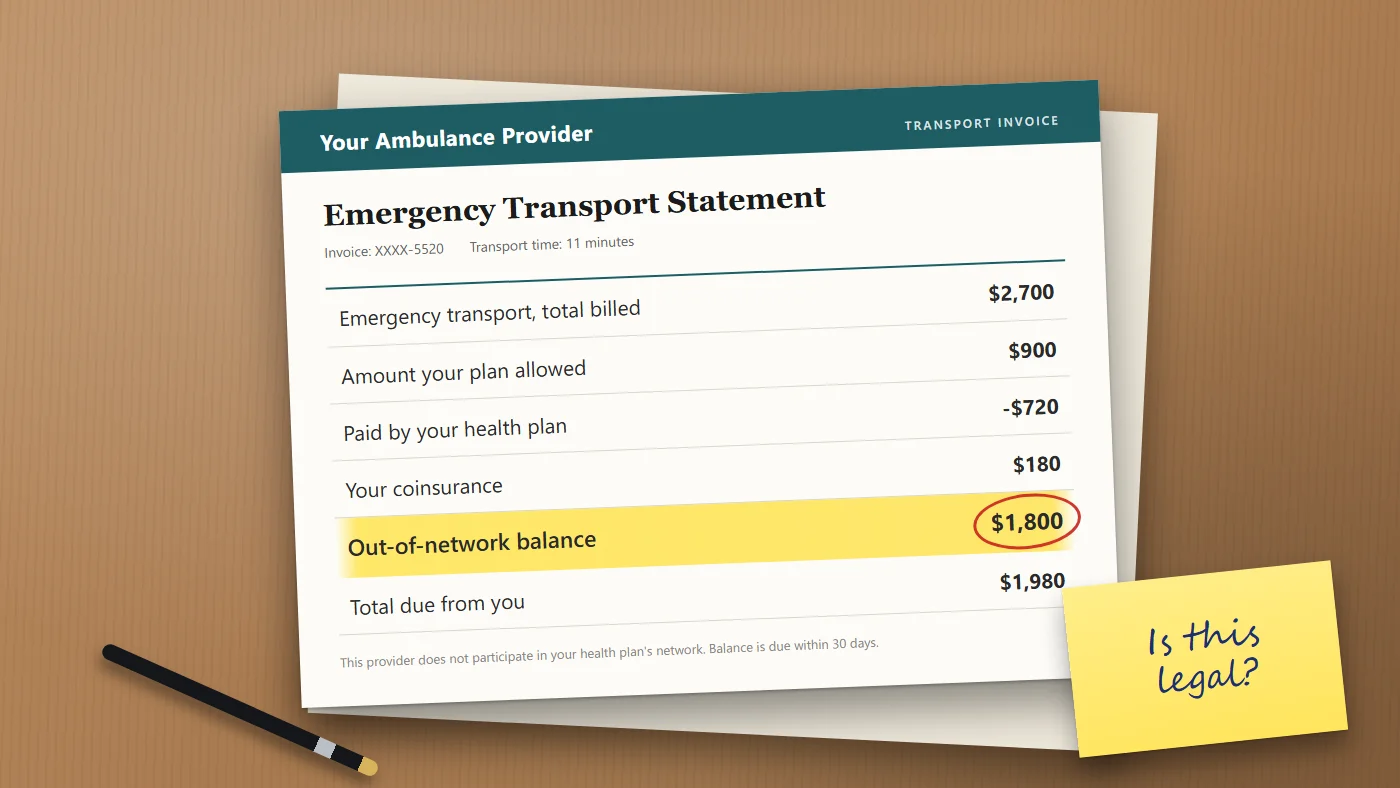
Illustrated ambulance transport bill on a desk with the out-of-network balance line highlighted and circled
Illustration

Nobody who dials 911 gets to pick the ambulance. A dispatcher sends the closest crew. Whether that crew has a contract with your health plan never comes up, and you're in no shape to ask.

For most of the rest of an emergency, that question stopped mattering on January 1, 2022, when the federal No Surprises Act took effect. Land in an out-of-network ER, and for most emergency services the hospital can no longer send you the out-of-network "balance bill" for whatever your plan didn't pay. The same goes if the hospital is in your network but a doctor working there isn't. It even covers air ambulance flights. You pay what you'd pay in network: your normal copay, deductible or coinsurance. Anything past that gets settled between the provider and your insurer, and you're not part of that fight.

Ground ambulances were left out. Congress couldn't agree on how to handle them, so it set up an advisory committee and moved on, and as of September 2026 the federal rule hasn't changed. That makes the ride to the hospital the one part of a typical emergency that can still produce a surprise bill under federal law.

How often does it happen? Researchers at the Peterson-KFF Health System Tracker went through claims from large employer plans. Of the emergency ground ambulance rides, 51% included an out-of-network charge that could turn into a surprise bill. Non-emergency rides weren't much better, at 39%. About 3 million privately insured people arrive at an emergency room by ambulance each year, and by the researchers' estimate roughly 1.5 million of them were exposed.

51%. About half of emergency ground ambulance rides for privately insured patients carried an out-of-network charge, according to a Peterson-KFF analysis of 2018 insurance claims.

Those claims date from 2018, before the newer state laws. Read the numbers as the size of the problem, not a current count.

Which bills are protected, and which aren't

Find your situation below. The sorting follows guidance from the Centers for Medicare & Medicaid Services.

SituationFederal protectionWhat you can be charged
Emergency room visit at an out-of-network hospitalYesIn-network cost sharing only
Out-of-network anesthesiologist, radiologist or pathologist at an in-network hospitalYesIn-network cost sharing only
Air ambulance from an out-of-network companyYesIn-network cost sharing only
Out-of-network surgeon you chose for planned care, after signing a consent formNo, you waived itOut-of-network rates
Ground ambulance, out of networkNoWhatever your plan doesn't pay, unless state law says otherwise
Care at an out-of-network facility you chose for a non-emergencyNoOut-of-network rates

Does your plan count? If you get coverage through work, or you bought it yourself (marketplace plans included), yes. Short-term plans don't, and neither do dental-only or vision-only plans or health care sharing ministries. People on Medicare, Medicaid, TRICARE or veterans' care already had their own rules against balance billing before this law came along.

Got a bill that falls in one of the "Yes" rows and asks for more than your in-network share? You don't owe the extra. The provider isn't allowed to bill it. The No Surprises Help Desk at 1-800-985-3059 takes complaints and can tell you if a specific bill is covered.

How does an ambulance bill get so big?

Take a made-up ride. It lasts 11 minutes, and the ambulance company bills $2,700. Your plan decides a reasonable price is $900 and pays 80% of that, or $720. With an in-network provider you'd owe the other $180, and that would be that.

This company has no contract with your plan, though, so it isn't bound by the $900 figure. It bills you the $180 plus the $1,800 your insurer didn't recognize. Total: $1,980, for a ride you couldn't shop for. Under federal law, that bill is legal.

Your own bill could land higher or lower. For a sense of scale, the average ground ambulance bill for people with commercial insurance was $1,093 in 2021. That's a Health Care Cost Institute number, as cited by Georgetown University's Center on Health Insurance Reforms.

Who's sending these bills? Often not a company at all. In the Peterson-KFF data, fire departments and other government agencies ran 62% of emergency ground rides. A public agency often has no contract with any private insurer, so nearly every ride it runs is out of network.

The advisory committee did finish its homework. Its 2024 recommendation was to ban balance bills for ground ambulance rides and cap what the patient pays at $100 or 10% of the rate, whichever is less. Congress hasn't turned that into law.

Where state laws fill part of the gap

Some states didn't wait. By March 2026, 22 of them had some protection against ground ambulance surprise bills, and five of those laws were brand new (Georgetown's count). States split on which ambulance services are covered, how the payment rate gets set and whether non-emergency rides count.

Then comes the wrinkle that trips people up: a state law only helps if your plan answers to the state. Mostly that means plans you buy yourself and "fully insured" employer plans. Most large employers self-fund their health plans, and those answer to federal law instead. Washington, for one, bans ground ambulance balance billing for state-regulated plans and lets self-funded employer plans opt in, which means that if you work for a company that hasn't opted in, the state law doesn't help you.

So an ambulance bill raises two questions. Does your state have a law? And is your plan the kind that law covers? Those two answers decide which of the steps below will work for you.
Continued

What to do when the ambulance bill arrives

  1. Wait for the insurance claim to finish. Ambulance companies often mail a bill before your plan has processed the claim. Look for the explanation of benefits from your insurer. If there isn't one, call the ambulance billing office, give them your insurance details and ask them to file the claim.
  2. Ask for an itemized bill. It should show a base rate, a level of service such as basic or advanced life support, mileage and any supplies. Check the pickup and drop-off points, the mileage, and if the level of service matches what happened.
  3. Find out what kind of plan you have. Call the number on your insurance card, or ask your employer's benefits office, and find out if the plan is fully insured or self-funded. Then call your state insurance department and ask if the state has a ground ambulance billing law and if it applies to your plan.
  4. Ask your insurer to pay more. Tell the plan the ride was an emergency and you had no choice of provider. Ask it to reprocess the claim at the in-network level or to negotiate with the ambulance company. If it refuses, file an internal appeal. If that fails, you have the right to an external review by an independent reviewer.
  5. Negotiate with the ambulance provider. CMS's own guidance for ground ambulance bills says providers can sometimes lower the price and may offer payment plans. It helps to walk in with a number. When no local rate has been set, Washington's law uses 325% of the Medicare rate or the billed charge, whichever is lower, so asking a provider to accept a multiple of the Medicare rate is a reasonable opening.
  6. Ask about hardship programs. If a city, county or fire district runs the service, ask if it has a hardship or resident policy. If a nonprofit hospital runs it, ask if the hospital's financial assistance policy covers ambulance charges.
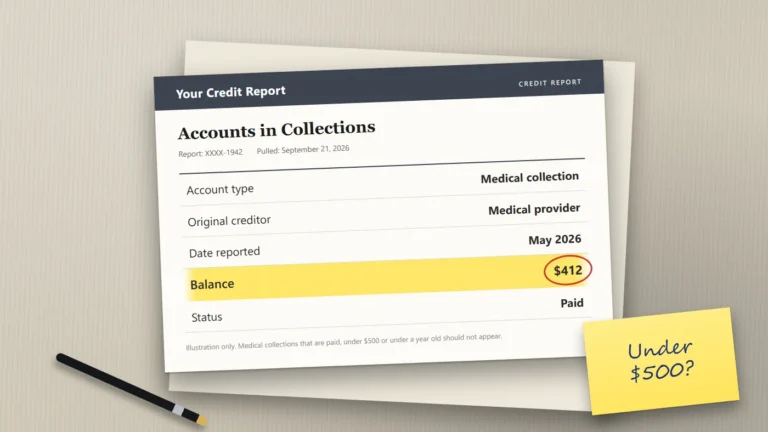
  7. Keep everything in writing. If the account goes to a collection agency, dispute it in writing within 30 days of the collector's first notice, and say that an insurance appeal is pending.

Don't ignore the bill while all this plays out. Silence is what moves an account to collections. I'd send a short letter every few weeks saying the claim is under appeal; it keeps the file active and on your terms.

Are you on Medicare?

Then the rules are different. Part B pays for a ground ambulance when going any other way could endanger your health. An air ambulance gets covered when ground travel can't get you there fast enough. Once you've met the Part B deductible, your share is 20% of the Medicare-approved amount. Have a Medigap policy or a Medicare Advantage plan? That changes what your share looks like, so look up your plan's ambulance copay.

Where people get burned is the non-emergency ride. Medicare may cover one only when a doctor has ordered the transport in writing as medically necessary, and if the ambulance company thinks Medicare may not pay for a non-emergency trip, it has to hand you an Advance Beneficiary Notice of Noncoverage before you ride. Read it before you sign. Signing means you may be billed for the whole ride.

The consent form that gives up your protection

Related searches

There's one other way people lose protection. A signature.

Say you're scheduled for care at an in-network hospital or surgery center, and an out-of-network provider asks you to sign a notice and consent form. The rules are strict. It must be a separate document, it has to come with a cost estimate, and it has to list in-network alternatives you could use instead. Sign it, and you've agreed to out-of-network rates and given up the federal protection for that provider.

In an emergency, nobody can ask you to sign one. The form is also off-limits for anesthesiology, radiology, pathology and neonatology, and for assistant surgeons, hospitalists and intensivists. If one shows up for any of those, or turns up buried in a stack of admission papers, you can decline and ask for an in-network provider.

Where to get help, and how to dodge the next one

Start with the free options. The No Surprises Help Desk handles federal questions, your state insurance department handles state-regulated plans, and many states fund consumer assistance programs that'll work an appeal with you.

When the amount is large, or the plan and the provider keep pointing at each other and nothing moves for weeks, some people hire a medical billing advocate to run the appeal and negotiate the ambulance bill on their behalf. Fees range from hourly rates to a share of the savings, so get the terms in writing and compare more than one. Sued over a medical bill? That's the point to talk to a consumer attorney or a legal aid office. And be careful with companies advertising medical debt relief. Ask exactly what they do and what they charge before you hand over account details.

The other lever is your coverage. You can't pick the ambulance. You can pick the plan. When you compare health insurance plans for 2027, read the ambulance line in each plan's summary of benefits, since a flat copay is easier to budget for than coinsurance after the deductible. Marketplace open enrollment starts November 1. Medicare's fall enrollment period runs October 15 through December 7, and Medicare Advantage ambulance copays differ from plan to plan.

Next time an unexpected medical bill lands, sort it first. Emergency care, care inside an in-network facility, or an air ambulance? Federal law probably caps what you owe, and the help desk can confirm it. A ground ambulance? Then it comes down to your state and your plan type, and the seven steps above are how you find out.

This article is general information, not financial, legal, tax or medical advice.

Illustrated itemized hospital statement on a desk with a duplicate CT scan charge highlighted and circled Read nextHow to Request an Itemized Hospital Bill and Spot the Most Common Errors Illustrated credit report page on a desk with a medical collection account under $500 highlighted and circled Read nextMedical Debt and Your Credit Report: What the Rules Actually Are in 2026

About the author

Margaret Linwood

Margaret Linwood covers Medicare, Social Security and what health care actually costs after 60. She builds every piece around the number a reader will face on a bill or a notice, and shows where that number comes from.

Sources

Updated Sep 22, 2026 · Reviewed against CMS No Surprises Act guidance, Medicare.gov, Peterson-KFF Health System Tracker, Georgetown CHIR, Washington Insurance Commissioner

Related searches