You pay the card every month. You're never late. And when the next statement shows up, the balance looks almost the same as the last one.
That isn't a mistake on your part, and it isn't a billing error. It's how the minimum payment is built. On many cards the minimum is set to cover that month's interest plus about 1% of what you owe, so at today's rates roughly two-thirds of an early minimum payment goes to interest and only a third touches the debt.
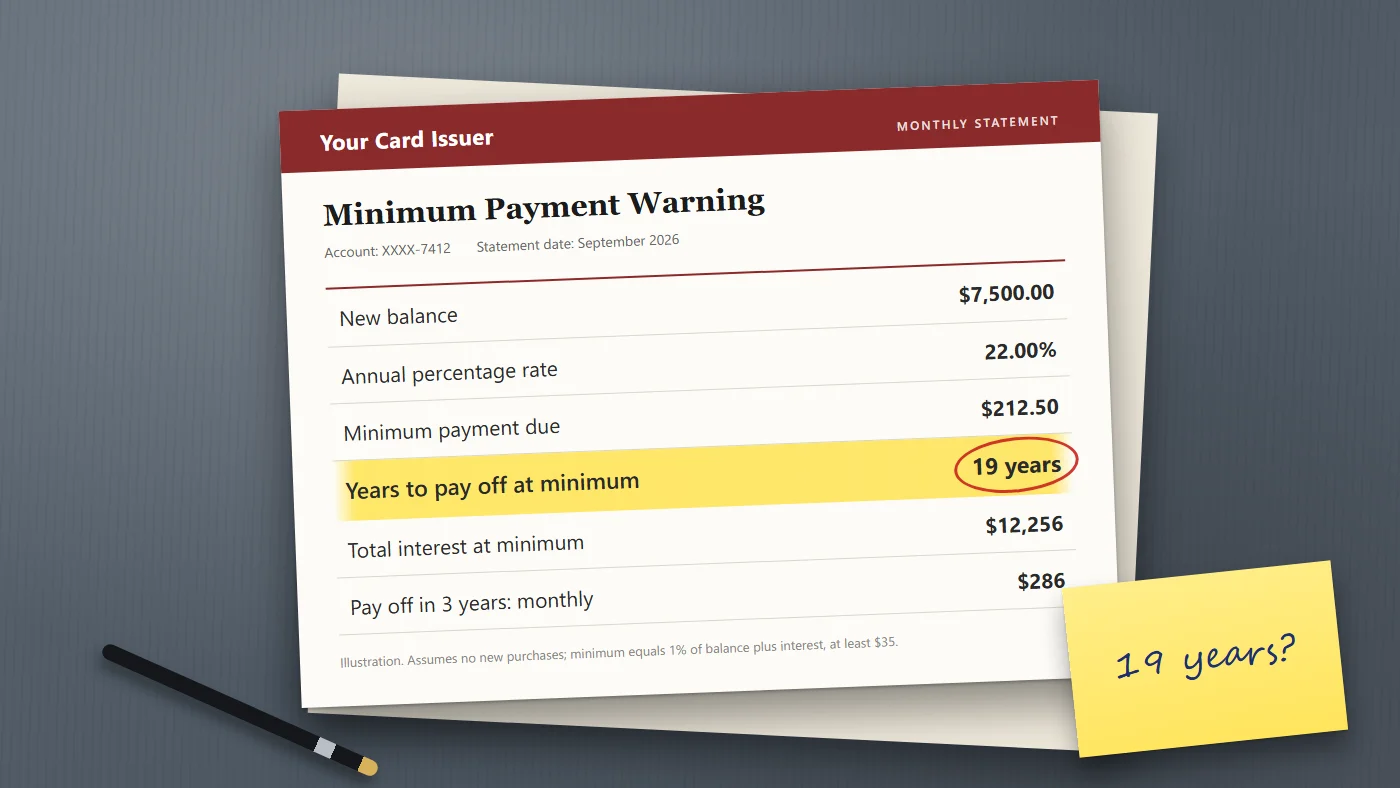
Here are real numbers. Take a $7,500 balance at 22% APR, stop using the card, and pay only the minimum each month. You'd make 237 payments. That's 19 years and 9 months. Along the way you'd hand over $12,256 in interest on top of the $7,500 you borrowed.
Those figures don't come from a bank brochure. They come from a month-by-month calculation, and the assumptions and the table are below, so you can hold them up against your own statement.
Where the 22% and the $7,500 come from
The rate is the Federal Reserve's. In its G.19 consumer credit release of September 8, 2026, the Fed put the average rate on credit card accounts that were charged interest at 22.15% for the second quarter of 2026. Across all card accounts, including the ones paid in full every month, it was 20.94%.
The balance is close to what a typical card borrower owes. LendingTree looked at anonymized credit reports for more than 400,000 of its users and put average card debt at $7,756 in the first quarter of 2026. Nationally, Americans owed $1.263 trillion on credit cards in the second quarter of 2026, according to the New York Fed.
So $7,500 at 22% isn't a worst case. It's an ordinary one.
Carrying a balance is ordinary, too. In a Federal Reserve survey covering 2025, 45% of adult cardholders said they'd carried a balance for at least one month in the past year. Is your balance bigger or smaller? The curve has the same shape either way. Only the dollar amounts change.
The math, month by month
The assumptions, stated plainly:
- Starting balance of $7,500, with no new purchases and no fees.
- 22% APR, which is 1.8333% a month.
- A minimum payment equal to 1% of the balance plus that month's interest, and never less than $35. Many large issuers use a formula like this one. Yours is spelled out in your cardholder agreement.
| Month | Balance at start | Minimum payment | Goes to interest | Goes to the debt | Balance at end |
|---|
| 1 | $7,500.00 | $212.50 | $137.50 | $75.00 | $7,425.00 |
| 12 | $6,715.05 | $190.26 | $123.11 | $67.15 | $6,647.90 |
| 36 | $5,275.88 | $149.48 | $96.72 | $52.76 | $5,223.12 |
| 60 | $4,145.16 | $117.44 | $75.99 | $41.45 | $4,103.71 |
| 120 | $2,268.05 | $64.26 | $41.58 | $22.68 | $2,245.37 |
| 180 | $1,240.99 | $35.16 | $22.75 | $12.41 | $1,228.58 |
| 237 | last payment | | | | $0.00 |
Look at month 1. You send $212.50, the bank keeps $137.50 as interest, and $75 comes off what you owe.
Now jump to month 60. After five full years of on-time payments, you've paid $6,227 in interest and still owe $4,104. Ten years in, you still owe $2,245.
19 years and 9 months. That's how long a $7,500 balance at 22% APR takes to clear on minimum payments alone, under the assumptions above. Total interest: $12,256, or about $1.63 in interest for every dollar borrowed.
Why does the payment keep shrinking?
Most people notice the rate. Fewer notice the second thing in the table: the minimum payment gets smaller every month.
It starts at $212.50. A year later it's $190. After five years it's $117. Because the payment is a percentage of the balance, every dollar of progress lowers the next bill, and a lower bill means slower progress, so the debt feels lighter each year while the finish line keeps sliding out toward two decades.
You can see what that one feature costs with a single change. Keep paying $212.50 a month, the amount of the very first minimum, and never let it drop. The same debt is gone in 58 months, just under five years, with $4,682 in interest. Same card. Same rate. The only difference is that you turned down the smaller bill the card kept offering you.
And the $35 floor? It barely matters here. In this example the formula stays above $35 until about month 180, and by then you've already paid roughly $11,500 in interest.
All of this assumes you never use the card again. Pay $212 and charge $150 in the same month, and the balance barely moves. That's the most common reason a balance stays frozen for years.
Your own version of this math is already printed on your statement, in a box most people skip. The rest of this article shows where to find it, what three different payment choices do to the 19 years, and which outside options are worth pricing.
Find the box on your own statement
It's usually on the first page, somewhere near the due date, and federal rules say every credit card statement has to carry it. The Consumer Financial Protection Bureau describes it as a minimum payment warning with two numbers in it. One is how long it'll take to pay off your current balance if you make only minimum payments, and the other is how much you'd need to pay each month to clear the balance in 36 months.
Both numbers assume you don't buy anything else. Keep using the card and the real timeline runs longer than the printed one.
Do you have to pay the 36-month amount? No. The CFPB's point is simpler: the more you pay each month, the less interest you'll pay over time.
And when you do pay extra, another rule works in your favor. The issuer generally has to apply anything above the minimum to the balance with the highest interest rate first. So a cash advance balance at 29% gets paid down before regular purchases at 22%.
What three changes do to the 19 years
Same $7,500, same 22%, no new purchases. Only the payment changes.
The cheapest fix doesn't cost anything extra. Hold the payment at $212.50, the first month's minimum, and the card is paid off in 58 months with $4,682 in interest. Compared with the minimum-payment route, that's about $7,574 less, and it doesn't add a dollar to the first month's budget.
Add $50, for $262.50 a month, and it's gone in 41 months. Interest comes to $3,221.
Or pay the 36-month amount from the box, which here is $286.43. That's about $74 a month more than the first minimum. Three years later you're done, with $2,811 in interest, and the interest bill has shrunk by more than $9,400.
What about a lower rate? If you stay on minimums, it helps less than you'd think. At 17% instead of 22%, the same minimum-payment schedule still runs about 19 years (227 months), because the formula keeps paying down just 1% of the balance a month. Interest drops from $12,256 to about $9,320. A lower rate does its real work when you keep the payment up and let more of it reach the debt.
What to do this week
- Start with paper. Pull the latest statement for each card and write down the balance, the APR and both numbers from the minimum payment warning box.
- The payoff math only works on a balance that isn't being refilled, so stop new charges on the card you're paying down. Everyday spending can move to a debit card or a card you pay in full.
- Set a fixed automatic payment, as a permanent dollar amount rather than the "minimum due" setting. Use at least this month's minimum, or the 36-month figure if you can swing it. In the $7,500 example, that's the gap between 58 months at a steady $212.50 and nearly 20 years on a payment that shrinks.
- Call the number on the back of the card and ask whether they can lower your rate. Mention how long you've been a customer, and that you pay on time. If money's tight, ask about a hardship program too, and be ready to say what you can afford and for how long, as the CFPB suggests. Nobody has to say yes. The call costs nothing.
- Check the rate history, because two federal rules may be on your side. If your issuer raised your rate, it has to review that increase at least every six months and bring the rate down if the reasons no longer apply. If you were moved to a penalty rate for being 60 days late, six on-time minimum payments in a row should get your old rate back on the existing balance.
- More than one card? Send every extra dollar to the one with the highest APR, pay minimums on the rest, and once the first card is cleared, roll its payment into the next one.
- Six months from now, compare the new balance with the one you wrote down in step 1.
If you do only the third step, I'd still call that a good week.
When a lower rate from somewhere else makes sense
If your card's rate stays near 22%, moving the debt is the other lever. There are three common routes, and each has a cost the ads don't lead with.
A 0% balance transfer card is the one that looks free. You move the balance to a new card that charges no interest for a promotional period. The CFPB notes that the promotional rate is temporary, that a transfer fee usually applies, and that new purchases on the card may start collecting interest right away. Transfer fees commonly run 3% to 5% of the amount moved. Say yours is 4%. That's $300 on $7,500, and clearing the new $7,800 in 18 months takes about $433 a month. Can you manage that? Then $300 replaces thousands in interest. If you can't, the regular rate shows up with most of the balance still sitting there. Approval usually takes good credit.
A debt consolidation loan swaps the cards for one fixed payment with an end date. It's a personal loan from a bank, credit union or online lender that pays the cards off. Borrow $7,500 over 36 months at 13%, for instance, and you'd pay about $253 a month and about $1,600 in interest. Your actual rate depends on your credit, and some lenders take an origination fee out of the loan before you see it. The CFPB warns about low teaser rates in ads, and about stretching the term so far that the total cost climbs. Rates spread widely between lenders, so compare several offers, and use the prequalification tools that don't affect your credit score before you settle on one.
Then there's a home equity loan or line. Rates tend to be lower because your house backs the loan, which is also the risk. The CFPB points out that you could lose the home if you fall behind, and that closing costs apply.
None of it works if the cards fill back up. Move $7,500 to a loan, run the cards up again, and you're on the hook for both.
Free help, and the offers to walk away from
If the numbers don't work on your own, a nonprofit credit counseling agency can go over your budget for free or a small fee. Some offer a debt management plan, where the agency arranges lower rates with your card issuers and you make one monthly payment through the plan. Ask about fees before you sign anything.
Debt settlement companies are a different business. They try to get creditors to accept less than you owe, often after telling you to stop paying your cards, which can wreck your credit and lead to lawsuits. Walk away from any company that promises to make your debt go away, pressures you to stop talking to your card company, or charges a fee before any debt is settled. Those are the CFPB's red flags. For companies that sell by phone, that up-front fee is illegal.
Whichever path you price, bring the same numbers to every comparison: the rate, the monthly payment, and the total you'll have paid by the last month. That last one is the figure the minimum payment keeps out of sight. It's printed, in its own way, in the box on page one of your statement.
This article is general information, not financial, legal, tax or medical advice.