Americans age 60 and older filed 201,266 fraud complaints with the FBI's Internet Crime Complaint Center in 2025, and they reported losing $7.7 billion. That's up 59% from 2024. It's one year, one agency, and it counts only the people who came forward.
Most of that money isn't lost to clumsy emails with bad spelling. It goes out over the phone, in calm conversations with someone who claims to be your bank, a federal agent, a computer technician or your grandchild. The newest version of that last one uses software to copy a real voice.
You don't need to become a security expert. Nearly every one of these scams depends on two moves: getting you to act fast, and getting you to send money in a way that can't be reversed. Learn to spot those two moves and most of the scripts fall apart.
There's a second, quieter risk. After years of data breaches, your Social Security number and date of birth may already be in criminal hands, sitting in a file somebody bought for a few dollars. You can't pull that information back. You can make it much harder to use, and the main tools are free.
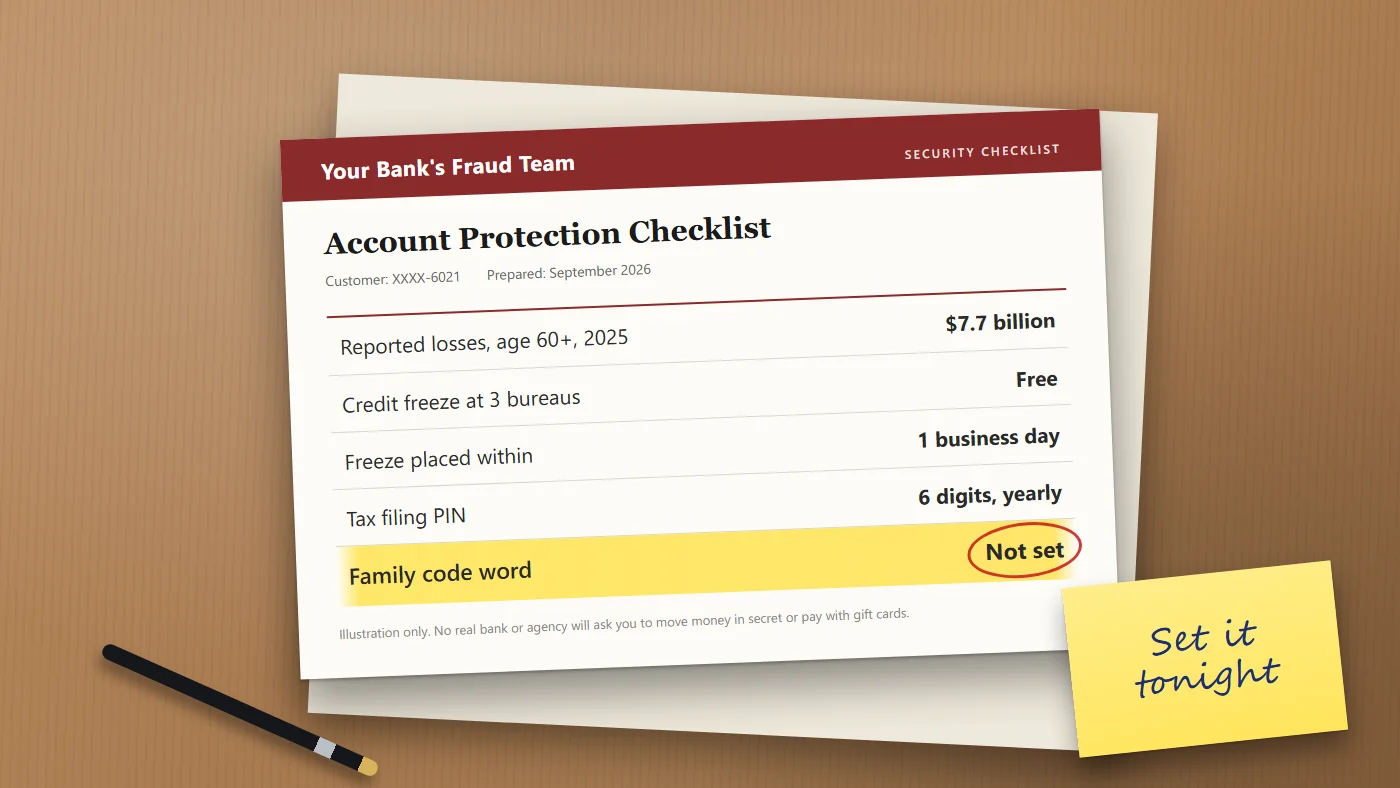
The number: $7.7 billion. That's what people 60 and older reported losing to fraud in 2025, according to the FBI's Internet Crime Complaint Center, across 201,266 complaints. The average reported loss was about $38,500. The FBI has said for years that many victims never report, so the real total is likely higher.
The call that sounds like your grandchild
What follows is the pattern as the Federal Trade Commission and the FBI describe it, pieced together from their warnings rather than from any one family's story.
The phone rings. A young voice, shaky and upset, says there's been a car accident or an arrest. It sounds like your grandson. He begs you not to tell his parents. Then someone else takes the phone, a "lawyer" or an "officer," who says bail or a fee has to be paid today.
Could that really be a fake? Yes. The FTC warns that all a scammer needs is "a short audio clip" of a family member's voice, which he can pull from videos posted online, plus a voice-cloning program. In December 2024 the FBI put out a public alert saying criminals are generating short audio clips of a loved one's voice to pose as a relative in a crisis and ask for money right away.
These callers lean on two pressures, according to the FTC. Urgency: you're the only one who can help, and it has to be now. Secrecy: don't tell anyone. They'll ask for a wire transfer, cryptocurrency, a payment app, or gift cards with the numbers read over the phone. What those methods share is that once the money moves, it's very hard to get back.
The five scripts behind most of the losses
| Script | How it starts | How they want to be paid | The tell |
|---|
| Family emergency | A call from a "grandchild" in trouble, sometimes with a cloned voice | Wire, gift cards, crypto, payment app | "Don't tell Mom and Dad" |
| Fake bank or fraud department | A call or text about suspicious charges on your account | "Move your money to a safe account" | Your real bank won't ask you to move money to protect it |
| Government impersonator | A caller says your Social Security number is tied to a crime | Crypto ATM, cash, gold handed to a courier | Threats, plus a demand for secrecy |
| Tech support | A pop-up says your computer is infected and gives a number to call | Remote access to your computer, then a bank transfer | Real security warnings don't ask you to call a phone number |
| Investment and crypto | A friendly contact online shows you "profits" on a trading site | Crypto deposits that keep growing | Deposits are easy, withdrawals never go through |
Investment fraud cost people over 60 more than any other category in 2025: about $3.5 billion in reported losses. Cryptocurrency was behind most of it. Tech-support scams came second, at just over $1 billion.
The FTC looked at the biggest losses in a report published in August 2025. Among older adults hit by impostor scams, the number of reports of losses of $10,000 or more rose more than fourfold from 2020 to 2024. Reports of losses above $100,000 rose nearly sevenfold. The FTC tied these cases to three lies: someone is using your accounts, your information is being used to commit crimes, or your computer has a security problem. Each one ends the same way. The caller offers to help you "protect" your money by moving it.
Then there's the courier version, which the FBI has warned about since early 2024. Victims are told to pull out cash or buy gold bars, and a courier shows up at the house to collect. The FBI's warning is blunt: the U.S. government and legitimate businesses will never ask you to buy gold or other precious metals.
Knowing the scripts helps. A handful of habits and account settings help more, because they still work on a day when you're tired, worried or caught off guard, and they take about an hour.
Set up a family code word tonight
The FBI's alert on AI-enabled fraud includes this advice: create a secret word or phrase with your family to verify identity. It costs nothing and takes one conversation over dinner.
- Pick a word or short phrase that isn't online. Not a pet's name, a street or a birthday. Something odd that everyone will remember.
- Share it in person or by phone with close family. Don't text it or email it.
- Agree on the rule. Anyone who calls asking for money, in any emergency, gets asked for the word. No word, no money.
- Add a fallback. The FTC suggests hanging up and calling the person back on a number you know is theirs. If they don't answer, call another relative. You can also ask a question only the real person could answer.
A real grandchild in real trouble won't be offended.
A scammer will push back, get angry or hang up, and that reaction tells you everything you need to know about who was on the line.
Lock your credit in one sitting
A credit freeze is the strongest free tool you've got against someone opening accounts in your name. While it's in place, the FTC says, nobody can open a new credit account in your name, including you. Placing and lifting it costs nothing, and it won't touch your credit score.
- Contact all three credit bureaus. Equifax, Experian and TransUnion each need a separate request. Freezing one doesn't freeze the others. You can do it online, by phone or by mail.
- Save the login or PIN for each bureau. Write it down and keep it with your important papers. You'll need it to lift the freeze.
- Know the timing. Under federal law, a bureau has to place a freeze within one business day of an online or phone request, and lift it within one hour when you ask online or by phone. Mail requests take up to three business days.
- Lift it only when you need to. Applying for a loan, a credit card, an apartment or some insurance policies? Ask which bureau the company uses and lift the freeze at that one for a few days.
A freeze has limits. It won't stop charges on cards you already have, and it can't stop someone from using your Social Security number to file a tax return or claim benefits. It does nothing about a scam call. What it blocks is new credit, and it blocks that well.
Want something lighter? A fraud alert tells lenders to verify your identity before opening an account. An initial alert lasts one year and can be renewed, and you only have to contact one bureau, which must tell the other two.
Close the tax and benefits doors
Your Social Security number can be misused in places a credit freeze never reaches. Two free steps cover the biggest gaps.
Get an IRS Identity Protection PIN. The IRS describes it as a six-digit number that prevents someone else from filing a tax return using your Social Security number. Anyone with an SSN or ITIN who can verify their identity is eligible, and the quickest route is your online account at IRS.gov. You get a new PIN each year and give it to whoever prepares your return.
Claim your online accounts before someone else does. Create a personal account with Social Security and one with the IRS, even if you rarely plan to log in. An account that already exists, protected by your own password and a second verification step, is harder for a stranger to set up in your name.
Then add two habits. Pull your credit reports, which are free at AnnualCreditReport.com. And turn on text or email alerts for every withdrawal and transfer at your bank, so a problem shows up in minutes instead of on next month's statement.
If you only get to one step from this section, I'd make it the bank alerts. They're the one tool here that catches money leaving an account you already have.
Is paid identity protection worth it?
You'll see plenty of advertising for identity theft protection, credit monitoring and family plans aimed at older adults. Some of these services are useful. None of them replaces the free steps above.
The FTC draws the line clearly. Credit monitoring tells you about changes on your credit report, but it won't alert you when someone withdraws money from your bank account. Identity monitoring scans databases for your information, but it won't warn you if someone files a tax return in your name. Both tell you about a problem after it's started. A freeze and an IP PIN work earlier, by blocking the attempt.
What a paid plan can add is convenience and help with cleanup: monitoring at all three bureaus in one dashboard, alerts when your data turns up in a known breach, insurance that reimburses certain recovery costs, and a caseworker who handles the calls and paperwork if your identity is stolen. For an adult child managing a parent's finances from another state, or anyone who doesn't want to watch accounts personally, that can be money well spent.
Comparing plans? Ask these questions:
- Does it monitor all three credit bureaus or only one?
- What exactly does the insurance cover, and what's excluded? Money you sent to a scammer yourself often isn't covered.
- Is there a family or couple's plan, and can an adult child receive the alerts?
- What's the price after the first year? Introductory rates often rise at renewal.
- Does it include call blocking or scam-call screening, or is that sold separately?
Your bank, credit card or insurer may already include basic monitoring at no charge. Check before you pay twice.
Already sent money or shared information?
Speed matters more than embarrassment.
- Call your bank or card issuer right away. Use the number on the back of your card. Ask them to stop or recall the transfer and to watch the account.
- If you paid with gift cards, call the card company. Keep the cards and the receipts.
- Report it. File with the FBI at ic3.gov and with the FTC at ReportFraud.ftc.gov. If you're 60 or older and want help filing, the Justice Department's Elder Fraud Hotline is 833-372-8311 (833-FRAUD-11), staffed Monday through Friday, 10 a.m. to 6 p.m. Eastern.
- If you gave out your Social Security number or account details, go to IdentityTheft.gov. The FTC site builds a free personal recovery plan with step-by-step instructions. Place the credit freezes the same day.
- Watch for the second wave. People who've lost money often hear from "recovery" firms or fake agents who promise to get it back for a fee. The FBI logged 10,516 recovery-scam complaints in 2025, with $1.4 billion in reported losses across all ages. Real law enforcement doesn't charge you to investigate.
The one-hour plan
Tonight, agree on a family code word. This week, freeze your credit at all three bureaus, request an IRS Identity Protection PIN and turn on bank alerts. After that, look at whether a paid monitoring plan adds anything you'd actually use.
Then tape one line near the phone. No real bank, agency or grandchild needs you to move money in secret within the hour, so when a call asks for speed and silence together, hang up and dial a number you already trust.
This article is general information, not financial, legal, tax or medical advice.