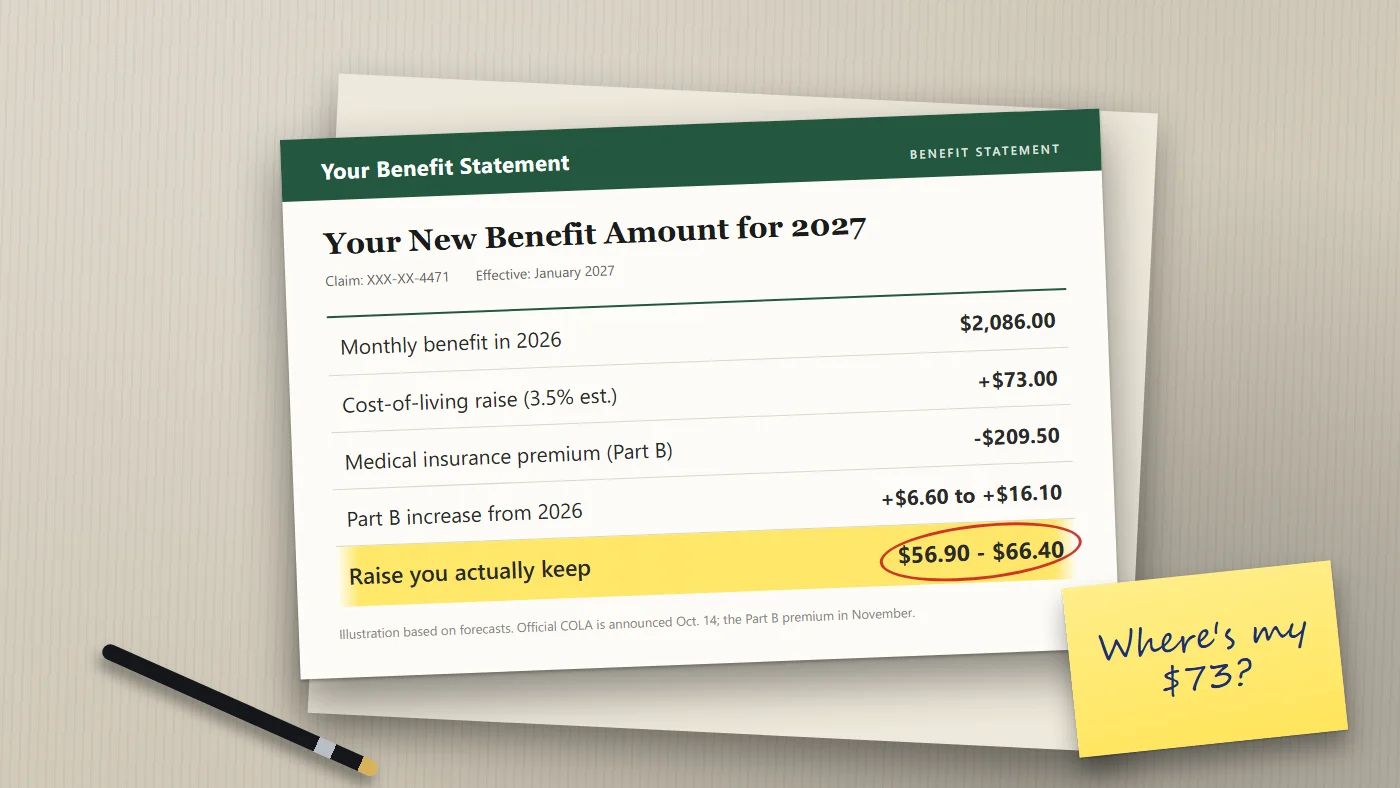
Social Security will announce the 2027 cost-of-living adjustment on October 14. The Senior Citizens League, which tracks the inflation data month by month, put its last forecast before the announcement at 3.5%. On the average retired worker's check, $2,086 a month as of July, that's about $73.
You won't see all of it. If you're on Medicare, your Part B premium comes out of your Social Security payment before the deposit lands, and that premium is going up too. It's $202.90 a month in 2026. The Medicare Trustees projected $209.50 for 2027 in their June report, while some private forecasters quoted in the financial press think it'll come in closer to $215 to $219, on the theory that the Trustees have lowballed costs before. Nobody outside CMS knows yet. The agency usually publishes the real number in November.
Two announcements, then, about a month apart. The second gets subtracted from the first.
Last year shows how that plays out. The 2026 COLA was 2.8%, which Social Security said worked out to about $56 a month for the average retiree. Then the Part B premium rose $17.90. Close to a third of the raise was gone before it reached anyone's bank account.
If the Trustees are right, 2027 looks gentler than that. If the private forecasts are right, it doesn't. Either way, the size of your own check decides how much of the raise you keep, and people with the smallest checks keep the smallest share.
Your raise, after Part B
The COLA is a percentage. The Part B increase is a flat dollar amount that's the same for nearly everyone. That mismatch is the whole story: a 3.5% raise hands a $3,000 check two and a half times as many dollars as a $1,200 check, and both pay the same premium increase.
The table runs a 3.5% COLA against both Part B forecasts. They're illustrations, not predictions for your account.
| Monthly benefit now | 3.5% raise | Left if Part B is $209.50 (+$6.60) | Left if Part B is $219 (+$16.10) |
|---|
| $1,200 | $42.00 | $35.40 | $25.90 |
| $2,086 (average retired worker) | $73.00 | $66.40 | $56.90 |
| $3,000 | $105.00 | $98.40 | $88.90 |
In the better case, Part B takes about 9% of the average retiree's raise. In the worse case it takes 22%. For someone living on $1,200 a month, the worse case eats 38% of the raise.
Why run the $219 column at all, if it's only a private guess? Because it's the high end of what's being floated, and if you're budgeting on a fixed income, planning around the worse number costs you nothing. If November comes in lower, the difference is a small pleasant surprise instead of a gap in the grocery budget.
In 2026 the average raise was about $56 a month and the Part B premium rose $17.90. Roughly one dollar in three never made it to the bank.
Why doesn't the raise keep up with Medicare?
The COLA is pegged to the Consumer Price Index for Urban Wage Earners and Clerical Workers, the CPI-W, averaged over July, August and September. It follows what working households spend money on. Groceries, rent, gas. It isn't built to follow what Medicare costs.
Part B runs on its own formula. By law the standard premium covers about a quarter of what Part B is expected to spend the following year on doctor visits, outpatient care and drugs given in a clinic, so when that spending grows faster than prices in general, the premium outruns your COLA. The Trustees' own projections put it at $255.50 a month by 2030.
A decent COLA year can still feel flat. One number follows the checkout line and the other follows health care spending.
The floor under your check
There's one protection written into the law, called the hold harmless provision. If the Part B increase in dollars is bigger than your COLA in dollars, your premium increase gets trimmed so your net Social Security payment doesn't fall below last year's.
With a 3.5% COLA it won't come into play for many people in 2027. A $6.60 increase is covered by the raise on any benefit above about $190 a month. Even a $16.10 increase is covered once your benefit tops roughly $460. Very few checks are that small.
It has gaps, though. The rule doesn't protect you if any of these apply:
- 2027 is your first year on Part B
- you pay the income-related surcharge known as IRMAA
- your premium is billed to you directly instead of withheld from your benefit
- your state already pays your Part B premium
So the floor is real, but it's only a floor. It promises your deposit won't shrink. It says nothing about how much of the raise you get to keep.
Part B isn't the only thing standing between your gross benefit and the money that shows up in your account, either. There can be up to three more deductions, and each one has its own fix. The notice that lists all of them arrives in December, after most of the choices that shape it have already closed.
Four lines on the December notice
Social Security mails COLA notices in early December. If you have a my Social Security account, the same letter lands in the online Message Center, sometimes before the paper copy. It's one page, and it walks from your gross benefit down to the net deposit.
Read it top to bottom.
- Your new gross benefit. That's last year's benefit plus the COLA. Check that the percentage matches what Social Security announced on October 14. Mistakes here are rare, but every other line is figured from this one.
- The Part B deduction. For most people it'll be the standard premium CMS announces in November. If yours is lower, the hold harmless rule is doing its job. If it's higher, the next line usually explains why.
- Any income-related adjustment (IRMAA). In 2026 the surcharge kicks in when modified adjusted gross income is above $109,000 on a single return or $218,000 on a joint one, and it adds $81.20 to $487 a month to Part B. Your 2027 surcharge is based on your 2025 tax return. If your income has dropped since then because you stopped working, lost a spouse, divorced or lost income-producing property, Form SSA-44 asks Social Security for a new decision. It wants the life-changing event, the date and your expected income.
- Drug plan or Medicare Advantage premium. If you asked your plan to take its premium out of your Social Security, it shows up here. Plans had to send their 2027 prices in the Annual Notice of Change by September 30. If this line is going up, you've got until December 7 to move.
If your income changed in the last two years, I'd read line three before anything else. An IRMAA surcharge based on an old tax return is the most expensive mistake on the page, and it's the one most likely to be fixable with a single form.
There's also a voluntary deduction. If you filed Form W-4V for federal tax withholding, a flat percentage of the bigger benefit comes out too. A bigger benefit can also pull more of your Social Security into taxable income, since the income thresholds for taxing benefits are written into the law and aren't indexed to inflation.
If Part B is a real strain, your state may pay it
Medicare Savings Programs are run by the states, funded through Medicaid, and they pay the Part B premium for people with limited income. Once you're in, the $202.90 (or whatever the 2027 figure turns out to be) stops coming out of your check. Plenty of people who'd qualify never apply.
For 2026, Medicare.gov lists monthly income limits for one person of $1,350 for the QMB program, $1,616 for SLMB and $1,816 for QI. For a married couple they're $1,824, $2,184 and $2,455. Resources have to be under $9,950 for one person or $14,910 for a couple. Limits run slightly higher in Alaska and Hawaii, and states can leave certain income or assets out of the count, so a "no" based on the federal chart isn't the last word.
It helps with drugs, too. Anyone who qualifies for one of the three programs gets Extra Help with Part D automatically, which holds covered prescriptions to no more than $12.65 each in 2026.
You apply through your state Medicaid office. Your State Health Insurance Assistance Program, or SHIP, will help with the paperwork at no charge. New limits come out early each year, after the federal poverty guidelines are updated.
Where people go looking for the difference
You can't negotiate the Part B premium. You can change most of what sits around it, and the window for that runs from October 15 to December 7.
Plans with no premium of their own. KFF found that two-thirds (67%) of Medicare Advantage plans with drug coverage charged nothing beyond the Part B premium in 2026. If you're paying for a Medigap policy plus a separate drug plan, that comparison can be tempting. Run it slowly. A $0 plan works through a network of doctors and hospitals, often needs approval before certain services, and can bill you up to its out-of-pocket maximum, which federal rules let run as high as $9,250 for in-network care in 2026.
Plans that hand back part of Part B. They're usually sold as "giveback" plans. About 32% of Medicare Advantage plans offered some Part B premium reduction in 2026, according to KFF. The amounts are all over the map: among plans that offered one, 28% gave back $10 a month or less, while 36% gave back $100 or more. The refund shows up as a smaller Part B deduction on your Social Security payment, and it can take a few months to start. A big refund can come paired with higher copays somewhere else, so price the whole plan, not the refund.
When you compare plans, use one checklist for all of them: your doctors, your drugs, the premium, the out-of-pocket maximum and what a hospital stay costs. The Medicare Plan Finder shows 2027 plans by ZIP code starting in October. A licensed independent agent can run the same comparison. Ask which insurers they represent first, since few of them carry every plan in a county.
Income that doesn't ride on the COLA. Some retirees come at the problem from the other side and turn part of their savings into a fixed monthly check with an income annuity. It's a legitimate tool, and an easy one to get wrong. Payouts differ from insurer to insurer for the same deposit, most contracts carry surrender charges, and a fixed payment loses buying power every year unless you pay extra for an inflation rider. If you go this route, get quotes from more than one company for the same deposit, age and payout option, and compare the monthly amount side by side.
Mistakes that cost more than the premium
Dropping Part B to save $200 a month. Unless you've got other coverage through a current job, coming back later means a penalty of 10% of the premium for each full 12-month stretch you went without, and you'll pay it for as long as you have Part B. You can only re-enroll during set periods, too, which can leave you uninsured for months.
Picking a plan on the refund alone. A $50 monthly giveback is $600 a year. Nice, but small. One hospital stay on a plan with steep daily copays can cost more than that.
Ignoring an IRMAA letter. The surcharge looks at a tax return from two years back. If your income fell for one of the listed reasons, SSA-44 can remove it.
Assuming you earn too much for help. QI covers individuals with income up to $1,816 a month in 2026. Some states go higher. It takes one application to find out.
Dates for your calendar
- October 14, 2026. Social Security announces the 2027 COLA.
- October 15 to December 7. Medicare Open Enrollment. Changes take effect January 1.
- November. CMS announces the 2027 Part B premium, deductible and IRMAA brackets.
- Early December. COLA notices arrive by mail and in the my Social Security Message Center.
- Late December and January. SSI recipients get the first payment at the new amount on December 31, because January 1 is a holiday. Social Security benefits at the new amount start in January.
When both official numbers are out, do the subtraction yourself on the back of the envelope: new benefit, minus new Part B premium, minus anything else on the notice. If the answer's smaller than you expected, two of the fixes above close on December 7.
This article is general information, not financial, legal, tax or medical advice.