If you're in a Medicare Advantage plan or a stand-alone Part D drug plan, your insurer had to get a document to you by September 30. It's called the Annual Notice of Change, or ANOC. It may have come as a thick envelope or, if you signed up for paperless delivery, as an email pointing you to your online account.
It looks like the rest of the fall mail from insurers, and that's the problem. This one isn't an ad. It's your plan telling you, in writing, what it'll charge and cover starting January 1, 2027: premium, deductible, copays, drug list, pharmacy network, extras. Any of it can change, and the plan doesn't need your agreement.
Your silence is the agreement. Do nothing between October 15 and December 7 and you're renewed into the 2027 version of the plan automatically.
For a lot of people that works out fine. For others, January brings a higher specialist copay, a drug that moved up a tier, or a dental allowance cut in half, and by then the main window to switch has closed.
Most of that is avoidable with twenty minutes and a pen. KFF found that 43% of Medicare Advantage enrollees didn't review their own plan for changes in premiums or other costs during a recent open enrollment, and 44% didn't check for changes in what it covers. Nearly 7 in 10 people on Medicare didn't compare their coverage with any other option.
Why read it closely this year?
Some years the changes are small. The 2027 plan year has more moving parts than usual.
The federal limits that drug plans build on are going up. The maximum Part D deductible rises from $615 to $700, and the cap on out-of-pocket drug costs goes from $2,100 to $2,400. A federal program that held down stand-alone drug plan premiums in 2025 and 2026 ends December 31, and plans are free to pass some of that along.
Insurers have been trimming, too. KFF counted 9% fewer Medicare Advantage plans in 2026 than in 2025, and among the plans that stayed, fewer offered an over-the-counter allowance (66%, down from 73%), a meal benefit (57%, down from 65%) or rides to appointments (24%, down from 30%). Some large insurers have said publicly that they're pulling back further for 2027.
None of that tells you what your plan will do. Only the notice does.
The five lines that move your costs
Near the front of the notice there's a summary table with two columns, this year and next year. Start there. You're looking for five lines.
Monthly premium. A jump from $0 to $24 is easy to spot. It's also usually the least important of the five, because the others can cost more.
Maximum out-of-pocket amount. It's the most you can be billed in a year for covered medical care, which makes it your real exposure if the year goes badly, say a hospital stay followed by weeks of outpatient treatment and specialist visits. Federal rules let plans set it as high as $9,250 for in-network care in 2026. Plenty of plans sit well under that. So they've got room to raise it.
Drug deductible and the copay for your tiers. Watch for a deductible that now applies to tiers that used to skip it, and for a flat copay that's turned into a percentage. A $47 copay becoming 25% coinsurance on a $600 drug means paying $150 a fill.
Hospital and specialist copays. Inpatient stays are often priced per day for the first several days. A move from $295 to $395 a day doesn't look like much until you multiply it.
Extra benefits. Dental, vision, hearing, over-the-counter cards and gym memberships aren't required by Medicare, so they're the easiest things for a plan to cut. Check the dollar allowance, not just whether the benefit still exists.
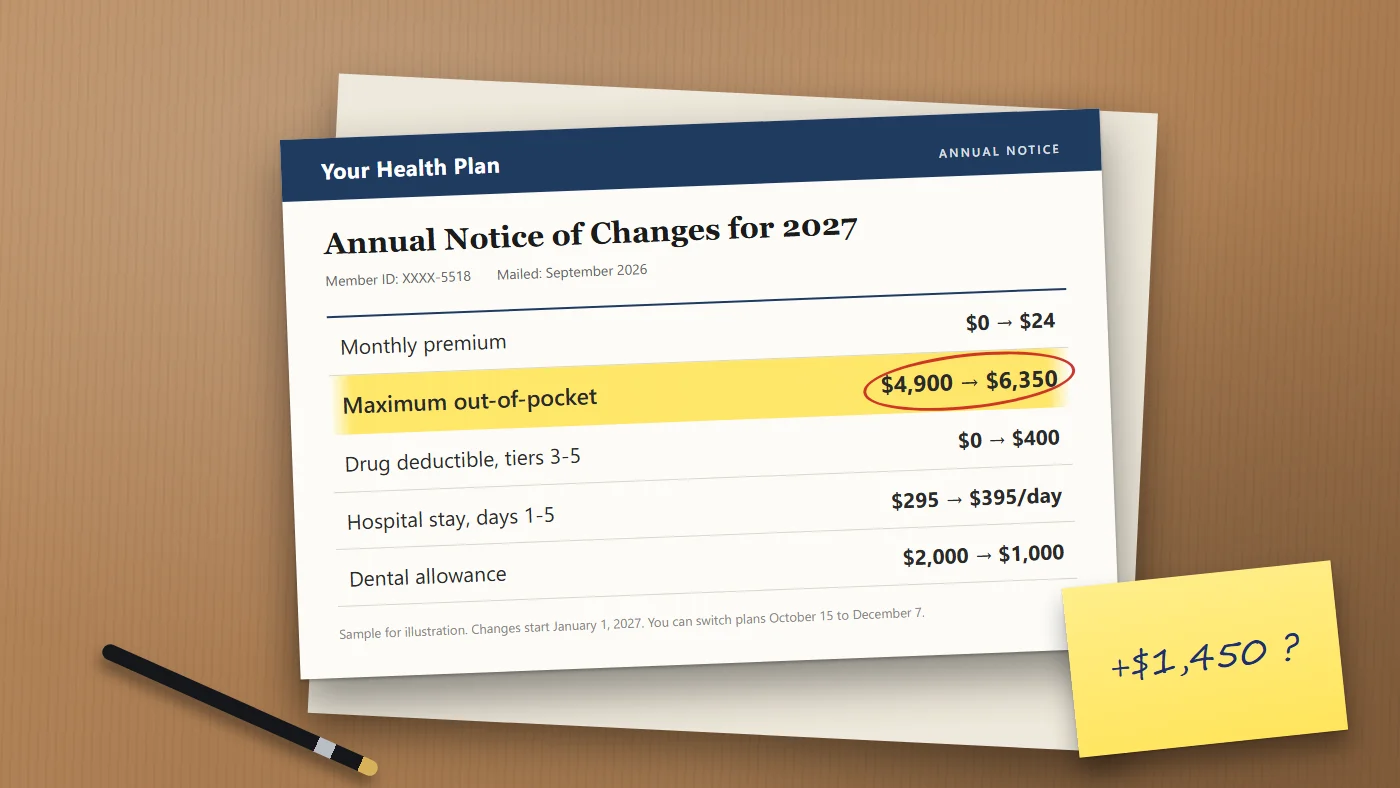
Say your notice looked like this. It's a made-up plan, but every line is the kind of change a real notice can carry.
| Line on the notice | 2026 | 2027 | What it means in a year |
|---|
| Monthly premium | $0 | $24 | +$288 |
| Maximum out-of-pocket | $4,900 | $6,350 | +$1,450 of risk in a bad year |
| Drug deductible (tiers 3 to 5) | $0 | $400 | Up to $400 more before coverage starts |
| Hospital stay, days 1 to 5 | $295 a day | $395 a day | +$500 for a five-day stay |
| Dental allowance | $2,000 | $1,000 | $1,000 less toward a crown or denture |
In this example the premium is the smallest change on the page: $288 a year. A year with one hospital stay, a brand-name drug and dental work adds about $1,900 more, and the ceiling on a truly bad year is $1,450 higher.
Someone who only checks the premium would call that a minor increase and renew.
There's something else the notice won't tell you, and for most people it's the question that matters more than any copay. You'll have to go find the answer yourself.
What the notice leaves out: your doctors
The Annual Notice of Change says the provider network may change and tells you where to find the new directory. It doesn't say whether your cardiologist, your hospital or the pharmacy on the corner will still be in network in January.
Insurers and health systems renegotiate their contracts every year, and sometimes the two sides walk away from each other. When that happens, the plan's name, premium and ID card can stay exactly the same while your doctor goes out of network.
So check it yourself, in this order.
- Call the doctor's billing office, not the front desk. Ask: "Will you be in network for [exact plan name] in 2027?" Use the full plan name from your notice. Insurers often sell several plans in the same county, and a practice may take one and not another.
- Look up the 2027 provider directory. Your notice lists the web address and a phone number for a printed copy. Search every doctor and hospital you wouldn't want to lose.
- Do the same for your pharmacy. Find out whether it's "preferred" or only "standard." The same prescription can cost more at a standard pharmacy.
- Look up every drug in the 2027 formulary. The notice summarizes drug list changes, but go to the full list and search each drug by name and dose. Write down the tier and any new rules, like prior authorization, step therapy or quantity limits.
- Put your five lines and these answers on one sheet. You'll want it if you compare plans.
If any answer comes back "no" or "we don't know yet," take it seriously. It matters more than a $10 difference in premium. Of everything in this article, the billing-office call is the one I'd make first.
The Evidence of Coverage, for specific questions
The notice is a summary of changes. The full rulebook for next year is the Evidence of Coverage, which plans generally post online by October 15 and will mail if you ask. It often runs past a hundred pages. Nobody expects you to read it cover to cover.
Use it to settle specific questions instead. Got a surgery planned? Look up the outpatient surgery and inpatient sections. If you use a lot of physical therapy, check the per-visit copay and any visit limits, and if you spend winters in another state, read what the plan covers outside its service area, because some plans cover only emergencies and urgent care there. The medical benefits chapter is laid out as a chart, so finding any single service takes a minute.
If the changes are bad: your options and your deadlines
You have more than one window. They aren't equal.
October 15 to December 7, Open Enrollment. The wide-open one. You can switch to another Medicare Advantage plan, move to Original Medicare with a stand-alone drug plan, or change drug plans. New coverage starts January 1, and enrolling in the new plan cancels the old one automatically.
January 1 to March 31, Medicare Advantage Open Enrollment. If you're in a Medicare Advantage plan on January 1, you get one change: a different Medicare Advantage plan, or back to Original Medicare with a drug plan. It's the safety net for people who find a problem at the first appointment of the year. It isn't available if you only have a stand-alone drug plan.
Special Enrollment Periods. Moving out of the plan's service area, qualifying for Extra Help or Medicaid, or losing your plan because it's leaving your county each open a separate window. If your plan is ending, you'll get a non-renewal letter instead of the usual notice, and different rules apply.
Thinking of leaving Medicare Advantage for Original Medicare? Look before you jump. About 4 in 10 people in Original Medicare carry a Medigap policy to cover the 20% coinsurance, and outside a few protected situations, Medigap insurers in most states can ask health questions and turn you down or charge more. Get a Medigap approval in hand before you drop your plan, not after.
Comparing plans without being sold to
Once you've got your five lines and your doctor and drug answers, you have what you need to compare Medicare plans on equal terms.
The Medicare Plan Finder on Medicare.gov shows every Medicare Advantage and Part D plan in your ZIP code. Enter your drugs and pharmacies and it estimates the total yearly cost of each plan. It won't reliably tell you whether your doctors are in network. That's why you made those calls first.
Plenty of people use a licensed Medicare broker instead, and a good one saves time. Brokers are paid by the insurers, not by you, and federal rules cap the commission. A few questions tell you most of what you need to know:
- Which insurers do you represent in my county, and which don't you?
- Can you show me the total yearly cost with my drugs for each plan, including the one I have now?
- Will you check my doctors against the 2027 directory before I sign?
If you want help from someone with nothing to sell, every state has a State Health Insurance Assistance Program, or SHIP. Its counselors are trained staff and volunteers, and it's free. Call 1-800-MEDICARE or search "SHIP" plus your state's name to find yours. Appointments get scarce by late November.
Use the same sheet for every plan you look at: premium, maximum out-of-pocket, drug costs for your list, hospital copay, the extras you actually use, and a yes or no for each doctor. The plan with the most TV ads often isn't the one that comes out ahead.
No notice in the mail?
Medicare.gov is blunt about it: if you didn't get this document, contact your plan. Call member services at the number on the back of your card and ask for the 2027 Annual Notice of Change. While you're on the line, have them confirm your mailing address. Many insurers also post it in your online account under plan documents.
Did you ever agree to electronic delivery? If so, the "letter" may be a September email that's easy to mistake for marketing.
If you've got Original Medicare with a Medigap policy and no drug plan, you won't get this notice at all. Medigap insurers send rate increase letters on their own schedule, and Original Medicare's changes are printed in the "Medicare & You" handbook that's mailed each fall.
Mistakes people make with this letter
Reading only the premium. A $0 premium can stay $0 while the out-of-pocket maximum climbs by more than a thousand dollars.
Assuming the same plan name means the same plan. Benefits, networks and drug lists get rebuilt every year under the same name.
Trusting last year's drug tier. One drug moving from tier 2 to tier 3 can cost more than any premium change.
Waiting for January to find out. The January to March window exists, but it allows one move, and only for people in Medicare Advantage.
Tossing the notice after you read it. Keep it with your plan card. If a bill in March doesn't match what the notice promised, that page is your proof.
Find the envelope, or the email, this week. Read the five lines, then call the billing office of the one doctor you'd least want to lose.
This article is general information, not financial, legal, tax or medical advice.