Most Medicare decisions come with a do-over. Pick a drug plan you don't like and you can change it next fall. Join a Medicare Advantage plan with the wrong network and you can move to another one between October 15 and December 7, or again between January 1 and March 31. The door reopens every year.
One decision doesn't work that way. When you first go on Medicare, you choose between two roads. On one, you join a private Medicare Advantage plan. On the other, you stay in Original Medicare and buy a Medigap policy, also called Medicare Supplement Insurance, to pay the bills Medicare leaves behind. You can go from Medigap to Medicare Advantage in any fall enrollment period with one phone call.
Going the other way is a different story. Outside a few protected situations, federal law doesn't require a Medigap insurer to sell you a policy, and in most states the company can ask about your health, check your prescription history, and then charge you more or turn you down. KFF, the health policy research group, estimated that 9 in 10 Medicare Advantage enrollees 65 and older, about 22.4 million people as of 2022, had no guaranteed right to buy Medigap once their first-year trial period was over.
So the choice that feels routine at 65, often made in a few minutes because one option shows a $0 premium, can turn close to permanent a decade later. That's usually when health has changed and the other road has started to look better. Bad timing, built in.
None of this makes Medicare Advantage the wrong choice. It means you should pick it knowing which way the door swings.
Two roads, side by side
Both roads start in the same place. You have Part A and Part B, and you pay the Part B premium, $202.90 a month in 2026.
Medicare Advantage replaces how you get that coverage. A private insurer runs it, usually with a network of doctors and hospitals and its own rules about approvals. More than half of eligible people are on this road: 35.2 million in 2026, or 55%, by KFF's count. Two-thirds of the plans with drug coverage charge no premium of their own, and nearly all include some dental, vision and hearing benefits.
Original Medicare with Medigap keeps the government as your insurer. Medicare pays its share and the Medigap policy pays most or all of the rest. You can see any provider in the country that takes Medicare, and you rarely need permission first. You buy a separate Part D plan for prescriptions. About 12.5 million people had a Medigap policy in 2023, according to KFF.
The premium figures below are KFF national averages. Your local prices will differ.
| Medicare Advantage | Original Medicare + Medigap Plan G + Part D |
|---|
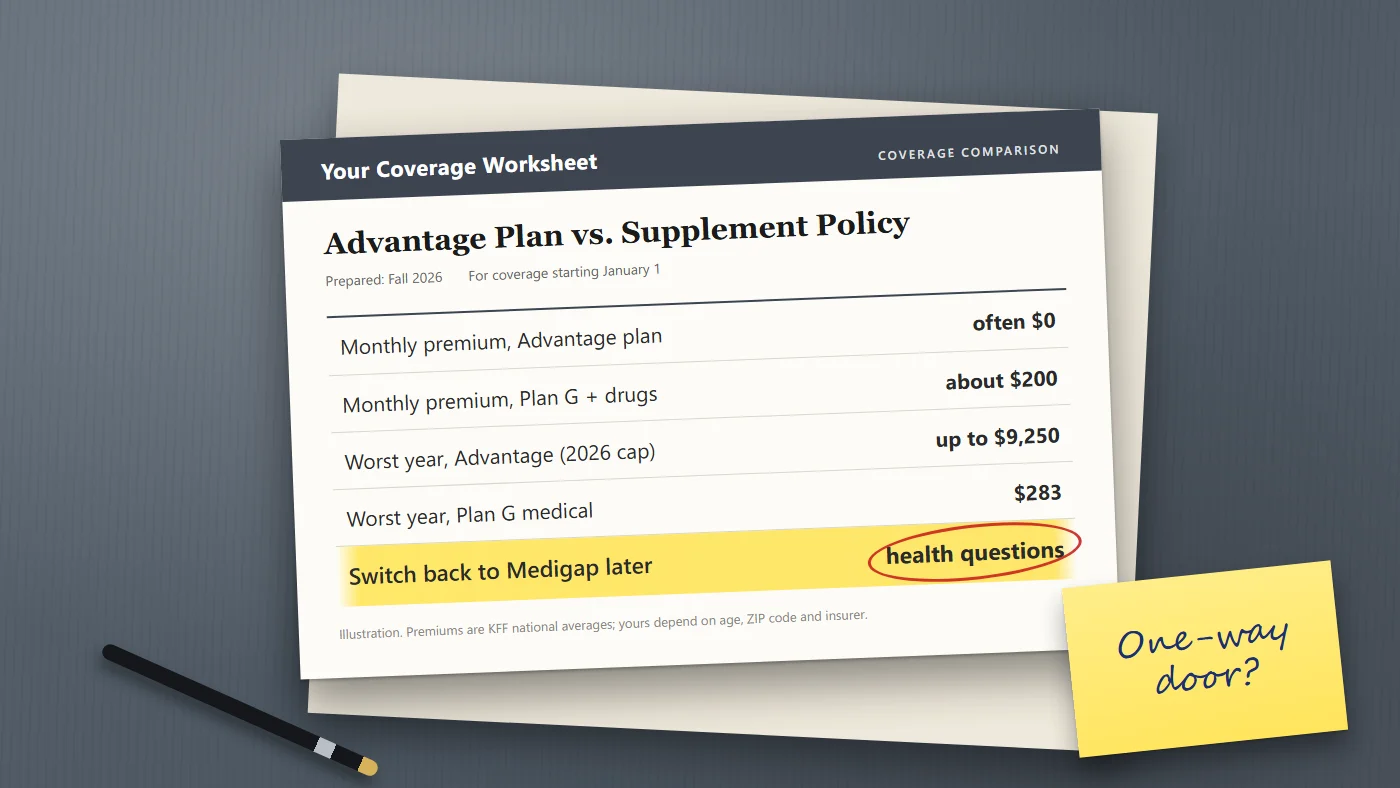
| Monthly premiums beyond Part B | Often $0 | About $164 for Plan G (2023 average) plus about $36 for a drug plan (2026 average) |
| Medical costs in a healthy year | Copays per visit | The Part B deductible, $283 in 2026 |
| Medical costs in a bad year | Up to the plan's out-of-pocket maximum, which federal rules capped at $9,250 in-network for 2026 | The same $283. Plan G pays the rest of covered Part A and B costs |
| Doctors and hospitals | The plan's network | Any that accept Medicare |
| Approval before care | Common for certain services | Rare |
| Dental, vision, hearing | Usually included, with limits | Not included |
| Switching later | Any fall, to another Medicare Advantage plan | Medigap insurers can ask health questions in most states |
The trade's right there in the numbers. In this example the Medigap road costs about $200 a month more in premiums, around $2,400 a year, doctor visits or not. The Medicare Advantage road costs little up front and more when you use it. Pay now or pay later.
KFF estimated that 22.4 million Medicare Advantage enrollees 65 and older, 9 in 10, had no guaranteed right to a Medigap policy if they wanted to switch back.
So why would anyone want to switch back?
People rarely leave a $0 plan while they're healthy. The wish tends to show up with a serious diagnosis, a specialist who's out of network, a string of prior authorization requests, or a move across state lines to be closer to family. Those are the same moments when a Medigap application is most likely to be priced up or declined.
KFF's analysis lists conditions that can lead to a denial, among them diabetes with complications, congestive heart disease, cancer and asthma. Each company sets its own rules, though, and a person turned down by one insurer may be accepted by another. Some conditions lead to a higher price rather than a flat no.
There are exceptions, and a few of them are wider than people expect. If you're choosing for the first time, or you're already in Medicare Advantage and want to know whether the door's still open, read the next part slowly.
When you can buy Medigap without health questions
In these situations an insurer has to sell you a policy no matter your health. The first four are federal and apply everywhere. The last depends on where you live.
- Your six-month Medigap Open Enrollment Period. It starts the first day of the month you're both 65 or older and enrolled in Part B. For six months, any Medigap insurer in your state has to sell you any policy it offers, at the same price it charges people in good health. It's the widest door you'll ever have, and it opens once.
- The 12-month trial right, first version. If you joined a Medicare Advantage plan when you first became eligible for Medicare at 65, you can leave within the first 12 months, go back to Original Medicare and buy a Medigap policy with guaranteed issue.
- The 12-month trial right, second version. If you dropped a Medigap policy to try Medicare Advantage for the first time, you can go back within 12 months. You're entitled to your old policy if the company still sells it, and otherwise to one from a set list of plans.
- Your plan leaves, or you do. If your Medicare Advantage plan stops serving your area, or you move out of its service area, you have a guaranteed right to buy Medigap Plan A, B, C, D, F, G, K or L from any insurer selling in your state. You can apply as early as 60 days before your coverage ends and no later than 63 days after. A similar right applies when employer or union coverage that works with Medicare ends. Plans C and F are limited to people who became eligible for Medicare before 2020.
- Your state goes further. KFF counts four states that require insurers to sell Medigap to people 65 and older regardless of health, either all year or during a set window each year: Connecticut, Massachusetts, New York and Maine, where the window is one month a year and covers Plan A. Minnesota has since passed a law adding an annual window for people 65 to 70. At least nine states have a "birthday rule" or similar window that lets people who already have Medigap switch to another policy without health questions. Those rules help you shop among Medigap policies, but they generally won't get you a first policy coming out of Medicare Advantage. Other states have their own twists, so ask your state insurance department what it offers.
Under 65 and on Medicare because of a disability? Federal law doesn't guarantee you a Medigap policy at all, although many states do, with their own conditions.
What underwriting looks like
You can still apply. Many people pass.
The application has a list of yes-or-no health questions about recent hospital stays, specific diagnoses, planned surgery and certain medications. The insurer may pull your prescription history and may follow up by phone. There's normally no physical exam. Medicare.gov says only that outside the protected periods a company may use medical underwriting or charge a different premium, which leaves the details to each insurer.
Two rules protect you while it plays out.
- Apply first, leave second. Don't drop your Medicare Advantage plan until the Medigap insurer has approved you in writing, and time the Medigap start date to the day your Medicare Advantage coverage ends.
- Try more than one company if the first says no. Underwriting rules differ, and a broker who works with several Medigap insurers usually knows which ones are stricter about which conditions.
You can only leave Medicare Advantage during an enrollment period: October 15 to December 7, or January 1 to March 31. Get the Medigap approval lined up inside that window.
Shopping for a Medigap policy
Medigap is odd among insurance products. The benefits are standardized by letter, so Plan G from one company pays exactly what Plan G from another pays. In most states the only differences are the price, how the price changes over time and the company's service, so the whole shopping job comes down to finding a company whose price you can live with today and whose increases over the next ten or fifteen years you can live with too. Massachusetts, Minnesota and Wisconsin use their own standard designs.
Plan G is the most popular Medigap plan; KFF found it covered 39% of all policyholders in 2023. It pays everything Original Medicare leaves behind except the Part B deductible. Plan N has a lower premium in exchange for small copays at office and emergency room visits. A high-deductible version of Plan G costs much less a month and comes with a deductible of a few thousand dollars.
When you ask for Medicare Supplement quotes, put three questions to each company.
- What's the monthly price for my age and ZIP code today? Quotes for the same plan in the same ZIP code can be far apart. As a yardstick, KFF put the 2023 average for Plan G at $164 a month. State averages ran from $140 at the low end to $236 at the top.
- How is the policy priced? Medicare's official Medigap guide describes three methods. Under community rating, everyone pays the same whatever their age. Issue-age pricing is set by how old you were when you bought. Attained-age policies start cheaper and climb as you get older, which is why the cheapest quote at 65 is often one of them.
- What have the rate increases been over the last several years? A good agent will have the history, and your state insurance department may publish it.
While you're on the phone, ask whether there's a household discount and whether paying yearly or by bank draft changes the price. Then think past this year. Moving to a cheaper company later isn't easy, since outside the state rules above it means going through underwriting again, so I'd weigh a company's rate history about as heavily as its starting price.
If Medicare Advantage is your road
For many people it's the right one. Lower premiums are the obvious draw, and a $2,400 yearly difference is real money in a household budget. Less obvious is the out-of-pocket maximum, which puts a ceiling on your bills that Original Medicare alone doesn't. The extras count too, if you actually use them.
Before you sign, find out whether your doctors and preferred hospital are in the network for the coming year. Then picture a hard year, one where a hospital stay, a string of specialist visits and months of follow-up care all land on top of your regular bills. Could you cover the out-of-pocket maximum? Add the hospital copay per day to that math. None of these numbers stays put, which is why the Annual Notice of Change that shows up every September deserves a careful read.
Still inside your first 12 months? Put the end date of your trial right on the calendar, because until that date you can change your mind with no health questions asked.
Mistakes to avoid
A $0 premium is a price, not a total cost. Choose on the premium alone and you've seen only one side of the trade.
Then there's the belief that you can always go back. In most states you can apply, sure. The insurer can also say no.
Don't cancel anything before you're approved. One coverage shouldn't end until the next is confirmed in writing.
Still working at 65, with an employer plan, and holding off on Part B? Your six-month Medigap window waits for you. It starts when your Part B starts, not on your 65th birthday, so that's the date to track.
Your own state may offer more. A short call to its insurance department or to a free State Health Insurance Assistance Program (SHIP) counselor can turn up rights the federal rules don't mention.
Past your trial window and not sure where you stand? Ask two or three Medigap insurers for quotes and an application before December 7. It costs nothing to ask, and their answer will tell you whether the door is still open.
This article is general information, not financial, legal, tax or medical advice.