For most people, picking a Social Security start date is a one-time call. You choose an age, you file, and the monthly amount you're approved for follows you for the rest of your life. Cost-of-living raises get layered on top, but the starting point doesn't change.
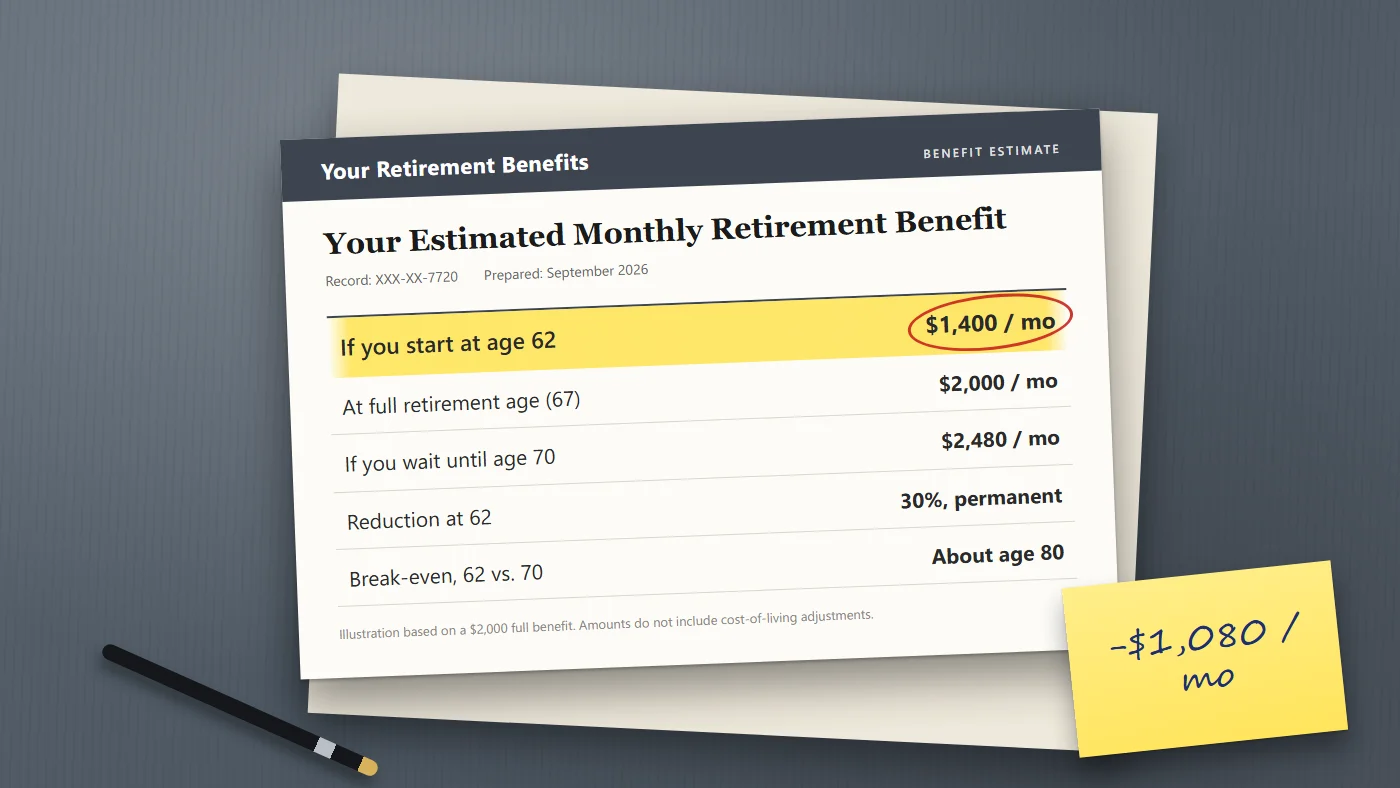
The rules behind that starting point are simpler than they look. Anyone born in 1960 or later reaches full retirement age at 67. File before then and the check shrinks, and at 62 it shrinks the most: you'd get 70% of your full amount. That 30% haircut doesn't go away on your 67th birthday, either. It's baked into every check that follows.
Waiting works the other way. Each year you hold off past 67 adds 8% to the benefit, and the credits keep coming until 70. By then you're at 124% of the full amount. Hold out any longer and you gain nothing.
What does that look like in dollars? Picture a full benefit of $2,000 a month. It's a round number, and it isn't far from a typical retiree's check (Social Security put the average for retired workers at $2,071 in January 2026). File at 62 and you'd get $1,400. At 67 you'd get the whole $2,000. Hold out to 70, and the check comes to $2,480, roughly 77% more than the early version, from the very same work history.
None of this makes 70 the right answer for everyone. The person who files at 62 cashes 96 monthly checks before someone waiting for 70 sees the first one. What you're really asking is how long the bigger check needs to erase that head start. And will you be around when it does?
The number to know: 30%, and it's permanent. In the $2,000 example, filing at 62 rather than 70 leaves you $1,080 short every month. Make it to 90 and that shortfall comes to about $124,800, before any cost-of-living raises.
What each age pays on the same record
The table sticks with the $2,000 full benefit and leaves out cost-of-living adjustments and taxes, so the structure is easy to see. Each total counts every check from the claiming age up to the age shown.
| Claim at 62 | Claim at 67 | Claim at 70 |
|---|
| Share of full benefit | 70% | 100% | 124% |
| Monthly check | $1,400 | $2,000 | $2,480 |
| Yearly income | $16,800 | $24,000 | $29,760 |
| Total collected by age 80 | $302,400 | $312,000 | $297,600 |
| Total collected by age 85 | $386,400 | $432,000 | $446,400 |
| Total collected by age 90 | $470,400 | $552,000 | $595,200 |
Start with the age-80 row. The three totals sit within about $15,000 of each other. No accident. That's roughly the idea behind the formula: the early cuts and the delayed credits were set so someone with an average lifespan ends up with about the same lifetime amount, whatever age they pick. The choice starts to matter once you live a lot longer than average, or a lot shorter.
So when does waiting pay off?
Think of a race with a head start. The early claimer banks checks for years, the late claimer gets bigger ones, and the birthday when the two totals meet is the break-even age.
62 versus 67. Check in on the early claimer at 67. They've already cashed 60 checks at $1,400 apiece, so they're $84,000 up. From that point, the person who waited collects $600 more every month. At that pace the lead takes 140 months to disappear, which lands at about age 78 and 8 months.
67 versus 70. Those three extra years mean skipping $72,000 in checks. What comes back is $480 more a month. Recovering the difference takes 150 months, so break-even arrives around 82 and a half.
62 versus 70. This is the widest split. By 70, the early claimer has pocketed $134,400. The late claimer's check is $1,080 bigger, though, and that closes the distance at roughly 80 and 4 months.
What about cost-of-living raises? They barely move these ages. Your benefit starts picking up COLAs at 62 even if you haven't filed, so all three columns rise by the same percentage. In dollars that tilts toward the larger check: 3% of $2,480 beats 3% of $1,400. The 2027 raise is scheduled to be announced on October 14, 2026.
A break-even age is a blunt tool. It ignores income tax on benefits, what the early checks might earn if invested, and the cost of pulling extra money from savings while you wait, which can hurt in a bad market. It also treats a dollar at 85 the same as a dollar at 63, when a guaranteed check often matters most at the age you can't work anymore. Use it as a starting point.
Now line those ages up against how long people actually live. A man who's made it to 65 has, on average, about 18 more years ahead of him, which gets him to around 83. For a woman the same age it's roughly 20.7 more, close to 86. Those figures come from Social Security's own period life table. They're averages, too, and plenty of people blow past them, especially people who reach 65 in good health.
For a single person in average health, then, it's close to a wash. It tilts toward waiting if you're healthy, if your parents lived into their 90s, or if you're a woman. It tilts toward claiming early if you have a serious health condition or nothing else to pay the bills with, because money in hand counts for more. Married? One more rule often outweighs everything above.
The survivor rule that changes the math for couples
When one spouse dies, the household keeps the larger of the two Social Security checks and loses the smaller one. If the survivor has reached full retirement age for survivor benefits, they can get up to 100% of what the deceased was receiving, and that includes any boost the deceased earned by waiting.
So the higher earner's claiming age ends up setting the income of whichever spouse lives longer. Say his full benefit is $2,400 and hers is $1,100. If he files at 62, his check drops to $1,680.
She wouldn't be stuck with that. A special rule puts a floor under a widow at full retirement age: 82.5% of his full benefit, about $1,980.
Now suppose he waits until 70. His check grows to $2,976, and if he dies first, that's what she gets. For her, his decision is worth about $1,000 a month, possibly for decades.
For the higher earner, the break-even question isn't "Will I live to 80?" It's "Will either of us?" Those odds are a lot better.
The lower earner's timing matters less, since the smaller check is the one that disappears. Many couples have that spouse claim earlier while the higher earner waits.
Spousal benefits work differently. A spouse can get up to 50% of the worker's full-retirement-age benefit, less for filing early, down to 32.5% at 62, and because that amount doesn't grow once full retirement age has passed, holding a spousal benefit past 67 gains you nothing.
When claiming at 62 still makes sense
Filing early isn't automatically a mistake. It can be the better call when:
- Your health is poor or your family history points to a shorter life, and you're single or the lower earner in your marriage.
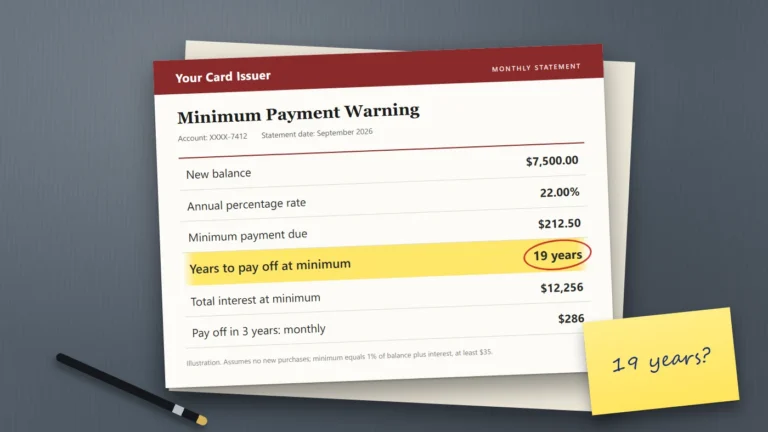
- You've stopped working and have no other income. Running up credit card debt at 25% interest to delay a benefit that grows roughly 6% to 8% a year is a bad trade.
- You're the lower earner and your spouse plans to delay the larger benefit.
- You have a minor child or a disabled adult child who may qualify for benefits on your record once you claim.
Still working? That's where claiming at 62 usually backfires, because of the earnings test. For every $2 you earn above $24,480 in 2026, Social Security holds back $1 of benefits, as long as you're under full retirement age for the whole year.
The year you reach full retirement age is gentler. The limit rises to $65,160, it only counts earnings before your birthday month, and the withholding drops to $1 for every $3.
That money isn't gone: your benefit is recalculated upward at full retirement age. Still, you've locked in an early claim while collecting little of it.
Seven steps before you file
- Get your real numbers. Sign in to your my Social Security account at ssa.gov and open your Statement. It shows your estimated benefit at 62, at full retirement age and at 70, based on your own earnings.
- Check your earnings record. The Statement lists your taxed earnings for every year. A missing or wrong year lowers your benefit, and you can fix it with a W-2 or a tax return.
- Do the same for your spouse. Write down both full-retirement-age benefits. The larger one is the one to protect.
- List what would pay the bills while you wait. Wages, a pension, savings, a 401(k) or IRA, home equity. Put a monthly number on each.
- Run your own break-even. Multiply the early check by the number of months you'd collect it before the later age, then divide by the monthly difference between the two checks. That's how many months past the later age it takes to catch up.
- Be honest about health and family history. Nobody knows their date. Most people have a fair idea which side of average they're on.
- Apply on time. You can apply up to four months before the month you want benefits to start. Whatever you decide about Social Security, sign up for Medicare at 65, because delaying it can bring a lifetime penalty of its own.
Covering the years between retiring and claiming
For most people the hard part of waiting isn't the math. It's the gap. Stop working at 63 and claim at 70, and something else has to pay the bills for seven years.
People fill it a few ways. Some draw down a 401(k) or IRA faster in their 60s, on purpose, so the larger Social Security check can carry more of the load later, when required minimum distributions from those accounts would otherwise push their taxable income higher every year. Others work part-time. A few buy a period-certain annuity: hand over a lump sum, get a fixed monthly payment for a set number of years in place of the check you're putting off. Current annuity rates decide how big that lump sum has to be, and they vary by insurer, so get more than one quote.
Delaying Social Security is really a purchase of a larger, inflation-adjusted lifetime income from the government. Some planners compare that cost with buying similar income from an insurance company, and how it comes out depends on your age, your health and interest rates at the time.
Questions like these are where a retirement planning session can earn its fee. A Social Security calculator, including the free one at ssa.gov, will show your benefit at each age. A financial advisor who works with retirees can go further and model taxes, a spouse's benefit and savings withdrawals together. If you hire one, ask how they're paid: an advisor on an hourly or flat fee earns nothing extra if you buy an annuity, and an agent paid by commission does. I'd ask that question before any other.
Already claimed and wish you hadn't?
Two narrow ways out.
Within 12 months of approval, you can withdraw your application with Form SSA-521. You repay every dollar you and your family received, including amounts withheld for Medicare premiums and taxes, and you only get to do it once. Afterward it's as if you never applied, and you can claim later at a higher amount.
After full retirement age, you can ask Social Security to suspend your benefit. You repay nothing. Your checks stop, and you earn delayed retirement credits of 8% a year until you restart or reach 70, when payments resume on their own. While you're suspended, a spouse or child drawing on your record generally isn't paid either, and you'll be billed directly for Medicare Part B.
Outside those two windows, the age you picked stays with you.
Mistakes that cost the most
- Claiming at 62 just because it's the first date available. Common, and the weakest reason there is.
- Thinking only about your own life expectancy when a spouse will inherit your check.
- Claiming while still working and watching most of the benefit get withheld.
- Assuming the reduction ends at 67. It doesn't. The percentage is permanent.
- Delaying to 70 with no plan for the gap years, then selling from savings in a panic during a bad market.
- Forgetting Medicare at 65 because you aren't on Social Security yet.
There's no single best age, and Social Security says as much itself. Before you file, log in to your Statement, write your three monthly figures on one page with your spouse's next to them, and run step 5 for 62 against 70.
This article is general information, not financial, legal, tax or medical advice.