Taxes

The New $6,000 Senior Deduction: Who Qualifies and What It Does to Taxes on Social Security

Social Security benefits are still taxable, but a temporary $6,000 deduction for people 65 and older wipes out the bill for many retirees, if their income and filing status fit.

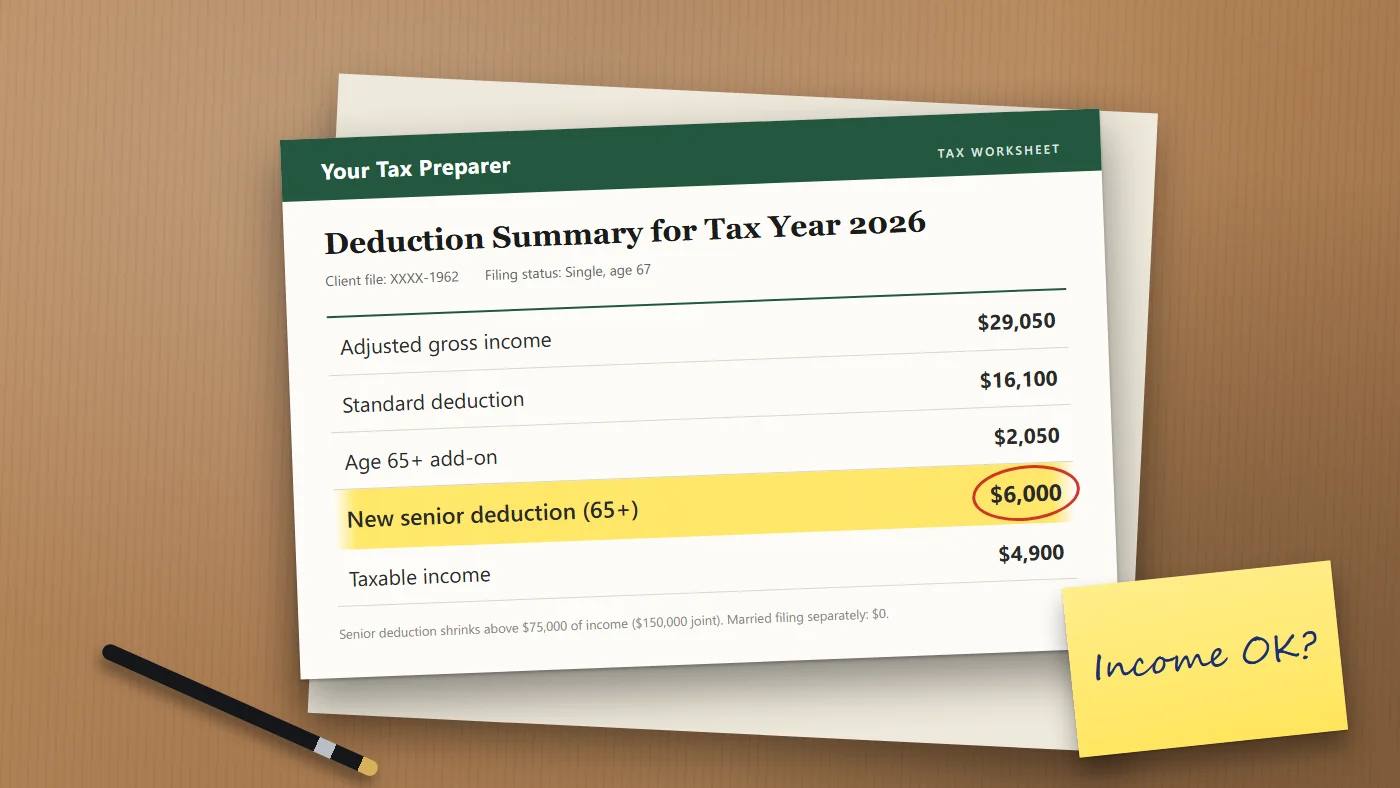
A tax deduction worksheet on a wooden desk with the line "New senior deduction (65+) $6,000" highlighted and a sticky note asking "Income OK?
Illustration

Congress didn't end the tax on Social Security benefits. The rules that decide how much of your check gets taxed are the same ones that were on the books in 2024. Up to 85% of your benefits can still count as taxable income. Even the income lines that trigger that tax are old: one set dates to 1983, the other to 1993, and neither has budged since.

So what did Congress actually do? It created a deduction. Under a law passed in July 2025, anyone 65 or older can knock an extra $6,000 off their taxable income. Married, and you both qualify? Then it's $12,000 between you. It's temporary, too: it only runs from tax year 2025 through 2028 and expires after that unless Congress renews it.

If your federal bill is small to begin with, that deduction may be enough to erase it. There are strings. It starts shrinking once your income passes $75,000, or $150,000 if you file jointly. It's gone entirely if you're married and file separately. And the return has to show a valid Social Security number for each person claiming it.

So your benefits are still taxable on paper. What you actually owe now depends on a deduction you might get in full, in part or not at all.

What passed, and what didn't

On paper, the law is Public Law 119-21. It was signed on July 4, 2025, and the IRS now files its tax provisions under a friendlier name, the Working Families Tax Cuts. The agency's summary of the senior part is plain enough: at 65 or older, you can claim an extra $6,000, and it sits on top of the age-65 standard deduction you already had.

None of it touches how benefits get taxed. That math still runs on a figure the IRS calls combined income. You get there by taking your adjusted gross income, adding any tax-exempt interest, and then adding half of your Social Security.

Where that total lands decides the rest. For a single filer, crossing $25,000 means up to half of your benefits can be taxed, and past $34,000 it's up to 85%. Joint filers have higher lines, at $32,000 and $44,000.

Nobody ever tied those lines to inflation, so more retirees drift over them every year. No wonder "no tax on Social Security" was such a popular promise. What you got instead is a bigger deduction at the bottom of the return.

What $6,000 is worth in real dollars

A deduction isn't a check. Big difference. It lowers the income your tax is figured on, so what it's worth depends on your bracket.

In the 12% bracket, taking $6,000 off your taxable income saves about $720. In the 22% bracket it's closer to $1,320. A couple who both qualify can double that.

Say you're single and 67. Social Security pays you $30,000 a year, and a pension plus IRA withdrawals bring in another $22,000. Add half the benefits to that other income and your combined income comes to $37,000. Now run the IRS worksheet. It says $7,050 of your benefits is taxable, so your adjusted gross income ends up at $29,050.

For 2026 you'd subtract the $16,100 standard deduction first, then the $2,050 extra for being 65, then the new $6,000. That leaves $4,900 of taxable income. All of it falls in the 10% bracket, so the federal bill is about $490.

Without the senior deduction? You'd owe about $1,090. The new break is worth $600 to you, which isn't nothing. Still, you pay something, and part of your Social Security still counts as income.

Stack the pieces and you get the numbers most retirees will work with for 2026:

Filing situation (tax year 2026)Standard deductionAge 65+ add-onNew senior deductionTotal
Single, 65 or older$16,100$2,050$6,000$24,150
Married filing jointly, one spouse 65+$32,200$1,650$6,000$39,850
Married filing jointly, both 65+$32,200$3,300$12,000$47,500
Married filing separately, 65+$16,100$1,650$0$17,750

Find your row. When your adjusted gross income, counting the taxable slice of your benefits, stays under that total, your taxable income is zero and there's no federal income tax to pay. Read that twice. It's AGI that has to fit, not just your pension and IRA money.

The income test: where $6,000 starts shrinking

Earn enough and the $6,000 gets chipped away. For a single filer, the chipping starts once modified adjusted gross income passes $75,000. On a joint return the line is $150,000. (For most retirees, modified AGI is simply the AGI line on Form 1040.) Above the line, you lose 6% of every extra dollar.

In round numbers, every $1,000 over costs you $60 of deduction. Picture a single filer with $100,000 of income. That's $25,000 past the line, so $1,500 disappears and $4,500 survives. Keep going to $175,000 and nothing's left.

For couples the cut hits each spouse's $6,000. A joint return showing $200,000 is $50,000 over the line. Each spouse loses $3,000, which leaves the pair with $6,000 out of a possible $12,000. By $250,000 it's all gone.

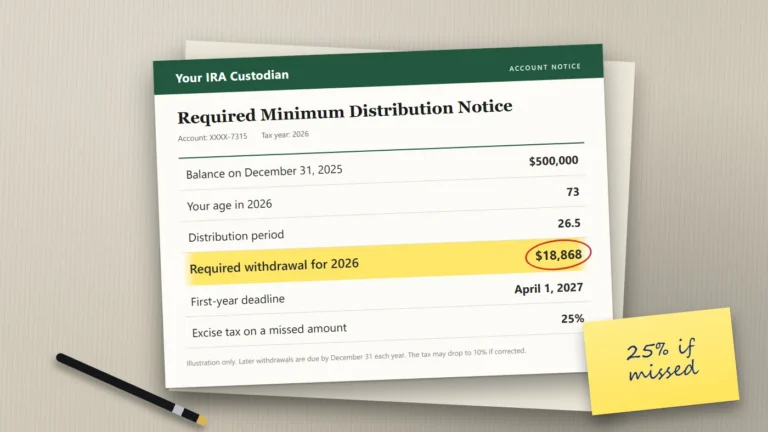
What counts as income here is broader than people expect. The taxable part of your Social Security counts, and so do IRA and 401(k) withdrawals, required minimum distributions, pension checks, Roth conversions and capital gains from selling stock or a house above its exclusion, which means one big December withdrawal can push you over the line for the whole year.

Timing now has a price. The rest of this piece is about getting it right on the return and in the calendar.
Continued

Five checks before you file

You claim the deduction on Schedule 1-A, a new schedule the IRS created for the 2025 tax year that attaches to Form 1040 or 1040-SR. Tax software fills it in from your birth date, but it can only use what you type in. Go through these in order.

  1. Confirm the age rule. You have to turn 65 on or before the last day of the tax year. For 2025 returns, that meant born before January 2, 1961. The same rule puts the 2026 cutoff at January 2, 1962. If only one spouse is 65, only that spouse gets the $6,000.
  2. Check your filing status. Married? You need a joint return. Married filing separately gets $0. People file separately for real reasons, like income-driven student loan payments or a spouse's back taxes, so run it both ways. A separate return can now cost up to $12,000 in lost deductions.
  3. Look for both Social Security numbers. The law requires a valid SSN for each person claiming it. A spouse listed with an individual taxpayer identification number won't get the deduction.
  4. Add up your income before December 31. Pull year-to-date pension income, IRA withdrawals and any gains. Near $75,000 or $150,000? You may be able to push a withdrawal or a sale into January. Well under? This could be a good year to take a bit more from a traditional IRA while the bigger deduction covers it.
  5. Don't skip it because you itemize. The $6,000 works with the standard deduction or with itemizing, which is unusual. The regular age-65 add-on disappears when you itemize. The new one doesn't.

Does it lower the tax on my benefits?

It lowers your tax bill, but not the part of the return that decides how much of your benefits get taxed, and that surprises a lot of people. The senior deduction comes off after your adjusted gross income is already set. Taxable income goes down. AGI doesn't.

Three things follow.

Related searches

It won't reduce how much of your Social Security is taxable. That math happens higher up on the return, and it ignores the new deduction completely.

It won't help with IRMAA, the income-related surcharge on Medicare Part B and Part D premiums. IRMAA looks at AGI plus tax-exempt interest from two years earlier, so a retiree whose income runs well into six figures can lose part or all of the new deduction and still owe the surcharge on top of the standard premium in the same year.

And it may or may not show up on your state return. States decide which federal deductions they follow, and a handful still tax Social Security under their own formulas. Check your state revenue department's instructions rather than assuming the federal result carries over.

Already filed for 2025 without it?

Most software and preparers picked up the deduction on 2025 returns filed this spring. Still, it takes two minutes to check. Open your 2025 Form 1040 or 1040-SR and look for Schedule 1-A with an amount in the senior section. If you were 65 by the end of 2025, your income was under the limits, and that schedule is missing or blank, you probably overpaid.

The fix is Form 1040-X, and there's no rush. You generally have three years from when you filed to claim a refund, and a return filed early counts as filed on the April deadline. Still, there's no reason to sit on money you're owed. When the deduction goes missing, it's usually for one of a few reasons: the software had the wrong birth date, a paper return was copied from an old template, or a couple filed separately and never compared the joint result.

Your 2026 withholding may need a look, too. Tax taken out of a pension through Form W-4P, or out of Social Security through Form W-4V, may still be set at amounts chosen before the deduction existed. Lower them, and more of each monthly check stays with you instead of sitting with the Treasury until next spring. Any estimated payments you still have left this year deserve the same second look.

Free help, paid help, and when each makes sense

If your income is a pension, Social Security and a modest IRA withdrawal, you probably don't need to pay anyone. Free help exists for exactly that kind of return.

The IRS runs two programs, Volunteer Income Tax Assistance and Tax Counseling for the Elderly. You can find a site near you through the IRS locator. Rather use the phone? Call 800-906-9887.

AARP Foundation Tax-Aide is the other big one. It runs free sites every season, you don't have to be a member, and it has its own line, 888-227-7669.

Doing it yourself works, too, once you've checked the fine print. The free tiers of tax programs don't all cover the same forms, so compare what each one charges for a return with retirement income before you start typing.

Paid help starts to earn its fee when you're close to the income limits and get to choose when income shows up. A Roth conversion is the classic case. Selling a rental or a block of stock is another, and so is deciding how to split withdrawals between a traditional IRA and savings. Through 2028, a dollar over the line gets hit twice. There's the regular tax on it, and then there's the lost deduction, which runs $60 to $120 per $1,000 over the line depending on whether one of you or both are claiming it.

In that spot, I'd book one planning session with a CPA or an enrolled agent who works with retirees before paying for anything else. When you compare them, ask:

  • Will you run a projection for 2026 through 2028, or only prepare this year's return?
  • Flat fee, or priced per form?
  • For a married couple, will you show the joint and separate results side by side?

Fees for the same return can swing a lot from one office to the next, so two or three quotes aren't overkill. Get them before January, when calendars start to fill up.

What happens after 2028

The deduction covers four tax years, 2025 through 2028, and then it's scheduled to stop. Unless Congress extends it, it won't be on the return you file in early 2030.

It also behaves differently from your other deductions while it lasts. The standard deduction and the age-65 add-on are permanent, and both rise with inflation each year. The senior deduction isn't indexed at all: it stays at exactly $6,000 for as long as it lasts, so it quietly shrinks in real terms.

That leaves three more filing seasons. Before you take any large withdrawal this fall, pull your year-to-date income and hold it up against $75,000. On a joint return, the number to watch is $150,000.

This article is general information, not financial, legal, tax or medical advice.

A retirement benefit estimate on a desk showing monthly amounts of $1,400 at age 62, $2,000 at age 67 and $2,480 at age 70, with the age 62 amount circled. Read nextSocial Security at 62, 67 or 70: The Break-Even Math in Plain Numbers A premium notice on a desk showing a monthly Part B premium of $649.20 based on 2024 income, with the amount circled and a note asking about 2024. Read nextIRMAA Explained: Why Your Medicare Premium Is Higher Than Your Neighbor’s — and How to Appeal

About the author

Margaret Linwood

Margaret Linwood covers Medicare, Social Security and what health care actually costs after 60. She builds every piece around the number a reader will face on a bill or a notice, and shows where that number comes from.

Sources

Updated Sep 22, 2026 · Reviewed against IRS, Public Law 119-21, CRS

Related searches