Only 24% of American adults have a will. That's from the 2025 Wills and Estate Planning Study by Caring.com and YouGov, and it's down from 33% in 2022. About 13% have a living trust. The most common excuse for having neither? People just haven't gotten around to it.
Die without a will and you don't get a say. Your state's intestacy law decides who inherits, following a fixed order of relatives. In many states a surviving spouse ends up splitting the estate with your children, which can leave a widow co-owning her own home with stepchildren. An unmarried partner, a stepchild you raised and a favorite charity usually get nothing. The state itself takes the property only when no relatives can be found.
A will fixes that. It names who gets what, who settles your affairs and who raises minor children. What surprises people is what a will doesn't do. It doesn't keep your family out of court. A will is a set of instructions to the probate court, and the court process still runs start to finish.
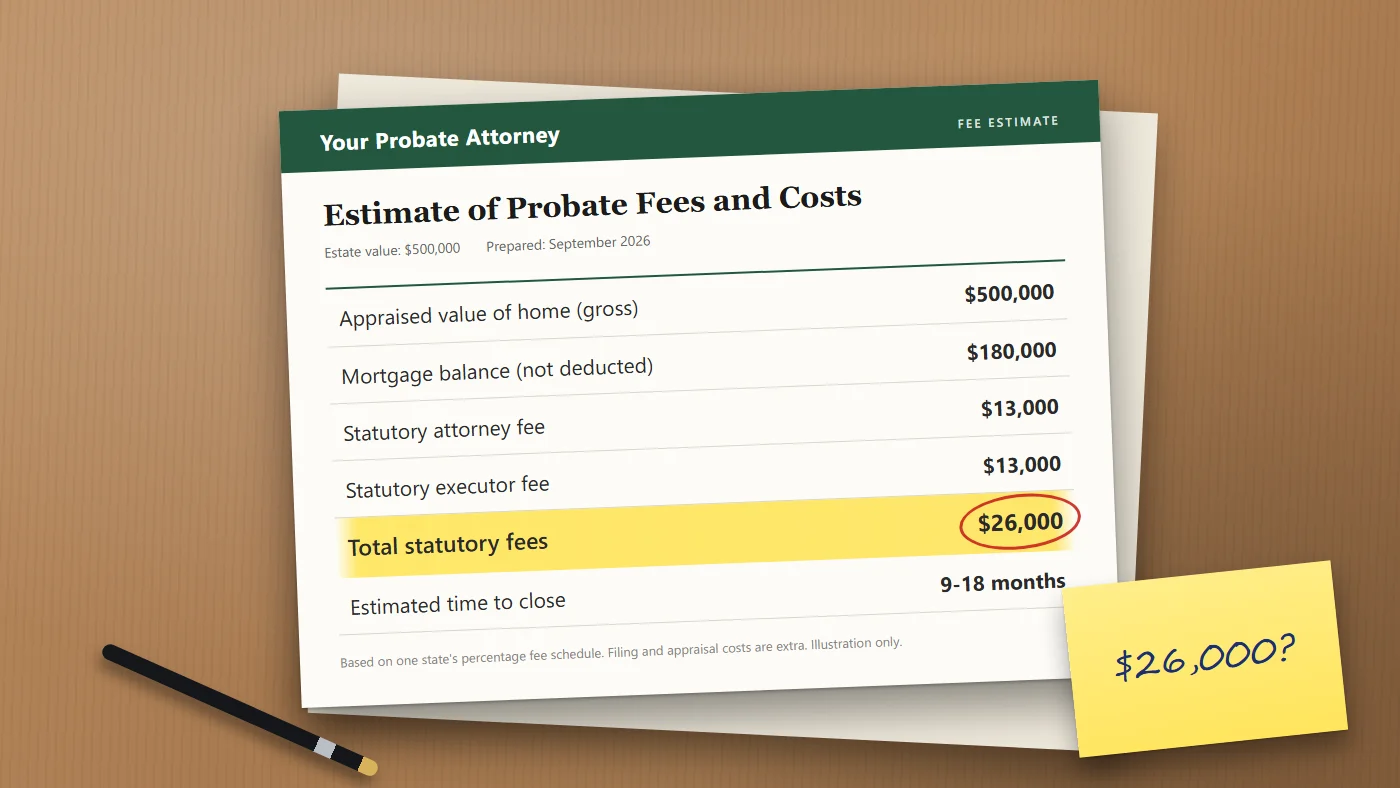
And that process has a price. In California, the fees for the attorney and for the person settling the estate are set by statute as a percentage of the estate's gross value. On a $500,000 estate, each is entitled to $13,000. That's up to $26,000 before filing fees, appraisals and publication costs, and the state's courts say a typical case takes 9 to 18 months.
A living trust is the document built to sidestep all that. Assets you put in the trust while you're alive pass to your heirs without a probate case. It costs more to set up than a will, and it only works if you finish the paperwork. Is it worth it? That mostly depends on what you own and where you live.
What probate costs, and why your state matters so much
Probate is the court-supervised process of proving a will, paying debts and handing out what's left. The bills come from several places: court filing fees, attorney fees, pay for the executor, appraisals, sometimes a bond, and a published notice to creditors.
States treat the big items very differently. California sets fees by formula: 4% of the first $100,000, 3% of the next $100,000, 2% of the next $800,000 and 1% of the next $9 million. It runs on the appraised value of the property. A mortgage doesn't shrink it.
The number to know: on a $500,000 California estate, statutory fees come to $13,000 for the attorney and $13,000 for the executor. On $1 million, it's $23,000 each. A home with a big mortgage still counts at full value.
Florida publishes a fee schedule that courts presume is reasonable: $3,000 for an estate of $100,000, then 3% of the next $900,000. That's $15,000 on $500,000. Florida law also requires the attorney to tell the personal representative in writing that there's no mandatory statutory fee and that the fee can be negotiated.
Most other states just require "reasonable" fees, often billed by the hour. Where streamlined procedures exist, an uncontested estate with a clear will can get through for modest cost. Same family, same house: a $26,000 process in one state, a far smaller bill in another.
Two costs never show up on an invoice. Probate files are public, so anyone can look up what you owned and who got it. And heirs usually wait months, sometimes well over a year in a busy county, before they can sell the house or split the accounts, while the mortgage, the property taxes, the insurance and the utility bills on an empty house keep coming due. Nobody itemizes that.
Will vs. living trust, side by side
A revocable living trust is a legal container. You create it, move your house and accounts into its name, and keep full control as trustee. You can change it or cancel it any time. When you die, the successor trustee you picked follows your instructions without asking a court's permission.
| Will | Revocable living trust |
|---|
| Goes through probate | Yes | No, for assets titled in the trust |
| Public record | Yes | Generally no |
| Typical attorney cost to set up | Lower | Higher, often three to five times a will |
| Cost to your heirs later | Probate fees and delay | Usually small |
| Helps if you become incapacitated | No | Yes, the successor trustee can step in |
| Names a guardian for minor children | Yes | No, you still need a will for this |
| Work required from you | Sign it properly | Sign it and retitle your assets |
Look at the last two rows. Even with a trust, you still sign a short "pour-over" will to name guardians and catch anything left outside. And the trust controls only what you actually move into it.
That retitling step is where a lot of trusts quietly fail. Before you pay for either document, look at the cheaper tools that skip probate on their own, who really needs a trust, what each option costs in 2026 and the mistakes that land families in court anyway.
Four ways to skip probate without a trust
Some of the best tools cost little or nothing.
Beneficiary designations. Retirement accounts, life insurance and annuities go straight to whoever's named on the form. The form beats the will. If your 401(k) still names an ex-spouse, your will can't fix that.
Payable-on-death and transfer-on-death registrations. Banks and brokerages let you name a beneficiary on ordinary accounts. Usually it's one form, no fee.
Transfer-on-death deeds. In a 2025 count, the American Bar Association found 32 U.S. jurisdictions that let you record a deed passing your home to a named person at death, with no probate. You keep full ownership while you're alive and can revoke it. Maryland joins the list when its new law takes effect on October 1, 2026. Other states still don't offer it, and the rules differ where they do.
Small-estate procedures. Every state has a shortcut for smaller estates, and the limits are all over the map. In California, for deaths on or after April 1, 2025, heirs can collect up to $208,850 in personal property with a simple declaration after a 40-day wait, and a primary residence worth up to $750,000 can pass through a simplified court petition.
Putting a child on the deed as joint owner also avoids probate. It's the shortcut most lawyers warn against. Adding a child is a gift. It exposes the house to the child's debts and divorce, it can trigger a Medicaid penalty if you need nursing home care within five years, and it can cost the child the step-up in tax basis on the gifted share.
So who needs which?
A will is usually enough if your main assets are retirement accounts and insurance with current beneficiaries, your state offers a transfer-on-death deed or cheap probate, and your family's simple.
A living trust earns its cost if any of these fit:
- You own a home in a state with percentage-based or high probate fees.
- You own real estate in more than one state. Without a trust, your family may face a separate probate case in each one.
- You're in a second marriage and want to provide for your spouse while making sure your children inherit in the end.
- You have a child with a disability who gets benefits, or an heir who shouldn't get a lump sum.
- You want someone to take over smoothly if you can't handle your own affairs, without a court guardianship.
- You care about privacy.
A revocable trust also has limits people don't expect. It won't shield assets from your creditors. It offers no protection from nursing home costs, because Medicaid counts everything in a revocable trust as yours. It doesn't cut income tax. And for nearly everyone, federal estate tax isn't the issue: the IRS filing threshold for 2026 is $15,000,000 per person. A number of states run their own estate or inheritance taxes with much lower thresholds, so check yours.
Whichever you choose, two other documents matter just as much while you're alive: a durable financial power of attorney and a health care directive.
What does each one cost to set up?
It depends on your city and how tangled your situation is. Commercial surveys of law firm pricing put a lawyer-drafted will at roughly $300 to $1,500, and a living trust package at roughly $1,500 to $5,000. The package normally includes the trust, a pour-over will, powers of attorney and a health care directive. Online will and trust services cost a fraction of that, from under $100 to a few hundred dollars.
Now set that against the probate bill. Big difference. In a high-cost state, a $3,000 trust that spares your heirs $26,000 and a year of waiting is easy math. In a low-cost state with a transfer-on-death deed already on the house, the same $3,000 may buy very little.
Online documents can work fine for a simple will: one state, no real estate elsewhere, no blended family, no disabled heir. They're weaker for trusts, because drafting is the easy part. Funding the trust, meaning the new deed and the retitled accounts, is where people stall, and a local estate planning attorney usually prepares and records that deed as part of the fee.
If I were comparing lawyers, I'd ask each one these four things:
- Is the fee flat, and what exactly does it include?
- Do you prepare and record the new deed for my house?
- What does probate typically cost here for an estate like mine? If the answer is "not much," you may not need the trust.
- What do you charge to update the documents later?
Most state bar associations run a lawyer referral service, and many attorneys offer a first meeting for a low flat fee or free. People 60 and older with limited income can often get a basic will through legal aid programs funded by the Older Americans Act. The Eldercare Locator at 1-800-677-1116 can refer you.
Seven steps you can take this month
- List what you own and how each item is titled. For every account and property, note whether it's in your name alone, held jointly or has a named beneficiary. That one page shows what would go through probate today.
- Check every beneficiary form. Retirement accounts, life insurance, annuities. Name a backup too.
- Add payable-on-death or transfer-on-death beneficiaries to bank and brokerage accounts that don't have them.
- Look up your state's rules. Search your state court website for the small-estate limit and whether transfer-on-death deeds are allowed.
- Decide: will only, or trust plus pour-over will. Use the list in the section above.
- Sign it correctly. Most states require two adult witnesses for a will, and a notarized self-proving affidavit saves your family a step later. A will that isn't properly witnessed can be thrown out.
- Tell your executor or trustee where the originals are. Review everything after a marriage, divorce, death, birth, home purchase or move. In the 2025 survey, about one in 10 Americans no longer lived in the state where their will was made.
Mistakes that send families to court anyway
The empty trust is the classic. You paid for a trust and never deeded the house into it, so the house goes through probate as if the trust didn't exist.
Then the stale beneficiary form: an ex-spouse or a deceased parent still listed. The form controls, whatever the will says.
Leaving everything to one child "to share." Legally it's that child's alone. Siblings have no claim, and the handoff can create tax and creditor problems of its own.
A do-it-yourself will with a signing error. A missing witness, or a witness who's also an heir, can void the will or that person's gift in some states.
And assuming a will avoids probate. It doesn't. It only makes probate follow your wishes.
Start with the one-page list. Once the beneficiary forms are updated, whatever's still in your name alone, usually the house, tells you whether a will covers it or a trust is worth pricing.
This article is general information, not financial, legal, tax or medical advice.