In August 2025, the government's price index for motor vehicle repair stood 15% higher than a year earlier. More than a third of that increase landed in a single month, when the index jumped 5% between July and August. The Bureau of Labor Statistics tracks this inside the Consumer Price Index, the same report used to measure inflation.
The pace has cooled since then. Prices haven't fallen. By August 2026 the repair index was another 2.6% higher, the broader category of maintenance and repair was up 5.2% over the year, and overall inflation ran 3.4%. Against August 2021, the repair index is up by more than half.
Part of it is the cars themselves. A bumper or a side mirror now holds radar units and cameras, so a repair that once meant a piece of plastic and an hour of labor now means electronics and calibration. In a 2023 study, AAA found that replacing a single front radar sensor ran $500 to $1,300 and a windshield camera $900 to $1,200, over and above the normal body work after a crash.
Meanwhile, the cars on the road keep getting older. S&P Global Mobility put the average age of U.S. cars and light trucks at a record 12.8 years in 2025, far beyond the typical factory coverage. So the question comes up in nearly every household with a car: should you pay for an extended warranty to cover the bills the factory no longer will?
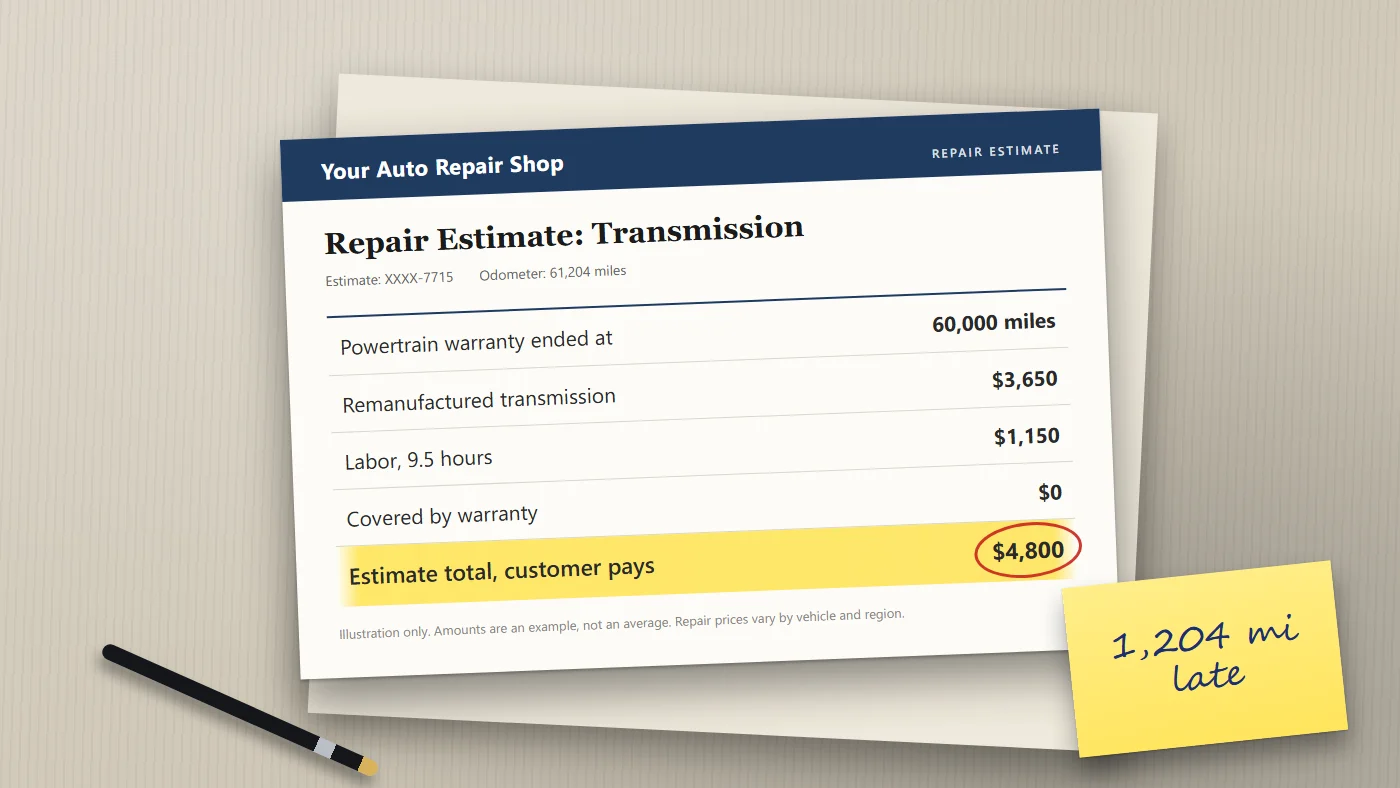
Picture an owner whose powertrain warranty ended at 60,000 miles and whose transmission fails at 61,000. The shop quotes $4,800.
The factory pays nothing.
Whether that bill means a bad week or a real emergency depends on what the owner set up beforehand.
For a lot of owners, the honest answer is no. For some it's yes. The contract and your own finances decide it more than the car does.
What you're actually buying
The Federal Trade Commission makes a point that tends to get lost in the sales pitch. An "extended warranty" isn't a warranty. A warranty comes with the car, from the manufacturer, included in the price. What you're offered later is a vehicle service contract, a separate product sold for a separate price by a dealer, an automaker or an independent company.
Why does the label matter? Because a service contract covers only what its text says it covers. The word "warranty" makes people expect that a broken car simply gets fixed, while a contract may name only certain parts and set conditions on every claim.
The same FTC page warns about the "final notice" letters and calls telling you your warranty's about to expire. They often misrepresent a connection to your dealer or manufacturer. More on those below.
The Consumer Financial Protection Bureau adds two facts dealers rarely volunteer. These products are optional, even when they show up pre-printed on the paperwork, and if one was added to your financing, you can cancel it and cut what you owe, something to remember the next time a finance manager slides a form across the desk.
The BLS motor vehicle repair index rose 15% in the 12 months through August 2025, including a 5% jump in a single month. A year later it was up a further 2.6%.
Why most owners come out behind
A service contract is priced so the company selling it takes in more than it pays out, which is how any insurance-type product works, and it means the average buyer pays more for the contract than they'll ever get back in repairs. No surprise there.
Consumer Reports found as much in past member surveys: owners typically paid more for the coverage than they got back in direct benefits. Its current guidance, updated in October 2025, still says that from a pure numbers standpoint the smart money skips the protection, buys a model with better-than-average predicted reliability, and maintains it.
Financing makes it worse. Roll a $3,200 contract into a 72-month car loan at 7%, and it adds about $55 to the payment and roughly $730 in interest. The real price becomes about $3,930, and you start paying for it years before most of the coverage could even be used.
Now put that same $55 a month into a savings account set aside for the car. After four years you'd have about $2,600, plus interest. If the car never needs a major repair, the money's still yours. AAA made a version of this suggestion back in 2017, when it put a typical repair bill at $500 to $600 and advised drivers to save at least $50 a month for unexpected expenses.
Who sets the price, anyway? It isn't fixed. Consumer Reports notes that the price of a service contract can be negotiated, just like the price of the car. The first figure a finance office quotes is an opening offer, so two buyers can pay very different amounts for the same plan on the same model, and most never find out because few people ask a second dealer.
The savings route assumes you'll actually save the money and leave it alone. It also assumes a $3,000 bill in year two, before the fund has grown, wouldn't sink you. If either assumption fails for you, a contract starts to make more sense.
Who a service contract can make sense for
Think of the contract as a trade: a known cost now against a bad surprise later. You'll probably lose a little money on it. That's fine when the surprise would do real damage.
Who's in that spot? If a $3,000 to $5,000 repair would go on high-interest debt, and you need the car to get to work or to medical appointments, the contract is doing a real job. Time counts, too. Owners who plan to keep the car well past the factory powertrain coverage, often 5 years or 60,000 miles, are heading into the years when big repairs get more likely.
Then there's the car. A model with a below-average reliability record is one case. A car packed with expensive technology, such as air suspension, turbochargers or large touch-screen systems, is another. And the best version of the deal is a plan backed by the automaker, bought at a negotiated price and paid for without financing.
It falls apart just as fast the other way. Years of factory coverage still left? Trade cars every three or four years? A model with a strong reliability record? An emergency fund already in place? Then it's hard to justify.
Go back to the owner with the $4,800 transmission estimate at 61,000 miles. With savings, that's a bad week. With nothing in the bank, the bill goes on a credit card at credit card interest, or the car sits in the driveway. That second owner is who a service contract is built for, as long as it really covers transmissions and the company behind it pays its claims.
What the fine print usually says
Plans generally come in three levels. The names change from company to company; the structure doesn't much.
| Plan type | What it typically covers | What to watch for |
|---|
| Powertrain | Engine, transmission, drive axles | Seals, gaskets, sensors and electronics are often excluded |
| Named-component ("stated") | Only the parts listed in the contract | If a part isn't on the list, it isn't covered |
| Exclusionary ("bumper-to-bumper") | Everything except a list of exclusions | The exclusion list can run for pages, so read every line |
A plan's real value shows up the day you file a claim. The FTC suggests a handful of questions to ask before you buy, and they're worth asking out loud.
Start with wear versus breakage. Plenty of contracts only pay for "mechanical breakdown." A part that simply wore down over time, rather than failing all at once, can get the claim turned away. Brake pads, clutches, belts, tires and batteries? Almost never covered.
Then there's paperwork. The administrator can ask you to prove the car was maintained on schedule, so hang on to every receipt, even for a $40 oil change.
Most plans also want the shop to call for approval before anyone picks up a wrench. Fix first and file later, and you may be paying for it yourself.
Last, ask where you're allowed to take the car. Some plans take any licensed shop. Others steer you to a network or back to the dealer who sold you the plan.
On the bill itself, ask if the deductible applies per visit or per repair, because three covered repairs in one visit can mean three deductibles. The contract may allow used or remanufactured parts, and it may pay less than full price for a part on a high-mileage car. Ask, too, if the company pays the shop directly or reimburses you later.
Two questions come before you buy. Overlap is one. A plan that starts the day you buy a new car spends its first years duplicating the factory warranty, so compare its start and end dates with the coverage you already have.
The other is who stands behind it. Get the names of the administrator and the backing insurer. Some sellers may not be in business when you need them, the FTC warns, and that leaves the contract worthless. Your state insurance department or attorney general's office can tell you if a company is licensed and how many complaints it's drawn.
Rules differ by state as well. Some states regulate service contracts much like insurance, and some require a free-look period or set how refunds are figured. Some auto insurers also sell a similar product called mechanical breakdown insurance, where the state allows it, usually only for newer cars.
How to shop for one without overpaying
- Find out what coverage you've still got. Call any franchised dealer's service desk with your VIN and ask for the dates and mileage limits on each factory warranty. Powertrain, corrosion, emissions and hybrid-battery coverage often run longer than the basic warranty.
- Look up the model's reliability record. If owners of your model and year report few major problems, the odds favor skipping the contract.
- The automaker-backed plan is negotiable, so get it priced by more than one dealer. A dealer across town, or one that sells plans online, may quote hundreds less for the identical factory plan.
- Get two independent quotes for comparison, and ask for the sample contract before you pay anything. The FTC warns about sellers who want money before they'll show you the terms.
- Read the exclusions and the claims section. Those two parts tell you what you're really buying.
- If you buy, pay cash. If you can't, a contract paid monthly with no interest costs less than one folded into a car loan.
- Check the cancellation terms. Most contracts can be cancelled for a prorated refund, minus a fee, so if you sell or total the car, claim that refund.
Consumer Reports says the best time to buy protection for a newer car is while it's still under the original factory warranty, which helps keep the cost down. You don't need to decide in the finance office on the day you buy the car.
Those "final notice" letters and calls
Own a car? You've seen them. The envelope says "Final Notice" or "Motor Vehicle Notification" and warns that your coverage is about to run out. A recorded call says much the same.
The FTC says these mailers and calls often misrepresent a connection to your dealer or manufacturer. Callers tend to push for personal financial information and a down payment right away, before you've seen any contract. Consumer Reports agrees: be skeptical of any cold call offering this kind of protection. I'd go a step further and not return the call at all.
The repair costs those letters warn about are real, though. The fix is to request quotes yourself, from companies you picked, not to answer a mailer that picked you. Misleading warranty mail and calls can be reported at ReportFraud.ftc.gov.
Getting real numbers before you decide
Two sets of numbers make this much easier, and both are free.
The first is what a repair would cost where you live. If one specific failure worries you, call two local shops and ask for a ballpark. A transmission repair cost or a quote for an engine control module on your exact model tells you more than any national average.
The second is what coverage costs for your car, at your mileage, in your state. Extended car warranty cost swings with the model, its age and the deductible you pick, so "starting at" prices in ads mean little. Line up at least three quotes. One should be the automaker's plan, one a well-reviewed independent plan. If your state and your car's age allow it, add mechanical breakdown insurance from an auto insurer. Give each a row: price, deductible, term in years and miles, main exclusions.
Now set the monthly cost of the best plan next to what you could save on your own. Would a single large bill mean debt, or no car? Then the contract may be the better trade. Before you sign anything, ask for the sample contract and read the exclusions page first.
This article is general information, not financial, legal, tax or medical advice.