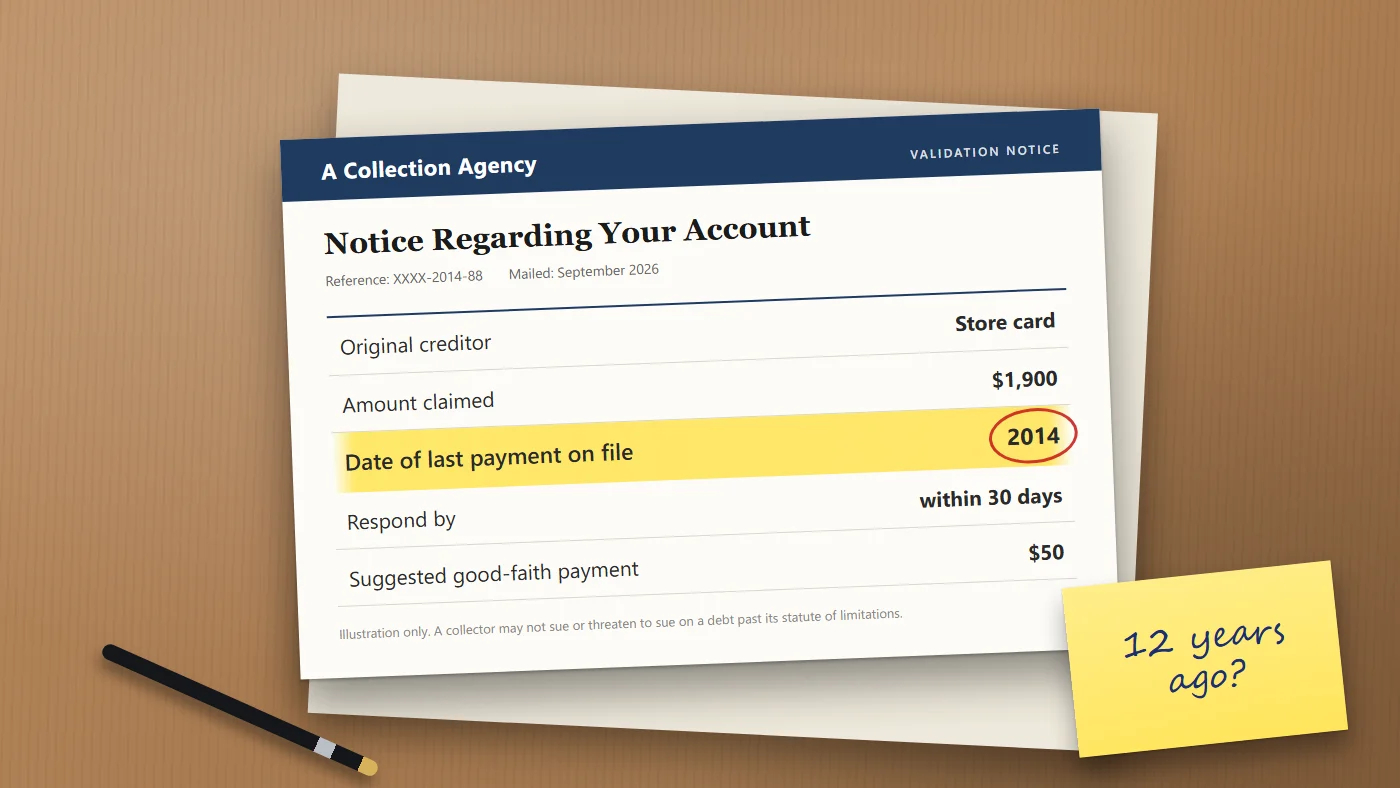
The phone rings. A collector says you owe $1,900 on a store card you haven't seen since 2014. You don't remember it, but you try to do right by people, so you offer $50 to show good faith and ask about a payment plan.
In some states, that $50 could be the most expensive payment you ever make. Old debts come with a legal deadline for lawsuits, and once it passes the collector can't take you to court for the money. But in a number of states, a payment or a signed acknowledgment can start that deadline over, turning a debt that couldn't be taken to court into one that can.
The deadline is called the statute of limitations. The Consumer Financial Protection Bureau says most states set it between three and six years for debts, though some run longer. The exact number depends on the type of debt, the state you live in, and sometimes the state named in your credit agreement.
Two things hold everywhere. The debt doesn't disappear when the deadline passes; the collector can still write and call, within the rules. And under a federal rule that took effect November 30, 2021, a collector can't sue you or threaten to sue you on a debt that's past its statute of limitations. That second point is what this article is about. It matters most in the first thirty seconds of the call.
What "time-barred" means, and what it doesn't
Regulation F is the CFPB rule that fills in the details of the Fair Debt Collection Practices Act. Section 1006.26 defines a time-barred debt as one for which the applicable statute of limitations has expired. Then it lays down the rule in a single sentence: a debt collector must not bring or threaten to bring a legal action against a consumer to collect a time-barred debt.
That covers the two things people fear most, the lawsuit and the threat of one. A collector who says "we'll take you to court" about a time-barred debt is breaking a federal rule.
Now the limits. The debt isn't erased. Letters and calls may not stop, either. According to the FTC, some state laws make it illegal for a collector to contact you about a time-barred debt, while other states allow it. Texas, for one, requires debt buyers collecting a time-barred debt to tell you in writing that they won't sue you for it.
Nor does a judge toss out a late lawsuit automatically. If a collector sues anyway, you have to show up and raise the statute of limitations yourself. The CFPB says it plainly: ordinarily, it's the responsibility of the person being sued to point out that the deadline has passed.
So what restarts the clock?
State law splits hardest here. The same $50 that changes nothing in New York can, in a state that allows revival, hand a collector a fresh window to sue over a debt that was legally dead a minute earlier.
The CFPB warns that making a partial payment, or acknowledging you owe an old debt, may restart the time period even after it has expired. The FTC goes further in its consumer guidance: in some states, if you pay any amount on a time-barred debt, or even promise to pay, the debt is "revived," and a new window opens in which you can be sued.
Three states show how far apart the rules can be. They're examples, not a survey of all fifty.
| State | Limit for a typical written credit contract | Can a payment or acknowledgment after the deadline revive the debt? |
|---|
| California | 4 years (Code of Civil Procedure 337) | A payment by itself can't revive a barred claim. A signed written acknowledgment or promise can extend the period (section 360). |
| New York | 3 years for consumer credit (CPLR 214-i) | No. A later payment, a written or oral affirmation, or other activity on the debt doesn't revive or extend the period. |
| Texas | 4 years for debt (Civil Practice and Remedies Code 16.004) | Not for debt buyers. Finance Code 392.307 bars them from suing after the deadline and says a payment or reaffirmation doesn't revive the debt. |
New York's rule dates to 2022 and Texas's to 2019. Many states haven't followed. Not in the table? Assume a payment or a signed letter can restart the clock until a lawyer or your state attorney general's office tells you otherwise. The smart move on the phone is the same either way: don't pay and don't admit anything until you have the debt in writing.
3 to 6 years. That's the statute of limitations on debts in most states, according to the CFPB. Depending on the state, the clock starts when you miss a payment or when you last paid. A collector can still call after it runs out, but can't sue or threaten to sue.
The start date deserves its own sentence or two. The FTC says the period usually starts when you miss a payment. The CFPB adds that in some states it runs from the most recent payment, even one made during collection. So a $50 payment on a debt whose clock hasn't run out yet can push the deadline further away, too. Either way, a payment works against you unless it's part of a written deal you actually want.
That leaves the practical question: the collector is on the line right now, waiting for an answer.
The first thirty seconds
Say little. Write down everything they say, including the name the caller gives, the time of the call and any amount or deadline they mention, because you may need those notes later if the collector's letters don't match what was said on the phone.
Don't confirm the debt is yours. Keep your bank details to yourself. Turn down "just a small payment today," and skip lines like "I know I owe it" or "I meant to pay that." In a state where acknowledgment can revive a debt, those words may matter, and you can't take them back.
Instead, ask for four things and note the answers:
- The name and mailing address of the collection company.
- The name of the original creditor.
- The amount they claim, and the date of the last payment they have on record.
- Their reference number for the account.
Then say: "Please send me the validation notice in writing. I'll respond after I get it." End the call. That sentence isn't a trick. It asks for a document the law already requires them to send.
The validation notice
Under Regulation F, a collector has to give you validation information in its first communication or within five days after it. The notice lists the collector, the creditor, the amount, and your rights.
Find the itemization date. The collector has to pick one reference date for the debt, such as the last statement date, the charge-off date or the date of the last payment, and use it consistently. That date is your first clue to where the debt sits against the statute of limitations. Compare it with your own records.
The notice also opens a 30-day window. Regulation F counts it from the day you receive the notice, and the collector may assume you got it five business days after sending. Within that window you can:
- Dispute the debt or any part of it. The collector then has to stop collecting until it sends you verification.
- Ask in writing for the name and address of the original creditor. Collection stops until they provide it.
Miss the deadline and the collector may assume the debt is valid. That doesn't settle in court if you owe it, but it takes away a useful lever. Use the window.
Seven steps, in order
- Gather your own records. Old statements, the last payment you can prove, and a note of when the account went bad. Your free credit reports at annualcreditreport.com can show the account and its history. The FTC suggests bringing anything that shows your last payment date if you're ever sued.
- Wait for the validation notice. If it hasn't shown up about a week after the first call, that's a warning sign in itself.
- Dispute in writing if anything's off. Wrong amount, wrong person, an account you've never heard of. Send it by certified mail with a return receipt and keep a copy.
- Work out the deadline. Take the last payment date or the first missed payment, whichever your state uses, and add your state's limit. If the math is close, have a consumer lawyer or legal aid office check it. Start-date and revival rules differ by state and by type of debt, and a contract may name another state's law.
- If the debt is time-barred, decide what you want. You can pay it in full, negotiate, or refuse. All three are legal choices. If you pay anything, the CFPB says to get the plan and the collector's promises in writing first. In a revival state, a partial payment may reopen the lawsuit window.
- Limit the contact. Regulation F presumes a collector is harassing you if it calls more than seven times in seven days about one debt, or calls within seven days after a phone conversation with you about it. You can tell the collector in writing to stop using a particular channel, such as your work phone or texts, or to stop contacting you altogether.
- Report violations. A threat to sue on a time-barred debt, calls over the limit, or contact after a written request to stop can go to the CFPB at consumerfinance.gov/complaint, the FTC at reportfraud.ftc.gov, and your state attorney general.
If a lawsuit arrives anyway
Don't ignore it. The FTC's advice is blunt. If you don't respond by the deadline in the papers, the court can enter a default judgment without hearing your side, and that judgment can lead to garnished wages, money taken from your bank account, or a lien on property.
Answer in writing or show up. Raise the statute of limitations as a defense. Bring your proof of the last payment date. The collector has to show that you're the right person, that the amount is right, and that it has the legal right to sue; on a time-barred debt the last point fails, but only if you say so.
Free or low-cost help is out there. The Legal Services Corporation keeps a directory of legal aid offices at lsc.gov, and LawHelp.org lists resources by state. Plenty of consumer lawyers take Fair Debt Collection Practices Act cases, in part because the law lets them recover fees from a collector who broke the rules.
The credit report runs on a different clock
People mix up two deadlines. The statute of limitations is about lawsuits. Credit reports have their own limit: the CFPB says a credit reporting company can generally report most negative information for seven years. Information about a lawsuit or a judgment can be reported for seven years or until the statute of limitations runs out, whichever is longer.
So a debt can be off your credit report and still be collectible in court, or still on your report and no longer collectible there. Paying a time-barred debt doesn't wipe it off a report. Check your reports and dispute anything that's wrong. And don't let a promise to "fix your credit" rush you into a payment you haven't thought through.
When should you bring in a professional?
Some of this you can handle alone. Asking for the notice, disputing in writing and keeping records don't take a lawyer. A few situations do.
If a lawsuit has been filed, or the collector says one is coming, talk to a consumer law attorney or a legal aid office before the response deadline. The statute of limitations defense has to be raised properly, and a local lawyer will know your state's revival rule. If I were holding a summons on a 2014 debt, that's the first call I'd make.
If the debt is real and still inside the deadline, and you can't pay it in full, a nonprofit credit counselor can go over your budget and help you propose a plan the collector may accept. For-profit debt settlement companies are a different business. The CFPB warns about firms that tell you to stop paying other creditors and that want fees before settling anything, which is illegal for companies that sell their services by phone.
If the collector broke the rules, a lawyer who handles FDCPA cases can tell you whether there's a claim. Keep the call log, the letters and the envelopes, because postmark dates can matter.
That $1,900 store card from 2014 may or may not be yours, and it may or may not still be collectible in court. Neither question gets settled on the first call. Ask for the paper, hang up, and count the years from the date printed on it.
This article is general information, not financial, legal, tax or medical advice.