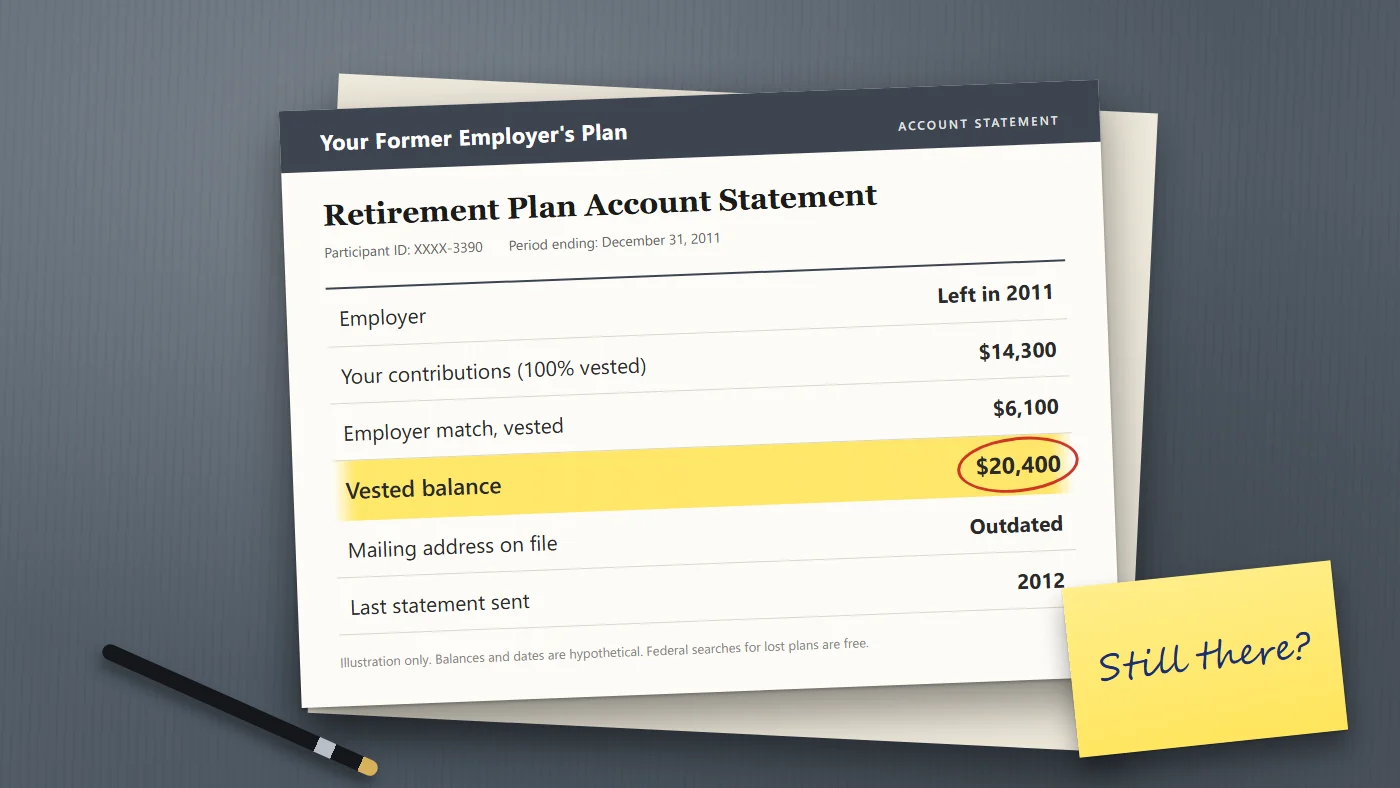
Think back through your work history. The job in the 1990s that lasted three years. The company that got bought. The one you left in a hurry. If any of them offered a 401(k) and you signed up, there may be an account with your name on it that you haven't looked at in a decade or more.
That money doesn't vanish. Your own contributions are always yours, and so are vested employer contributions. But a forgotten account can move without your say. Plans are allowed to push small balances out to an IRA you never picked, companies merge and switch recordkeepers, and uncashed checks end up with state unclaimed property offices. The account's still yours. You just have to find where it went.
The search is free and takes an evening. Since December 2024 the Department of Labor has run a database built for exactly this, and the federal pension insurer keeps another for plans that shut down. How much money slips through? In fiscal year 2025 alone, the Labor Department's enforcement staff helped 8,015 people collect $512.5 million in pension benefits their old plans owed them but hadn't paid.
This article covers where to look, in order, and then what to do once you find the account. That second decision is where people lose money to taxes.
Where does a forgotten account end up?
An old 401(k) balance can be in one of five places, and each has its own search.
Still in the old plan. The most common case. The employer's still around, the plan's still around, and your balance has been sitting in the default investment. The statements stopped when you moved and didn't update your address.
In a different plan under a different name. The company was bought, merged, or changed recordkeepers, so the plan may have a new administrator and a new sponsor name.
In an IRA you didn't open. Federal rules let a plan force out small balances after you leave. Under the tax code, a plan can pay out a vested balance of $7,000 or less without your consent (the cap was $5,000 before 2024), and the Labor Department's participant guide says amounts over $1,000 have to go into an IRA rather than to you in cash unless you choose otherwise. That IRA usually sits with a custodian the plan chose, parked in a conservative investment, and it may be charging a fee that's been nibbling at a small balance for years.
With the Pension Benefit Guaranty Corporation. PBGC holds unclaimed benefits for people who weren't paid when their retirement plan ended. Most are traditional pensions, but its search also covers 401(k)-style plans that closed and sent missing participants' money to PBGC.
With a state unclaimed property office. If the plan mailed a distribution check and nobody cashed it, the money can eventually be turned over to the state of your last known address.
| Where it might be | Free search | What you need |
|---|
| Private-sector pension or 401(k)-type plan, if you're 65 or older | DOL Retirement Savings Lost and Found, lostandfound.dol.gov | A Login.gov account verified with a state ID |
| Plan that ended and sent money to PBGC | PBGC unclaimed benefits search, pbgc.gov | Last name and last four digits of your Social Security number |
| Employer out of business, plan being wound down | EBSA Abandoned Plan Search | Plan or employer name and location |
| Any plan that still files annual reports | EBSA Form 5500 search | Employer name |
| Uncashed check turned over to the state | unclaimed.org, run by the state administrators' association | Your name and past states of residence |
$512.5 million. That's what 8,015 people collected in fiscal year 2025 with help from the Labor Department's enforcement program for terminated vested participants in pension plans, an average of about $64,000 each. The figure counts lump sums and the present value of lifetime payments the plans owed but hadn't paid.
The federal database that didn't exist two years ago
Congress ordered the Retirement Savings Lost and Found in the SECURE 2.0 Act and gave the Labor Department until December 29, 2024, to build it. It's live at lostandfound.dol.gov.
What's in it? Private-sector plans, both traditional pensions and 401(k)-type plans, that reported a former employee with a vested benefit. The core data comes from Form 8955-SSA, which plans have filed for years to report people who left with benefits they hadn't claimed. A newer intake portal lets plans add current data, and the Labor Department's data request to plans asks for former employees who are owed a benefit and are 65 or older. So if you're younger, your old plan may not show up yet.
You can search only for yourself. You'll need a Login.gov account verified with a state-issued driver's license or ID, plus a phone number tied to public records. Results show plans linked to your Social Security number, along with the administrator's contact information.
Two caveats from the department itself. A listing shows that you once participated, not that money is still there, because the benefit "may have already been paid out, rolled over into another retirement account, or provided as an annuity." And the contact details can be stale, since they come from older filings that don't reflect later mergers or administrator changes.
The database doesn't cover IRAs, government plans, some religious employers' plans, or Social Security. That's why the other searches still matter, and why the order you run them in makes a difference.
Run the searches in this order
- Write down every employer where you might have joined a plan, with rough dates. Old tax returns help: a W-2 with code D in Box 12 shows 401(k) contributions for that year. Old pay stubs and benefits enrollment emails help too.
- Fill gaps with your Social Security record. The free statement at ssa.gov lists your earnings by year, which can jog your memory about which jobs fell when. If you need employer names and addresses, Social Security sells an itemized statement through Form SSA-7050.
- Search the DOL Lost and Found. Set up the Login.gov account first; identity checks go faster with your driver's license and phone at hand.
- Search PBGC's unclaimed benefits database. It takes a last name and four digits of your Social Security number, updates quarterly, and was last refreshed August 5, 2026.
- Call the old employer's HR or benefits office if the company still exists. Ask who administers the plan now and which number handles a former employee's balance.
- If the company's gone, look it up in EBSA's Abandoned Plan Search, which lists plans being terminated and who's handling them. Then search Form 5500 filings by employer name; the filing shows the plan administrator and a contact address.
- Search unclaimed.org for every state you've lived in. It links to each state's official database, and searching is free. Skip any service that charges to search for you.
When you reach the plan, have your Social Security number, your dates of employment and any old address you used. Then ask: What's the current balance? Was a distribution ever made, and where did it go? What do you need from me to update my address and pay or transfer the account?
Check your vesting before you count the money
Your own contributions and their earnings were yours from day one. The employer match may not have been. The Labor Department's guide says 401(k)-type plans can require up to three years of service for full vesting under a cliff schedule, or up to six years under a graded one.
Left after 18 months? The account may be smaller than the statements you remember, because the unvested match went back to the plan. That's legal. Keeping vested money isn't, so if the balance looks wrong, ask for the vesting schedule and your service dates in writing.
You found it. Now what?
The IRS lays out four options when you leave a job, and they still apply years later.
Leave it where it is. Fine if the plan's funds and fees are good and the balance is big enough that the plan won't push it out. Update your address and beneficiary either way.
Roll it into your current employer's plan, if that plan accepts rollovers. One account is easier to track than three.
Roll it into an IRA. The most common choice. You pick the custodian and the investments, and you can pull several old plans into one place. Compare custodians on fees, fund choices and service before you move anything, because small fee differences compound over twenty years.
Cash it out. The expensive route. The distribution is taxed as income, and if you're under 59½ you'll generally owe a 10% additional tax, though there's an exception if you left that employer in or after the year you turned 55.
The 60-day trap and the 20% withholding
How you move the money matters as much as where it goes.
Ask for a direct rollover, where the old plan sends the money straight to the new plan or IRA. Nothing's withheld, and it isn't taxed.
If the plan sends the check to you instead, it usually withholds 20% for federal income tax. You then have 60 days to deposit the full pre-withholding amount into an IRA or plan, which means covering the withheld 20% out of pocket and waiting until tax time to get it back. Say the balance is $20,000. The check arrives for $16,000. To roll over the whole $20,000, you deposit that $16,000 plus $4,000 of your own money within 60 days. Miss the deadline and the $4,000, or the full $20,000, gets taxed as a withdrawal.
The IRS can waive the 60-day rule for some situations outside your control, but I wouldn't count on it. Ask for the direct transfer.
A separate rule applies to IRA-to-IRA moves: only one indirect rollover between IRAs is allowed in any 12-month period. Direct trustee-to-trustee transfers aren't limited.
What if it's a pension, not a 401(k)?
Some plans in the Lost and Found are traditional pensions, especially from jobs before the mid-2000s. The rules differ. You generally can't roll a monthly pension into an IRA the way you can a 401(k), and the plan may offer a choice between a lifetime monthly payment and a lump sum.
That choice has a long tail. Before you sign anything, get the plan's written explanation of both options and the deadline for choosing. If PBGC took over the plan when the employer's plan ended, PBGC pays the benefit under its own rules and has a claims process on its site.
When it's worth paying someone
Most of this you can handle with a phone and an evening. Two situations justify professional help.
The first is a big balance and a rollover decision with tax consequences: pre-tax and Roth money in the same plan, employer stock, a pension lump-sum offer, or a balance large enough that the choice of IRA custodian and investments will matter for decades. A fee-only financial advisor, paid by the hour or a flat fee, can walk through the options without earning a commission on where the money lands. Ask how they're paid before the first meeting.
The second is a plan that won't respond, or a balance you think is wrong. EBSA's benefits advisors take calls at 1-866-444-3272 and can contact a plan for you at no charge. They're part of the same agency behind the $512.5 million figure above.
Before any of that, pull out one old W-2 with code D in Box 12. The employer name printed at the top is your first search.
This article is general information, not financial, legal, tax or medical advice.