Congress didn't end the tax on Social Security benefits. The rules that decide how much of your check gets taxed are the same ones that were on the books in 2024. Up to 85% of your benefits can still count as taxable income. Even the income lines that trigger that tax are old: one set dates to 1983, the other to 1993, and neither has budged since.
So what did Congress actually do? It created a deduction. Under a law passed in July 2025, anyone 65 or older can knock an extra $6,000 off their taxable income. Married, and you both qualify? Then it's $12,000 between you. It's temporary, too: it only runs from tax year 2025 through 2028 and expires after that unless Congress renews it.
If your federal bill is small to begin with, that deduction may be enough to erase it. There are strings. It starts shrinking once your income passes $75,000, or $150,000 if you file jointly. It's gone entirely if you're married and file separately. And the return has to show a valid Social Security number for each person claiming it.
So your benefits are still taxable on paper. What you actually owe now depends on a deduction you might get in full, in part or not at all.
What passed, and what didn't
On paper, the law is Public Law 119-21. It was signed on July 4, 2025, and the IRS now files its tax provisions under a friendlier name, the Working Families Tax Cuts. The agency's summary of the senior part is plain enough: at 65 or older, you can claim an extra $6,000, and it sits on top of the age-65 standard deduction you already had.
None of it touches how benefits get taxed. That math still runs on a figure the IRS calls combined income. You get there by taking your adjusted gross income, adding any tax-exempt interest, and then adding half of your Social Security.
Where that total lands decides the rest. For a single filer, crossing $25,000 means up to half of your benefits can be taxed, and past $34,000 it's up to 85%. Joint filers have higher lines, at $32,000 and $44,000.
Nobody ever tied those lines to inflation, so more retirees drift over them every year. No wonder "no tax on Social Security" was such a popular promise. What you got instead is a bigger deduction at the bottom of the return.
What $6,000 is worth in real dollars
A deduction isn't a check. Big difference. It lowers the income your tax is figured on, so what it's worth depends on your bracket.
In the 12% bracket, taking $6,000 off your taxable income saves about $720. In the 22% bracket it's closer to $1,320. A couple who both qualify can double that.
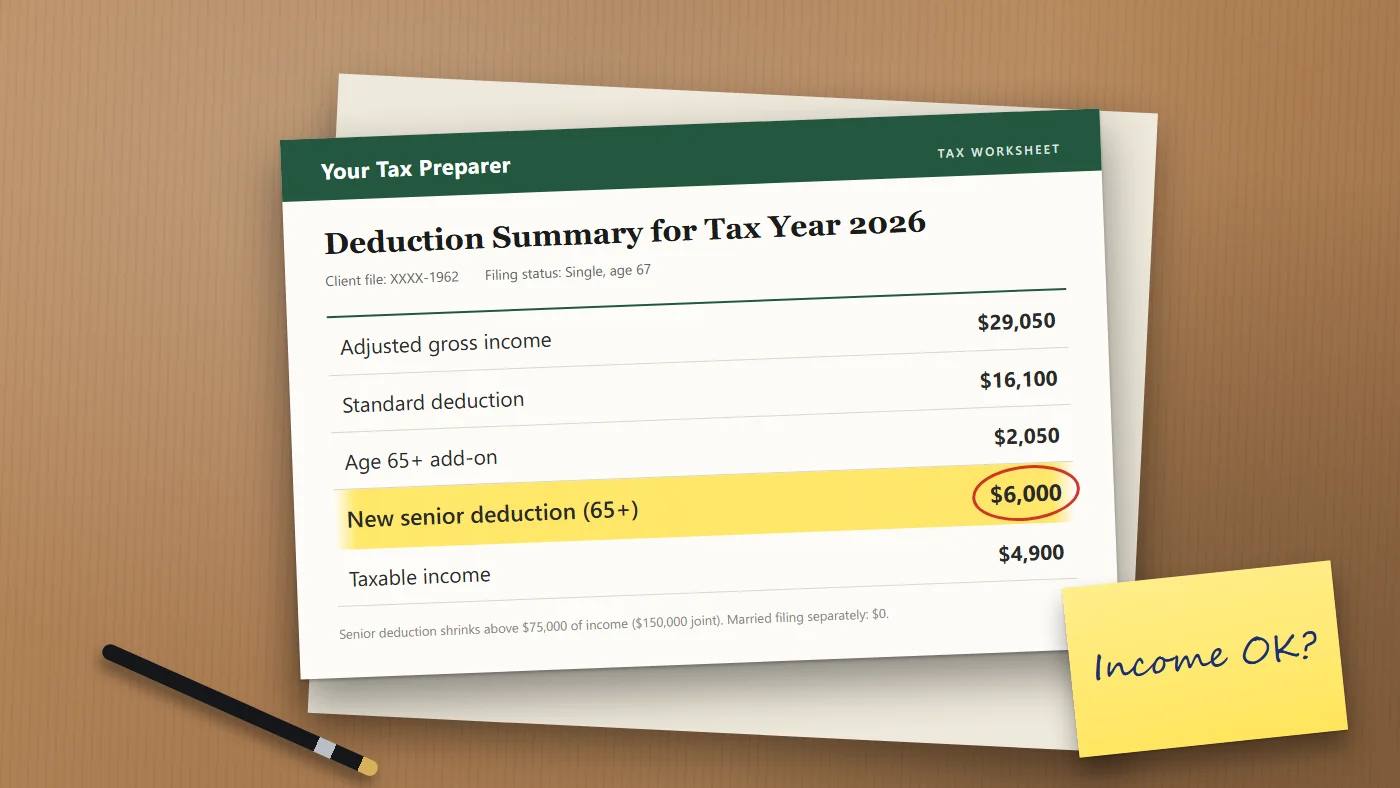
Say you're single and 67. Social Security pays you $30,000 a year, and a pension plus IRA withdrawals bring in another $22,000. Add half the benefits to that other income and your combined income comes to $37,000. Now run the IRS worksheet. It says $7,050 of your benefits is taxable, so your adjusted gross income ends up at $29,050.
For 2026 you'd subtract the $16,100 standard deduction first, then the $2,050 extra for being 65, then the new $6,000. That leaves $4,900 of taxable income. All of it falls in the 10% bracket, so the federal bill is about $490.
Without the senior deduction? You'd owe about $1,090. The new break is worth $600 to you, which isn't nothing. Still, you pay something, and part of your Social Security still counts as income.
Stack the pieces and you get the numbers most retirees will work with for 2026:
| Filing situation (tax year 2026) | Standard deduction | Age 65+ add-on | New senior deduction | Total |
|---|---|---|---|---|
| Single, 65 or older | $16,100 | $2,050 | $6,000 | $24,150 |
| Married filing jointly, one spouse 65+ | $32,200 | $1,650 | $6,000 | $39,850 |
| Married filing jointly, both 65+ | $32,200 | $3,300 | $12,000 | $47,500 |
| Married filing separately, 65+ | $16,100 | $1,650 | $0 | $17,750 |
Find your row. When your adjusted gross income, counting the taxable slice of your benefits, stays under that total, your taxable income is zero and there's no federal income tax to pay. Read that twice. It's AGI that has to fit, not just your pension and IRA money.
The income test: where $6,000 starts shrinking
Earn enough and the $6,000 gets chipped away. For a single filer, the chipping starts once modified adjusted gross income passes $75,000. On a joint return the line is $150,000. (For most retirees, modified AGI is simply the AGI line on Form 1040.) Above the line, you lose 6% of every extra dollar.
In round numbers, every $1,000 over costs you $60 of deduction. Picture a single filer with $100,000 of income. That's $25,000 past the line, so $1,500 disappears and $4,500 survives. Keep going to $175,000 and nothing's left.
For couples the cut hits each spouse's $6,000. A joint return showing $200,000 is $50,000 over the line. Each spouse loses $3,000, which leaves the pair with $6,000 out of a possible $12,000. By $250,000 it's all gone.
What counts as income here is broader than people expect. The taxable part of your Social Security counts, and so do IRA and 401(k) withdrawals, required minimum distributions, pension checks, Roth conversions and capital gains from selling stock or a house above its exclusion, which means one big December withdrawal can push you over the line for the whole year.
Timing now has a price. The rest of this piece is about getting it right on the return and in the calendar.