Insurance

Why Your Home Insurance Went Up With No Claims — and 7 Ways to Push It Back Down

Your renewal price is mostly about your neighborhood's losses, not your own record, but a real share of it can still be moved.

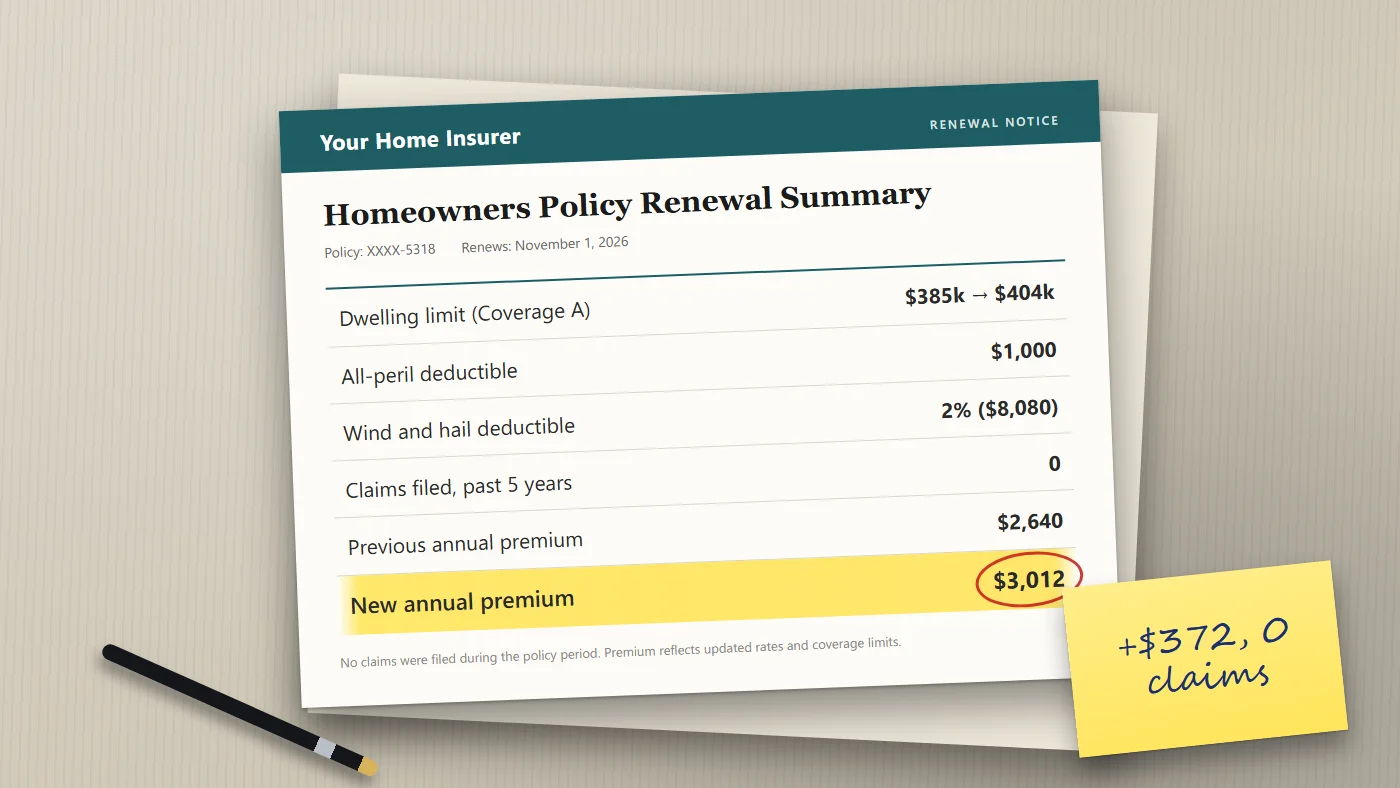
Illustrated home insurance renewal summary on a desk showing the annual premium rising from $2,640 to $3,012 with zero claims filed.
Illustration

The renewal notice usually lands about a month before your policy ends. You open it, and the premium is a few hundred dollars higher than last year. You didn't file a claim. Nothing changed at the house. It looks like a billing mistake.

It almost never is. Over 2025 the average U.S. home policy went up 12%, which left it at $2,948 a year (Insurify's figure, drawn from insurer rate filings). And this year hasn't let up. By Insurify's mid-year check, published in September, the national average had reached $3,012. That's another 2.2% in six months, with a forecast of $3,057 by the end of 2026.

Why didn't your spotless record protect you? Because you were never paying just for your own claims. Your premium is your share of what the insurer expects to pay out across everyone in your rating territory. On top of that goes whatever it now costs to rebuild a house after a fire or a storm, and then what the insurer itself pays for the backup coverage it buys to survive a bad year. A clean record keeps you out of the pricier tiers. It doesn't shield you from the pool.

Still, every renewal price has two layers. Where you live sets the first, and you can't argue with it. The second comes from your own policy, and most homeowners never look at it.

46% is how much the average home premium has climbed since 2021, per Insurify. General inflation over the same stretch was 16%, so insurance rose about three times as fast. On a typical policy that's roughly $900 more a year for the same house.

So who am I actually paying for?

Start with the weather, because insurers do. Last year the country got hit by 23 separate disasters that each did at least a billion dollars in damage. Only 2023 and 2024 had more, so 2025 ranks third on record (Insurify again). Then there were the severe thunderstorms: hail, tornadoes, straight-line wind. Those alone produced about $52 billion in insured losses.

And they landed in places that never thought of themselves as high risk. The steepest 2025 increases, 20% or more, hit Minnesota, Colorado, Iowa, Nebraska, Oklahoma and South Carolina.

Then there's the repair bill. Over two years, building material prices rose only about 7%. Then, Insurify found, they jumped roughly 15% in a single year. When a roof or a kitchen costs more to replace, every claim in your ZIP code costs more too, and that feeds straight into next year's rates.

Regulators see it too. In August 2026 the National Association of Insurance Commissioners put out its first national study of the homeowners market. It covers seven years, 2018 through 2024, and splits the results by region. Adjusted for inflation, premiums rose anywhere from 18.3% to 43.3%, depending on the region. Claims got more frequent and more expensive over that stretch, especially from 2021 on.

A different group, the Consumer Federation of America, came at it by ZIP code. Between 2021 and 2024, premiums went up in 95% of them.

The honest answer, then: your neighbors' roofs, last spring's hailstorm two counties over, and the price of lumber.

The part of the increase that's about you

Not all of it is the pool. Several things in your own file can move the price without a claim.

Your dwelling limit went up. Most policies carry an inflation guard that raises Coverage A, the amount to rebuild the house, every year. Higher limit, higher premium. Fair enough, but the figure is only an estimate, and it can be wrong in either direction.

Your roof had a birthday. Many insurers re-rate a home once the roof passes 10, 15 or 20 years. Some also change how they'd pay a roof claim, which can matter more than the price.

Your credit-based insurance score moved. It's built from your credit report, and in most states home insurers are allowed to use it. Not in California, Maryland or Massachusetts, where it's barred for home insurance. Lawmakers in several other states debated limits in 2026. Why the fuss? Homeowners with weak scores were paying noticeably more than strong scorers for the same coverage, in research CNBC reported on in April.

A discount fell off. New-home, new-roof and claims-free credits expire. A bundle discount vanishes the day you move your car insurance somewhere else.

Your claims file has something you didn't put there. Insurers check CLUE, a LexisNexis database that can hold up to seven years of claims tied to you and to the address. A prior owner's water claim can sit there. So can a phone call to your agent that got logged as a claim.

You stayed put. About a decade ago, regulators worried that loyalty could cost you. The practice they went after, "price optimization," sets your price partly on how likely you are to shop around, not on risk alone. The NAIC wrote a white paper on it in November 2015. More than a dozen state insurance departments then issued bulletins against it. Loyalty can cut the other way, too. Some insurers knock 5% off after three to five years, and 10% after six or more (those are the Insurance Information Institute's numbers). You won't know which side you're on until you see another company's price for the same coverage.

None of this means your insurer did anything wrong. The renewal figure is an opening position, and you're allowed to check every input that's about you. Order matters, too. A few of these checks take five minutes, and one can take a month.
Continued

Seven ways to push the premium back down

Work through these in order. The first three cost nothing but a phone call.

  1. Put this year's declarations page next to last year's. Compare four lines: Coverage A, each deductible, the endorsements and the discounts. Circle anything that changed. That tells you whether you're looking at a rate change, a coverage change or a lost discount.
  2. Call your agent or insurer and ask for a policy review. Ask two direct questions: "Which rating factors changed on my policy this year?" and "Which discounts am I not getting?" Then walk through the usual list, which the Insurance Information Institute keeps. A smoke detector, burglar alarm or deadbolts can earn at least 5%. At some companies, a sprinkler system plus a fire and burglar alarm that reports to a monitoring station is worth 15% to 20%. Retired and 55 or older? That can mean up to 10%. Mention a new roof, new wiring, new plumbing or a water shutoff valve. Insurers don't find out on their own.
  3. Check the rebuild number. Coverage A should match the cost to rebuild the structure, not the home's market value and not the land. Ask the insurer to rerun its replacement cost estimate with the correct square footage and finishes. Don't push it below the true rebuild cost. The NAIC tells homeowners to insure for at least 80% of replacement value, and falling short can shrink a claim check.
  4. Raise the deductible you can actually afford. Moving a $500 deductible up to $1,000 can take as much as 25% off the premium, by the Insurance Information Institute's estimate. First, though, look for a separate wind and hail deductible. It's often set at 1% to 5% of the dwelling limit. On a $400,000 house, even 2% already means $8,000 out of pocket after a storm.
  5. Price the bundle both ways. Some companies take 5% to 15% off when you buy two or more policies from them. Get the bundled quote, then price each policy separately elsewhere. Sometimes two companies beat one.
  6. Pull your CLUE report. You're entitled to one free copy every 12 months. Request it at consumer.risk.lexisnexis.com or by phone at 866-897-8126. If it lists a claim that isn't yours or never happened, dispute it in writing with LexisNexis, which has to investigate at no charge.
  7. Get at least three matching quotes. Start 30 to 45 days before renewal. Give every company the same dwelling limit, the same deductibles and the same roof settlement terms, or the prices won't mean much. The NAIC counted 715 companies writing homeowners coverage in 2024, so most states have real choice.
MoveWhat it can doThe trade-off
Ask for missed discounts5% to 20% on some itemsNone, one phone call
Raise deductible $500 to $1,000Up to 25% offYou pay more of a small loss
Bundle home and auto5% to 15% offHarder to move one policy later
Correct the dwelling limitVariesToo low can cut a claim payment
Fix a CLUE errorVariesA dispute can take about 30 days
Switch insurersVaries widelyNew inspection, new paperwork

The percentages come from the Insurance Information Institute and describe what some insurers offer. Yours can be smaller, or zero.

What not to cut

Some savings cost more than they return.

Related searches

Be wary of any offer that trims the price by changing how the roof gets paid. A roof settled at "actual cash value" is cheaper to insure because the insurer subtracts years of wear from the check, and on an older roof that can mean thousands of dollars less after a storm.

Don't shave Coverage A below the rebuild cost to hit a target premium. And think twice before filing a small claim you could cover yourself. It stays on your CLUE report for up to seven years. It can also cost you a claims-free discount worth more than the repair.

How do I compare quotes so the numbers are real?

You've got three ways to shop, and they reach different companies.

A captive agent sells one insurer's policies. An independent agent can quote several at once and usually knows which carriers are still writing new business in your county. Online comparison tools are quick, but check that the quote uses your actual dwelling limit and deductibles before you trust it.

Have these in hand before you start: the current declarations page, the year the roof was replaced, the age of the wiring, plumbing and heating system, and your CLUE report. Ask every company for the bundled home and auto price and a written list of the discounts it applied.

Then look past the premium. Your state insurance department publishes complaint data by company, and many states post rate comparison guides that show what several insurers charge for the same sample house, which is a quick way to see whether your quote is in the normal range. A policy that saves $200 and fights every claim isn't cheaper.

If you do switch, keep the old policy in force until the new one is bound. Call your mortgage servicer the same day so the escrow account pays the right company. I'd put that call ahead of everything else on switch day, because a lapse in coverage is the one mistake that's hard to undo.

If the bill still doesn't add up

When the insurer can't explain the increase, contact your state insurance department. Rate changes are filed with the state, and staff can tell you whether one was filed for your area. A complaint costs nothing. How much notice you're owed before a premium increase varies by state.

Pay through escrow? Then expect a letter from your servicer after its annual escrow analysis, and it may show a shortage. You often don't have to cover that in one lump. Say the shortage equals at least one month's escrow payment. Federal rules (Regulation X) then bar the servicer from demanding it within 30 days. It can only spread the amount over at least 12 months, or leave it alone. A smaller shortage can be billed within 30 days, so if the lump sum hurts, ask in writing for the 12-month option.

And if no standard insurer will quote you at all, that's a different problem with its own steps, including your state's FAIR plan as a last resort.

Once a year, 45 days out

Rates are likely to keep climbing in much of the country. No single call reverses that. What you control is whether you're paying for the right coverage at a competitive price, with every discount you qualify for.

Put a reminder on the calendar 45 days before next year's renewal date. Then sit down with two declarations pages, a free claims report and the phone number of one independent agent.

This article is general information, not financial, legal, tax or medical advice.

Illustration of a homeowners insurance nonrenewal notice with the line showing the policy will not be renewed highlighted Read nextYour Home Insurance Wasn’t Renewed: A 30-Day Action Plan Illustrated roof claim settlement statement on a desk showing a $21,000 roof estimate reduced by depreciation and a deductible to a $6,600 payment. Read nextRoof Claims in 2026: Why Insurers Now Pay Only Part of an Older Roof

About the author

Ray Castellano

Ray Castellano covers the bills that come with owning a house and a car: insurance renewals, escrow, loans, debt and taxes. He reads the fine print so you can check your own paperwork line by line.

Sources

Updated Sep 22, 2026 · Reviewed against NAIC, Insurance Information Institute, CFPB, Regulation X, Insurify rate data

Related searches