If you've owned your home for a while, a big share of your net worth is probably tied up in it. Cotality, a property data firm, put the average equity of a U.S. homeowner with a mortgage at $310,500 in the first quarter of 2026. Across all mortgaged homes, that's $17.9 trillion.
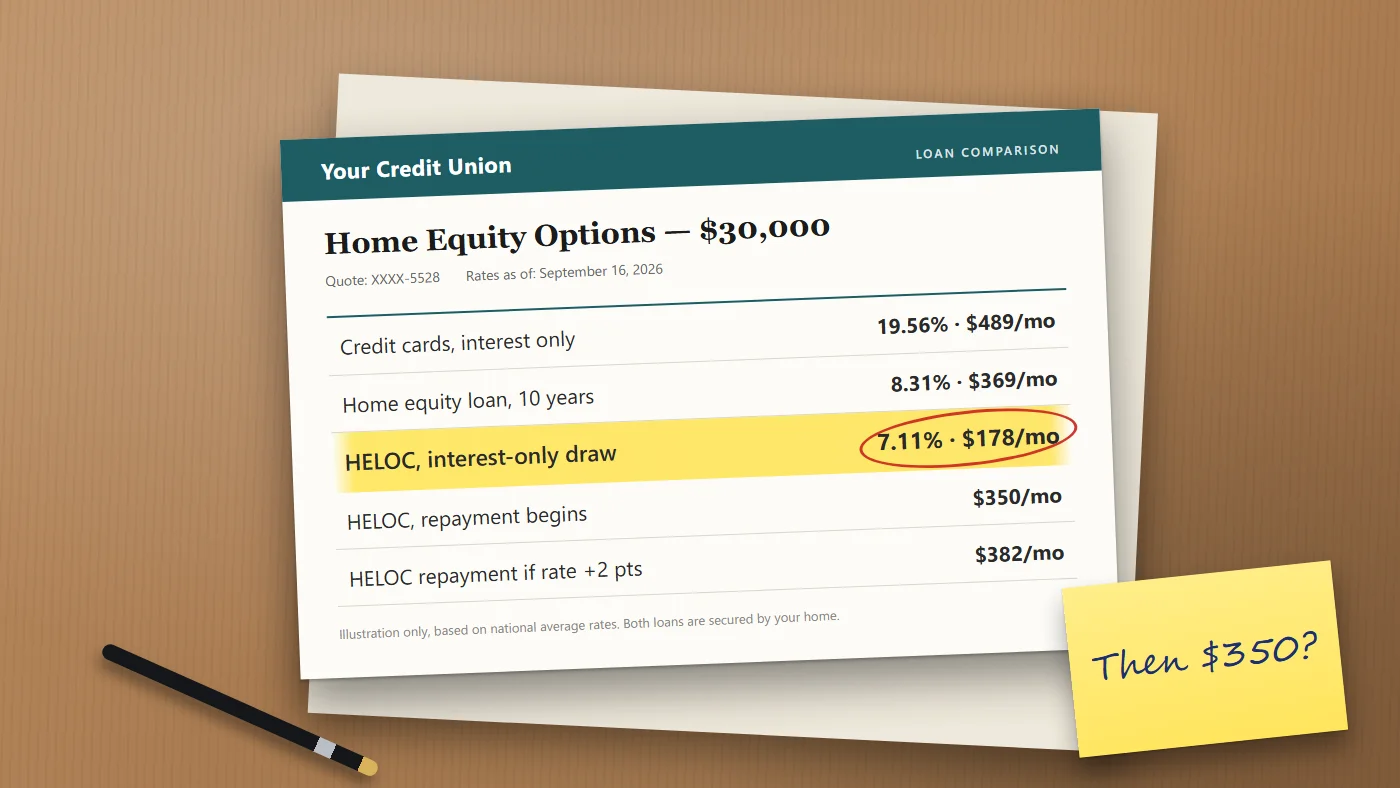
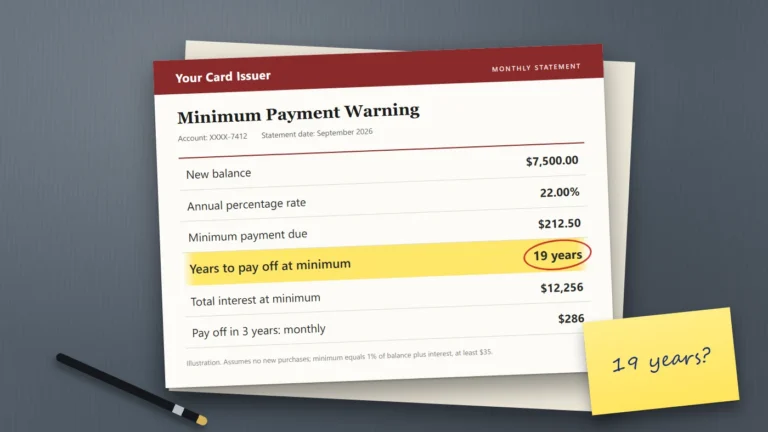
Meanwhile the average credit card charges 19.56 percent, according to Bankrate's survey for September 16, 2026. Carry $30,000 on cards at that rate and you're paying about $489 a month in interest before a dime touches the balance.
That gap is why home equity borrowing keeps coming up at kitchen tables. There are two main ways to do it without disturbing your first mortgage: a home equity loan and a home equity line of credit, or HELOC. The names are close. The products aren't. One gives you a fixed payment from the first month, and the other starts cheap and can change on you twice.
7.11 percent versus 19.56 percent. Those were Bankrate's national averages for a HELOC and a credit card on September 16, 2026. The gap of more than 12 points is real. So is the trade: card debt is unsecured, and a HELOC is secured by your house.
Hold on to that last sentence. A card issuer that isn't paid can wreck your credit and sue you. A home equity lender that isn't paid can foreclose, and the Federal Trade Commission says so plainly in its guidance on these loans: your home is the collateral, and you can lose it if you don't pay.
So which one is cheaper matters less than you'd think. What matters more is which one you could still repay in a bad year, with a payment you can see coming.
How each one works
A home equity loan is a second mortgage. You borrow one lump sum at a fixed rate and make equal payments for a set term, commonly 5 to 20 years. Think car loan. You know the date of the last payment on the day you sign.
A HELOC is a revolving line, closer to a credit card with your house standing behind it. The lender approves a limit. During the draw period, often 10 years, you borrow what you need, pay it down and borrow again, and many lines let you pay interest only while the draw lasts. Then the line closes and repayment begins, often over 10 to 20 years, and now you're paying principal and interest on whatever's left.
Nearly every HELOC has a variable rate tied to the prime rate, and prime follows the Federal Reserve. On September 16, 2026, the Fed raised its target range by a quarter point, to 3.75 to 4 percent. Its first increase since 2023. Oddly, Bankrate's HELOC average actually dipped that same week, which tells you averages and your own line don't move in lockstep. Still, a HELOC opened today won't necessarily stay at today's rate.
| Home equity loan | HELOC | Cash-out refinance |
|---|
| How you get the money | One lump sum | Draw as needed up to a limit | Lump sum from a new, larger first mortgage |
| Rate | Fixed | Variable, tied to prime | Fixed or adjustable |
| Average rate, mid-September 2026 | About 8.2 to 8.3 percent | About 7.1 percent | Near 7 percent for a 30-year loan |
| Payment | Same every month | Interest-only at first on many lines, then higher | Same every month |
| Your existing mortgage | Untouched | Untouched | Replaced at today's rate |
| Best fit | One known cost | Costs spread over time | Rarely, if your current rate is low |
The averages come from Bankrate (home equity, September 16, 2026) and Freddie Mac (6.95 percent on a 30-year mortgage, September 17, 2026). Your own offer depends on your credit score, your income and how much equity you leave in the house.
How much can you borrow?
Lenders look at combined loan-to-value: your first mortgage plus the new loan, divided by what the home is worth. Many cap it somewhere around 80 to 85 percent, and each lender sets its own limit.
Take a $400,000 house with $180,000 left on the mortgage. At an 80 percent cap, total debt can reach $320,000, so the most you could borrow is $140,000. At 85 percent it's $160,000.
Lenders also check your credit, compare your total debt payments with your income, and either order an appraisal or pull an automated valuation of the house, and if that value comes in lower than you hoped, your borrowing limit shrinks right along with it.
You don't have to take the max. The 15 or 20 percent left over isn't spare money, either; it's what protects you if prices slide and you need to sell.
The payment on a real loan looks different from the averages, and on a HELOC it changes twice. That math is next, with the fees lenders don't lead with.
Credit cards at 19.56 percent. Interest alone runs about $489 a month. Pay $600 a month and the balance still takes almost nine years to clear.
Home equity loan, 10 years at 8.31 percent. About $369 a month, every month. You'd pay about $44,270 over the term, and about $14,270 of that is interest.
HELOC at 7.11 percent, interest-only during the draw. The payment starts around $178 a month. Tempting. That low number is exactly what makes HELOCs attractive, and exactly what gets people into trouble, because $178 pays down nothing. If the rate climbs two points, the interest-only payment becomes about $228. When the draw ends and a 10-year repayment begins, the same $30,000 costs about $350 a month at 7.11 percent, or about $382 at 9.11 percent.
Two things fall out of those numbers.
First, a HELOC is only cheaper if you pay principal from the start. Send it $369 a month at 7.11 percent and you'll finish ahead of the fixed loan. Send $178 and you'll still owe the full $30,000 ten years from now. All of it.
Second, the fixed loan costs about a point more right now, and what you're buying with that point is certainty. With the Fed raising rates again, I'd give that certainty more weight than I would have a year ago.
What it costs to set up
Neither one is free to open. The FTC's list of fees to ask about includes application or origination fees, an appraisal, a title search, attorney or closing fees, and on HELOCs, annual fees and sometimes a charge for closing the line early, often within the first two or three years.
Home equity loans often carry closing costs of roughly 2 to 5 percent of the amount borrowed. Plenty of HELOCs advertise low or no closing costs, so read the terms for an early-closure fee or a minimum first draw. That's how some lenders make it back.
Ask every lender for the APR and an itemized fee list in writing, collect all the offers on the same day so you're comparing like with like, and don't let anyone hurry you past the fee page. Rates move.
The risks, biggest first
- Foreclosure. It's the lender's last resort, and it's still the core difference from unsecured debt. If your income is shaky, or the debt you're consolidating came from spending more than you earn, moving it onto the house doesn't fix the cause.
- Running the cards back up. This is the most common way consolidation fails. The cards hit zero, the habits don't change, and two years later you've got the equity loan and new balances. Decide ahead of time what happens to the cards.
- Payment shock on a HELOC. It hits once when rates rise and again when the draw period ends. Ask the lender for the payment at the rate cap and for the first month of repayment.
- A frozen line. The FTC notes that a lender can freeze or cut a HELOC if your home's value drops a lot or your finances change. It isn't a guaranteed emergency fund.
- Owing more than the house is worth. If prices fall and you have to move, both loans still get paid off at the sale.
You do get one protection at signing. Under federal Truth in Lending rules, when your primary home secures the loan, you have three business days after closing to cancel a home equity loan or HELOC for any reason, in writing. The lender then has to return the fees you paid.
Can you deduct the interest?
Only in narrow cases. Interest on a home equity loan or HELOC is deductible only if you itemize, and only if the money went to buy, build or substantially improve the same home that secures the loan, which rules out most of the reasons people borrow. That's the rule in IRS Publication 936, and it sits inside an overall cap of $750,000 of mortgage debt, or $375,000 if you're married filing separately, for loans taken out after December 15, 2017.
Put the money into a new roof and the interest may count. Use it to pay off cards, a car or tuition, and it won't. Most households take the standard deduction anyway. Don't let a tax break steer this.
Which one fits which job
Paying for one big thing whose price you already know, like a roof, an HVAC system or a single debt you want gone? That's home equity loan territory. You borrow once, and the payment never moves.
A remodel paid in stages is a different animal. The contractor bills as the work gets done, and with a HELOC you pay interest only on what you've actually drawn, not on the whole limit sitting there unused. Some lenders will also lock part of the balance at a fixed rate. Ask whether yours does, and what it charges for the privilege.
People sometimes lump a cash-out refinance in with these two, but it works very differently: it replaces your whole first mortgage. Say that mortgage is at 3 or 4 percent. Trading it for a new loan near 7 percent just to pull out $30,000 raises the cost of every dollar you already owe, not only the new ones. It can make sense when your current rate is at or above today's market. Few borrowers are in that spot.
And sometimes the answer is neither, because the amount is small or the plan behind it is shaky. For card debt under about $10,000, look first at an unsecured debt consolidation loan, or at a debt management plan run by a nonprofit credit counseling agency. You'll pay a higher rate than a HELOC charges. Your house stays out of it, though.
How to shop without getting burned
Start with your credit reports and scores, before any lender pulls them. An error there costs you rate, and since the best pricing usually goes to scores in the mid-700s and up, a mistake that drops you under that line is an expensive one to leave sitting.
Then get a rough fix on your equity. A recent home value estimate minus your mortgage balance gets you close enough, and running it with an 80 percent cap keeps you on the conservative side.
Quotes are where most people cut corners. Get at least three, all on the same day: one from your own bank or credit union, one from another local lender, one from an online lender. Don't skip the credit union because it's small; credit unions often price these loans well.
For each offer you'll want five numbers in writing. The APR and the total fees come first, then the payment once repayment starts and any early-closure fee, plus the rate cap if it's a HELOC.
On a line of credit, the rate is prime plus a margin. Prime is the same everywhere. So the margin is what you're really shopping, and a teaser rate that resets after 6 or 12 months is the thing to watch for, since the number in the ad may not be the one you live with.
Before you sign, rerun the payment at a rate two points higher than the one you're quoted. Doesn't fit the budget? Borrow less, or go with the fixed loan.
And use the three days. Take the closing papers home and read them there, not across a desk with a pen in your hand. If a number changed from the quote, you can cancel in writing.
A lender who contacts you first, pushes you to borrow more than you asked for, or wants your signature on paperwork with blanks in it is showing the classic signs of a predatory loan.
Before you compare a single rate, though, take a sheet of paper and write down the monthly payment you could still make after a job loss or a two-point rate jump. Shop against that number.
This article is general information, not financial, legal, tax or medical advice.