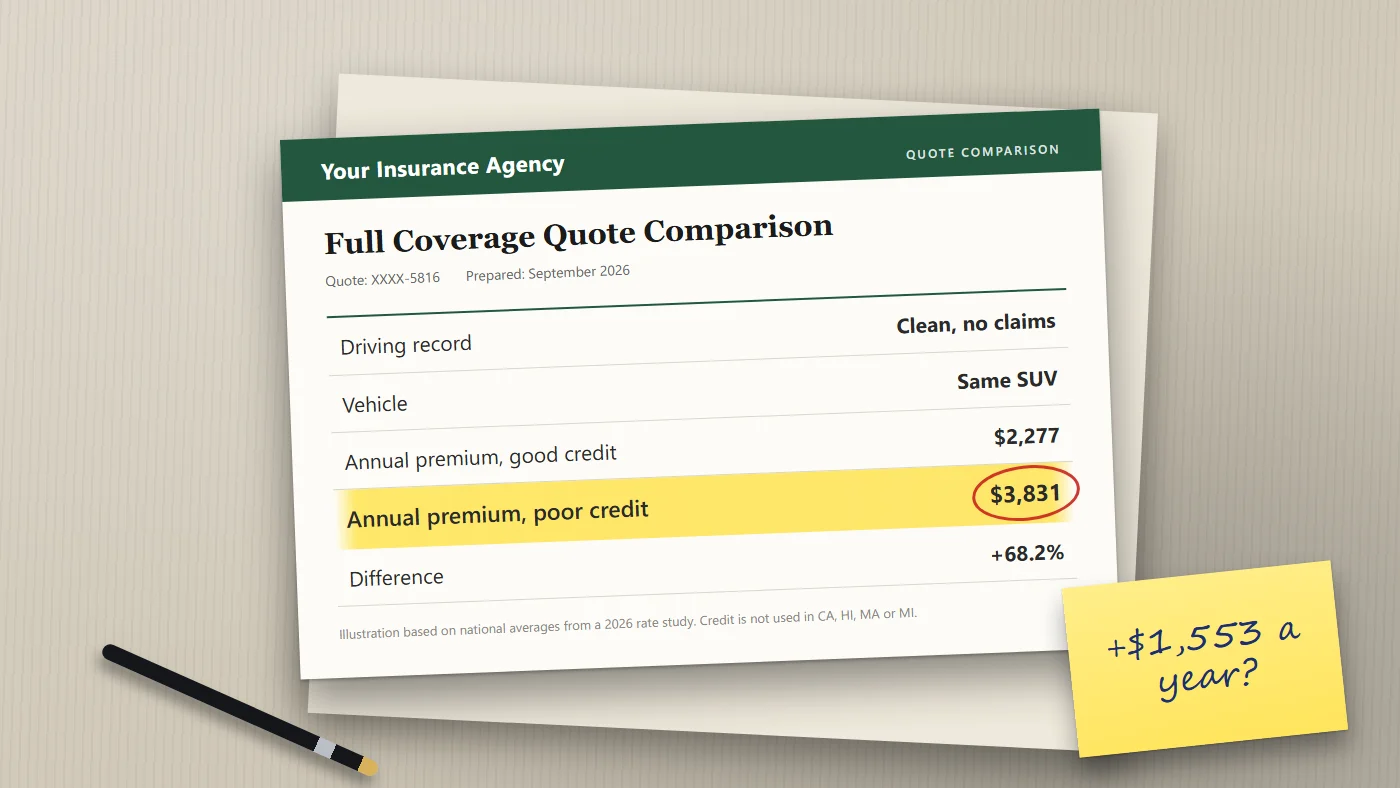
Picture two neighbors. Same age, same street, same eight-year-old SUV, and neither has had a ticket or a claim. One pays about $2,280 a year for full coverage. The other pays about $3,830.
What separates them isn't on the road. It's in their credit files. A LendingTree study using rate data pulled in June 2026 found that drivers with poor credit pay an average of 68.2% more for full-coverage car insurance than drivers with good credit, or $1,553 a year. Its sample driver is a 30-year-old man with a clean record and a 2018 Honda CR-V, so your own dollar figures will differ. The gap itself is the point.
MoneyGeek ran its own numbers in September 2026, comparing excellent credit with poor credit across the 46 states that allow the practice plus D.C., and put the average gap at $2,102 a year. It also found that in most of those states the credit penalty is bigger than the surcharge after a DUI conviction, which it puts at roughly $1,200 to $2,600 a year.
That's the part drivers find hardest to swallow. Someone with a perfect driving record and a rough credit history can pay more than someone with good credit and a drunk-driving conviction. It's legal in most of the country, too. FICO estimates, in a figure the NAIC repeats, that about 95% of auto insurers use credit-based insurance scores where the law allows them.
68% more: the average premium gap in LendingTree's study. Same driver profile, same car, same clean record. Good credit averaged $2,277 a year for full coverage, poor credit $3,831. Source: LendingTree analysis of Quadrant Information Services data, June 2026.
What are insurers actually scoring?
Not the FICO or VantageScore number in your banking app. Insurers use a credit-based insurance score, built from the same credit reports but designed to predict something else: how likely you are to file claims, rather than how likely you are to repay a loan. Same raw data, different question.
The inputs will sound familiar. Payment history, how much of your available credit you're using, how long your accounts have been open, how often you've applied for new credit and the mix of account types all feed in. Income, job and bank balances aren't in a credit report, so they aren't in the score.
Insurers defend the practice with data. In a 2007 report to Congress, the Federal Trade Commission concluded that these scores are effective predictors of risk under auto policies, meaning that, as a group, people with lower scores filed more claims or costlier ones than people with higher scores. The same report found the scores are distributed differently across racial and ethnic groups, which is a big part of why consumer advocates and some regulators want them gone.
You don't have to settle that argument to deal with your own bill. What matters is that many companies recalculate the score at renewal, that it can move your price with no change in how you drive, and that the insurer doesn't have to tell you the score itself.
Say a retired couple puts a $9,000 roof repair on a credit card and pays it down over a year. They've never missed a payment, and their driving hasn't changed. Then the statement posts. The card sits close to its limit, their credit usage jumps, and the insurance score built from that file drops. At the next renewal their premium can go up, and the letter won't mention the roof.
Where it's banned or limited
It's state law, and it varies.
| State rule | Where | What it means for you |
|---|
| Credit may not be used to set auto rates | California, Hawaii, Massachusetts, Michigan | Your credit file shouldn't affect your car insurance price |
| Credit use is limited in specific ways | A number of states, including Maryland and Oregon | Some bar using credit to raise your premium at renewal, or to cancel or refuse to renew |
| Credit allowed with consumer protections | Most other states | Usually can't be the sole reason to deny, cancel or raise rates; notice required |
In the LendingTree data, those four top-row states showed a 0% difference between good and poor credit. At the other end, poor credit more than doubled the premium in six places, led by Washington, D.C., Virginia and New York.
The list isn't frozen. MoneyGeek counted six states with 2026 bills to ban or restrict the practice, including Illinois and New York. If you live in one of them, check your state insurance department's site for the current rule.
Age makes it worse. LendingTree found that 80-year-old drivers saw the largest percentage jump for poor credit, 87%, with the average premium in its sample going from $2,625 to $4,910. For a retiree on a fixed income who's carrying a card balance after a hospital bill, a new roof or a spouse's funeral, and who hasn't had a ticket in decades, that's a rough thing to find on a renewal notice.
So what can you do about it? In most states you can't switch the scoring off. You can find out whether it hit you, fix what's wrong in the file and look for insurers that weigh it less. Those are three separate jobs, and the first one starts with a piece of mail most people toss.
The notice you're entitled to
Under the federal Fair Credit Reporting Act, if an insurer charges you more because of something in a consumer report, that's an adverse action. The FTC's guidance for insurers says it counts even when the report was only part of the reason, and a higher premium is one of its examples.
The insurer then has to send you a notice that includes:
- the name, address and phone number of the credit bureau that supplied the report;
- a statement that the bureau didn't make the decision and can't explain it;
- your right to a free copy of that report if you ask within 60 days, and your right to dispute anything inaccurate.
These notices often arrive as a separate, dull-looking page tucked into a new policy or renewal packet. If you got one, credit affected your price. Simple as that. Not sure? Call and ask: "Was a credit-based insurance score used to rate my policy, and did it put me in anything less than your best tier?" They should be able to answer.
Steps that can change the number
- Pull all three credit reports. They're free every week at AnnualCreditReport.com or by phone at 1-877-322-8228, the only source authorized by federal law. You don't need to pay for a report or a score for this step.
- Look for errors insurers would care about. Late payments that were really on time, accounts that aren't yours, a paid collection still showing a balance, a wrong credit limit that makes your usage look high.
- Dispute errors in writing with the bureau and with the company that reported them. Include copies of your proof. The bureau has to investigate.
- Pay down revolving balances where you can. Credit usage is recalculated every month, which makes it the fastest-moving part of any credit score.
- Set every bill to autopay for at least the minimum. Payment history carries the most weight, and a single 30-day late mark can stay on your report for up to seven years.
- Hold off on opening several new accounts in the months before renewal.
- Ask your insurer to re-run your score. Many companies re-score only at renewal, and some only when you ask. If your credit has improved since you bought the policy, request a re-rate, but first ask whether a worse result could raise your premium. In some states it can't.
- Ask about a life-event exception. Many states require insurers to reconsider credit-based rating after events like a serious illness, a death in the immediate family, divorce, job loss or identity theft. You usually have to ask in writing.
Getting insurance quotes won't hurt your credit, by the way. Insurers make what the bureaus call a soft inquiry, which lenders don't see and scoring models ignore.
Should you pay for credit monitoring or repair?
Plenty of people land here after reading a notice like the one above, so it's worth being plain about what each kind of service does.
You can check your credit score free in lots of places, including most card issuers and bank apps. A free score is fine for tracking direction. It won't match the insurance score, but the two tend to move together.
Credit monitoring services alert you when something new lands on your file. They're useful if you've had identity theft or received a data breach notice. Some are free; paid versions mostly add identity theft insurance and more frequent updates, so compare what's included before signing up for a monthly fee.
Credit repair companies dispute items for you. They can't legally remove accurate negative information, and federal law bars them from charging you before they've done the work. Anything they do, you can do yourself for free. If you'd still rather hire it out, read the FTC's rules first and compare a few services on price and cancellation terms.
If the real problem is debt rather than errors, I'd call a nonprofit credit counseling agency before any repair company.
Shopping for insurance when credit is the problem
Insurers don't weigh credit equally, and for anyone who can't fix their file quickly, that's the most useful fact in this article. Rate studies that break results out by company show wide differences in how hard each one penalizes poor credit.
That changes the math. Comparison shopping matters more for you than for the neighbor with excellent credit. A few practical points:
- Get quotes from four or five companies, including regional insurers and at least one independent agent. Tell the agent up front that credit is your weak spot. They often know which of their carriers go easier on it.
- Keep coverage identical across quotes. Same liability limits, same deductibles, same drivers.
- Ask about usage-based or pay-per-mile programs. These lean on how much and how you drive. For a careful, low-mileage driver, they can offset part of a credit penalty. Read the privacy terms first, since these programs collect driving data.
- Ask about every non-credit discount. Defensive driving courses, multi-policy, paid-in-full, low mileage and vehicle safety features still apply.
- Don't let coverage lapse while you shop. A gap in coverage is its own rating factor and can cost more than the credit penalty.
- Re-shop after your credit improves. A 40-point gain does little good if nobody re-scores you. Put a reminder on the calendar a month before each renewal.
If you live in a state that limits credit use and think your insurer broke the rule, file a complaint with your state insurance department, which you can find through the NAIC's directory of every state department and the link to its complaint form.
Mistakes that keep the price high
Assuming a clean driving record is enough. In most states it's one factor among many, and it isn't always the heaviest.
Tossing the adverse action notice. It names the bureau whose file was used and opens a 60-day window for a free report from that bureau.
Paying for a score before you've checked the reports. Errors live in the reports, and the reports are free.
Closing old credit cards to "clean up." That shortens your credit history and raises your usage ratio, which can push both kinds of score the wrong way.
Staying with one insurer out of habit after your credit has changed. It cuts both ways: if your score went up, the company that priced you on the old file may not re-score you unless you ask.
Your next step fits on a sticky note. Pull the three reports this week, then call your insurer and ask whether a credit-based score set your tier.
This article is general information, not financial, legal, tax or medical advice.