Insurance
Is Your Car Reporting Your Driving to Insurers? How to Check and Opt Out
What regulators found, what changed in 2026, and the three places to look for your own driving file.
 Ray Castellano
Updated Sep 22, 2026 · 10 min read
Most cars built in the last several years carry their own cellular connection. It runs the app that locks your doors, the crash-response button and the maintenance alerts. It also sends data back to the manufacturer, and for years some of that data didn't stay there.
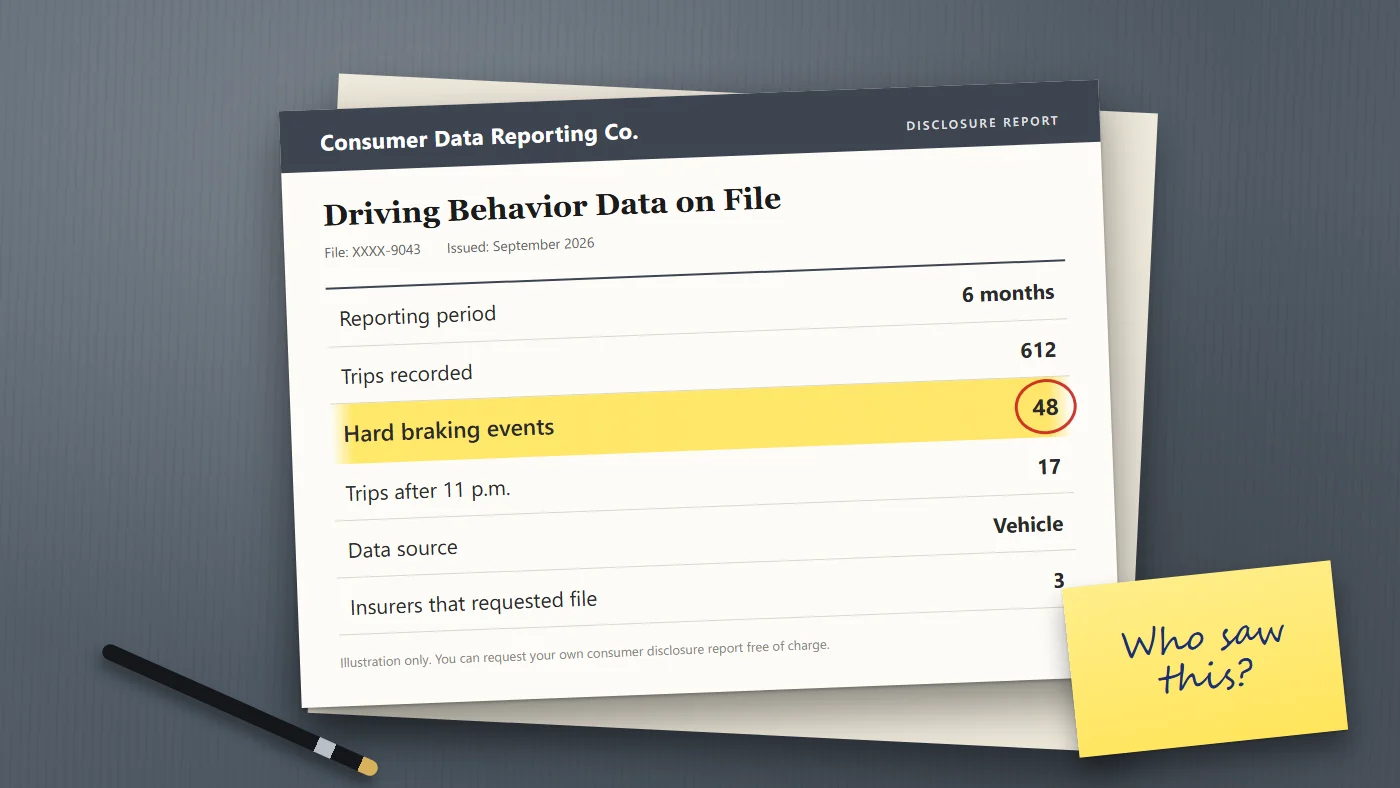
In January 2025 the Federal Trade Commission took action against General Motors and its OnStar unit. The agency said GM collected precise location and driving behavior from millions of vehicles, as often as every three seconds for some drivers, and sold it without clear consent. The events it logged included hard braking, late-night driving and speeding.
The buyers were consumer reporting agencies, the same kind of company that keeps your claims history. They packaged the data into driver reports, and according to the FTC, insurers relied on those reports to set rates and, in some cases, to deny coverage.
Plenty of drivers had no idea. The FTC called the enrollment process behind the feature doing the collecting, a program named Smart Driver, misleading. Some people didn't know they'd been signed up at all, and found out only when a premium went up or an application was turned down and an agent mentioned a report they'd never heard of.
Every 3 seconds: how often, the FTC says, location and driving data was collected from some vehicles. Texas, in a separate lawsuit, alleges the data of more than 1.5 million of its drivers was sold.
What's happened since
The FTC finalized its order on January 14, 2026. For five years, GM and OnStar can't disclose drivers' location or driving behavior data to consumer reporting agencies. For 20 years, they have to get your affirmative consent before collecting or sharing connected-vehicle data, let you get a copy of your data and ask for it to be deleted, and give you a way to turn off precise location tracking where the vehicle allows it.
States have moved too, each in its own way.
| Who acted | Against | What it says happened | Status as of September 2026 |
|---|
| Federal Trade Commission | GM and OnStar | Location and driving data collected and sold without clear consent | Final order, January 2026 |
| Texas Attorney General | GM | Driving data of more than 1.5 million Texans sold to companies serving insurers | Lawsuit filed August 2024, pending |
| Texas Attorney General | An insurer and its data subsidiary | Driving data gathered through software built into phone apps, covering more than 45 million Americans | Lawsuit filed January 2025, pending |
| Arkansas and Nebraska Attorneys General | GM and OnStar | Similar claims under state consumer laws | Lawsuits filed in 2025 |
| California Attorney General and privacy agency | GM | Location and driving data of hundreds of thousands of Californians sold to two data brokers from 2020 to 2024 | $12.75 million settlement announced May 2026, subject to court approval |
California's case adds two useful facts. The state says GM earned roughly $20 million nationwide from these sales. It also found that California drivers didn't see higher premiums from the data, because California law doesn't let insurers use driving data like this to set rates. Drivers in other states had no such protection.
Much of this surfaced in March 2024, when The New York Times reported that GM owners who'd asked LexisNexis for their files were finding page after page of their own trips, with start and end times, distances and counts of hard braking and speeding. Within weeks, GM said it had stopped sharing this data with the two brokers, LexisNexis and Verisk, and it later ended Smart Driver. Lawsuits are allegations until a court rules, and the companies dispute parts of them.
Why this still matters if you don't drive a GM
The collecting hasn't stopped. Nearly every automaker gathers driving and location data from connected cars, and what the enforcement actions changed is who the data can go to and what consent is needed first. Texas opened inquiries into several other automakers in 2024. California's privacy agency has fined Honda ($632,500, in March 2025) and Ford ($375,703, in March 2026) for making it too hard to opt out.
Your phone can do the job, too. Texas's case against an insurer's data company is about software tucked inside ordinary apps, such as ones for gas prices or family location, that allegedly logged how the phone moved while its owner drove. No connected car needed.
And a lot of driving data now reaches insurers with the driver's blessing. Usage-based insurance programs, the plug-in devices and phone apps that promise a discount for safe driving, are the legal, opt-in version of the same idea. About one in six insurance shoppers ended up buying one, according to J.D. Power's 2025 study. They can save money. Some can also raise your rate, which isn't always spelled out at sign-up.
So can your car record how you drive? Almost certainly. The better questions are whether a file with your name on it already exists, who's seen it and how to shut off the flow. Each one has a specific place to look.